
 coindesk.com
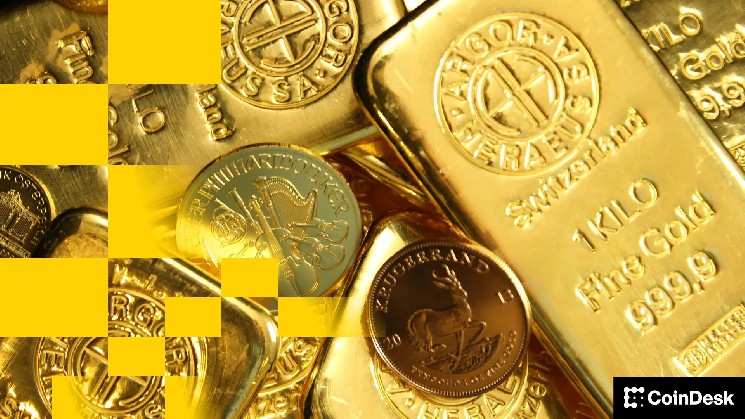
In traditional finance, it is a truth universally acknowledged that, when the economy wobbles, investors turn to safe-haven assets like gold. Such assets have a low, or sometimes even negative, correlation to stock markets and other risk assets, and so can protect portfolios when trouble hits. Yet in decentralized finance (DeFi), for many long years, traders had no such options. When a sell-off began, the best most could do was sit out the pandemonium in stablecoins.
Crypto’s “Black Friday” on October 10, 2025 saw at least $19 billion worth of long positions wiped out in 24 hours, and things have gotten dicier since. As is usual in times of trouble, stablecoins have soaked up liquidity, with the asset class’s total market cap growing 2% to over $303 billion between the end of September and November 18. This, though, is lower than we might expect. And this is because, during this sell-off, DeFi traders had more options.
Between October 9 and October 13, the wider crypto and DeFi markets shed around 11%. However, total assets in on-chain commodities — a sector barely more than six months old — increased by around 5%. Longer-term figures are even more impressive, with on-chain commodities surging by a whopping 27% in October alone. And, notably, this surge was led by unprecedented demand for tokenized gold.
Enter gold, exit pirates
Over this same period, data from RWA.xyz shows that the onchain gold sector grew from $2.4 billion to over $2.6 billion (as represented by the market capitalizations of Tether Gold, Paxos Gold, Matrixdock Gold and WisdomTree Gold Token). Year-to-date, the collective value of tokenized gold has risen from $1 billion on Jan. 1, 2025 (when gold was the only asset in the RWA “commodities” sector) to over $3 billion today.
This demand has been reflected in the broader market, with gold enjoying perhaps the best year in its history as a troy ounce of the precious yellow metal skyrocketed from $2,624.49 on January 1 to $4,065.81 on November 18. Global political instability combined with a decline of the world’s global reserve currency, the U.S. dollar, is prompting enormous amounts of gold buying, especially among central banks in Asia.
And the gold bug is spreading. Despite their notoriously higher risk tolerance for investments predicated on nothing more than a cute dog, DeFi investors are piling into gold. As the crypto market tanks, onchain gold is defying the trend as Web3 investors in it for the long haul are dampening volatility in the same way that TradFi investors have done for centuries. And this is incredibly healthy.
Indeed, this huge spike in onchain gold is more significant than any analyst has yet given credit to. Because what it signals is that DeFi investors are planning to stay in DeFi, even when the tide turns. They're buying an asset that's going to help balance the enormous volatility of this sector and allow them to stay in it when Shiba’s in the doghouse. This is huge for a sector whose Achilles heel has always been liquidity.
Gold’s biggest rush is onchain
More than this, though, the tokenization of gold and other Real World Assets (RWAs) is quite literally the fuel behind the current growth of the decentralized finance ecosystem. The DeFi RWA sector has grown 132% year-to-date from $7.09 billion on January 1 to $16.42 billion on November 18. This compares to growth of just 4.5% in the DeFi sector as a whole ($115.89 billion on January 1 to $121.07 billion on November 18) over the same period.
But, just as for all commodities that are finding their way onchain, the point is not the fact that they are tokenized. Yes, we can track prices in real time and everything is more visible, but the really interesting stuff comes with what can be done with these assets onchain. As we move forward into this new financial sphere, we're going to see more and more opportunities to rehypothecate these assets in ways not possible in traditional financial markets.
If you buy a share of a company, you own a share of a company. But in decentralized finance, if you become a liquidity provider for Curve, for example, there's no end of things you can do with that LP token. In DeFi, LP tokens can be used in different ways depending on the objective. These include:
- Borrowing and lending assets, mostly as collateral, depending on the platform
- Collateral for yield farming
- Liquidity management for a protocol
- As protocol treasury assets (i.e an LP token could be used in treasury management yield strategies).
The same will soon be true of on-chain commodities. We are going to be able to slice and dice these assets to earn a yield, lend, borrow and more with some of the world’s safest assets.
This is an enticing investment prospect in any market, but particularly in an unstable one like today’s. And so, it's no surprise that we see institutional giants like BlackRock and Franklin Templeton piling into decentralized finance, and the RWA sector in particular.
And if we think big into the future, we might envisage stablecoins pegged to RWAs that can protect against currency devaluation. This is going to become an increasing concern in a market where, currently, 99% of stablecoins are pegged to the U.S. dollar — a fiat currency rapidly losing value.
DeFi is the next stage of financial evolution. While prominent banking CEOs might make headlines decrying it, in the background, they are investing in it. And the numbers don’t lie. This market is the next stage of evolution for assets like gold, which, for the first time, will be open to wealth generation opportunities simply not possible on Wall Street. In tokenized form, gold can truly flourish and become a more active part of the financial system.