Centralized lenders also saw a rebound as borrows grew 37% to $24.4 billion, though the market remains a third smaller than its 2022 peak.
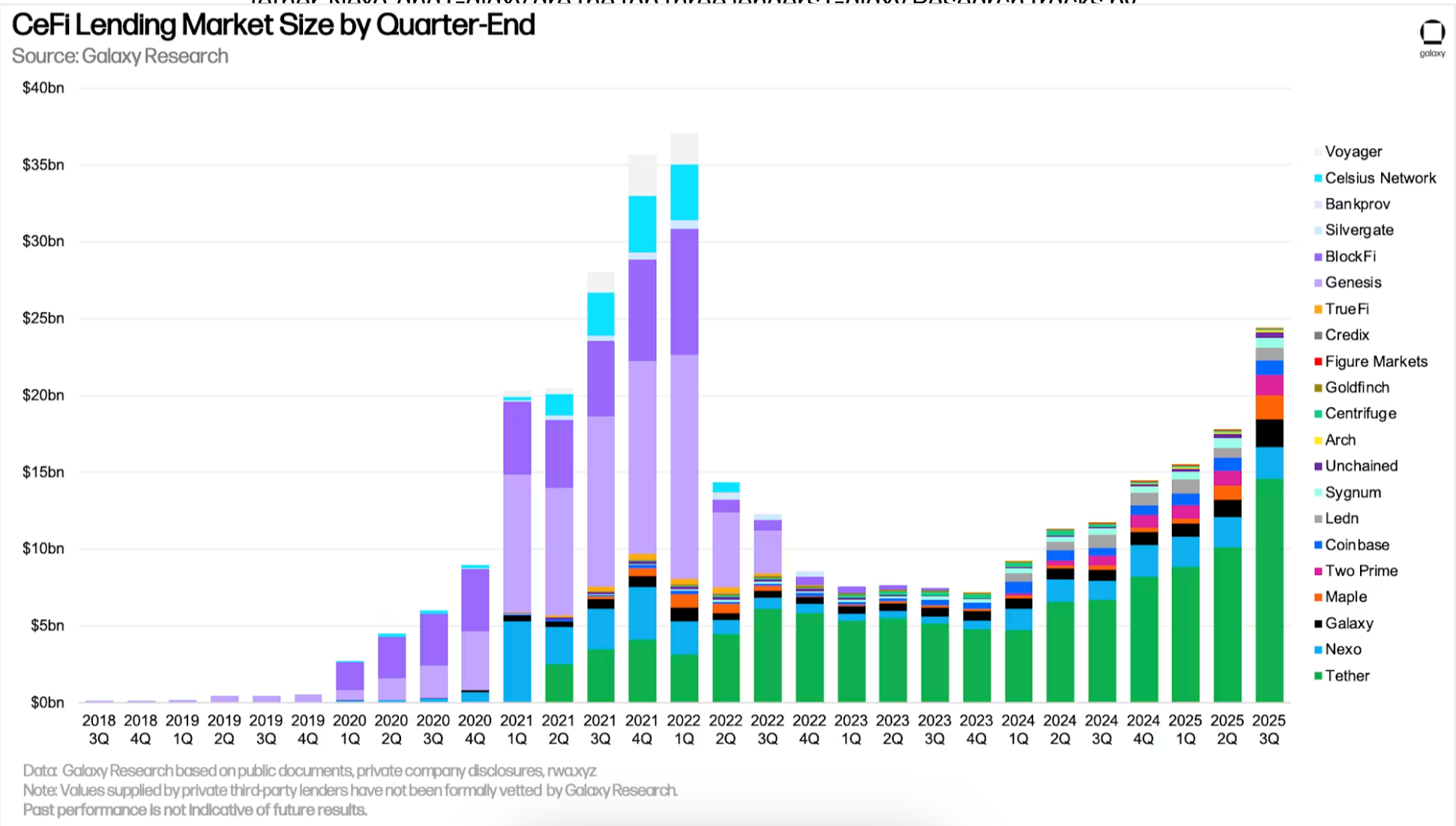
Centralized lending graph (Galaxy Research)
Survivors of the last cycle have largely abandoned uncollateralized lending, turning toward full-collateral models as they seek institutional capital or public listings. Tether remains the dominant CeFi lender, holding nearly 60% of tracked loans.
The quarter also saw a decisive shift within DeFi itself, with lending apps now capturing more than 80% of the onchain market, and CDP-backed stablecoins shrinking to 16%. New chain deployments, including Aave and Fluid on Plasma, helped fuel activity, with Plasma attracting more than $3 billion in borrows within five weeks of launch.
It's worth noting that shortly after the end of Q3, a leverage-induced wipeout occurred resulting in more than $19 billion worth of liquidations, the largest single-day cascade in crypto futures history.
Still, Galaxy's report claims the liquidation event did not reflect systemic credit weakness: most positions were mechanically de-risked as exchanges’ auto-deleveraging systems kicked in.
Meanwhile, corporate digital-asset treasury (DAT) strategies continue to rely on leverage, with more than $12 billion in outstanding debt tied to crypto-acquiring firms. Total industry debt, including DAT issuance, hit a record $86.3 billion.
The data suggests crypto leverage is rising again, but on firmer, more transparent footing, with collateralized structures replacing the opaque, unbacked credit that fueled the last boom-and-bust cycle.

 coindesk.com