According to the post, DeFi funds and curators included TelosC, Elixir, MEV Capital, Varlamore and Re7 Labs. The post showed that TelosC has about $123 million in material exposure, while Elixir lent $68 million to Stream, which is estimated to be 65% of its stablecoin backing.
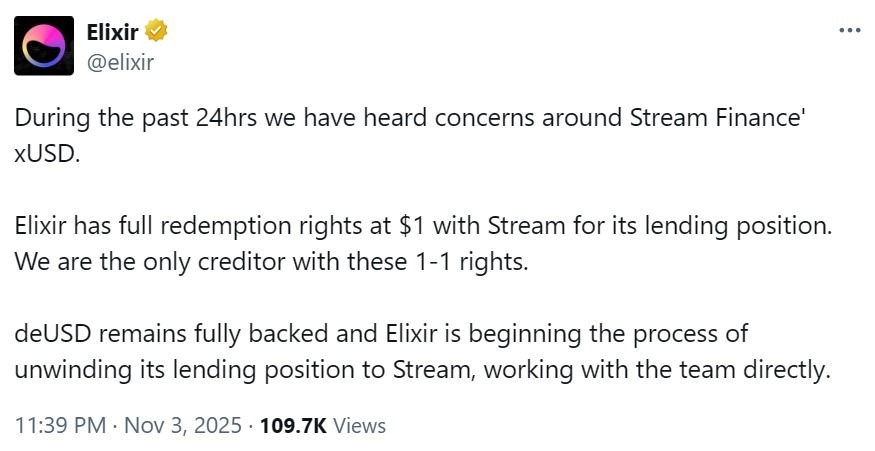
Source: Elixir
YAM said more vaults and stables were “likely affected”
Elixir claimed to have contractual redemption rights at $1 per deUSD. However, Stream Finance reportedly said that the repayment must wait until lawyers determine “who is owed what.”
The findings reinforce existing concerns about transparency in the DeFi ecosystem’s high-yield infrastructures.
The protocols involved had layered exposures through lending markets and derivative stablecoins, making it difficult to pinpoint who ultimately bears the losses.
“This is not an extensive list; there likely are more stables/vaults affected, and the information presented here is not guaranteed to be accurate,” YAM wrote.
Related: Crypto sentiment nosedives to ‘extreme fear’ as Bitcoin drops under $106K
Stream Finance’s $93 million loss
The exposure map follows Stream Finance’s announcement that it had paused deposits and withdrawals after finding a $93 million loss attributed to an external fund manager.
The project stated that it had employed the services of the law firm Perkins Coie to investigate and recover assets. Still, it did not provide a timeline for resuming its normal operations.
Prior to the announcement, traders noticed unusual delays and discrepancies between the project’s reported total value locked (TVL) and figures listed by aggregator DefiLlama.
After the announcement, Staked Stream USD (xUSD) quickly depegged to about $0.50, striking fear among users. At the time of writing, CoinGecko data indicated that the asset was trading at $0.33.
Magazine: China officially hates stablecoins, DBS trades Bitcoin options: Asia Express

 cointelegraph.com