Centrifuge’s new deJAAA token, a wrapper for Janus Henderson’s AAA CLO fund, is already trading on Aerodrome, Coinbase and other exchanges, with Stellar planned next. Meanwhile, Aave’s Horizon RWA Market now lets institutional users post tokenized Treasuries and CLOs as collateral.
This trend underscores a bigger shift: RWAs are no longer just copies of traditional assets; instead, they are becoming core parts of on-chain finance, powering lending, liquidity, and yield, and helping to close the gap between traditional finance (TradFi) and DeFi.
“RWAs have crossed the chasm from experimentation to execution,” Sid Powell, CEO of Maple Finance, says in the report. “Our growth to $3.5B AUM reflects a broader shift: traditional financial services are adopting crypto assets while institutions seek exposure to on-chain markets.”
Investor demand for higher returns and more diversified options is mainly driving this growth. Tokenized Treasuries proved there is strong demand, with $7.3 billion issued by September 2025 – up 85% year-to-date. The growth was led by BlackRock, WisdomTree, Ondo, and Centrifuge’s JTRSY (Janus Henderson Anemoy Treasury Fund). Spark’s $1 billion Tokenization Grand Prix also further fueled adoption in 2025.
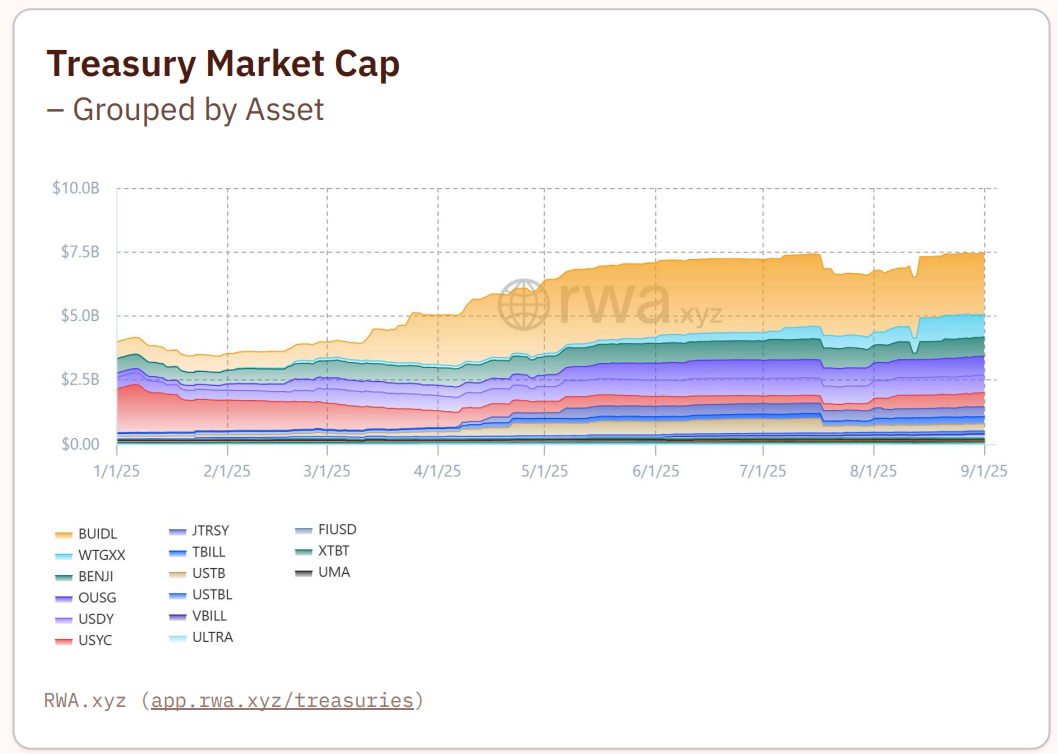
Tokenized Treasuries
Investors are putting money into longer-term bonds, private credit, and stocks to get higher returns. At the same time, more people can join in, as open platforms and DeFi make these markets accessible beyond just institutions
Together, these changes show that RWAs are becoming an essential part of digital financial markets. The report notes that tokenization is “more than just representing traditional assets on-chain. By unlocking liquidity, expanding global access, and enhancing collateralization, it fundamentally transforms them.”

 thedefiant.io




