Zero-knowledge rollup is a secondary network that relies on zero-knowledge proofs, a type of cryptography that has become one of 2023’s hottest blockchain trends, partly due to the technology’s ability to provide fast “finality” or settlement of transactions.
Read more: Manta's Layer-2 Blockchain Already Plans to Ditch OP Stack for Polygon
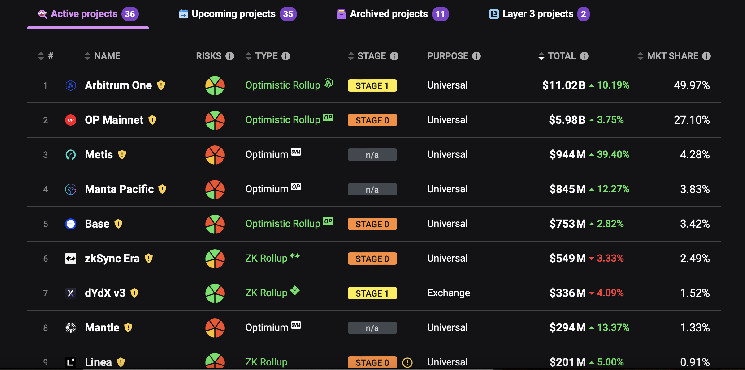
L2Beat's TVL sums the dollar value of tokens canonically bridged, externally bridged, and natively minted, while DeFiLlama, the other prominent source, only considers assets actively engaged in decentralized applications. Per DeFiLlama, Manta and Base are contesting for the ninth spot, each boasting a TVL of around $420 million.
Manta's paradigm bridging program, which went live in December, seems to have driven the rapid growth in the total value locked. Bridging means porting assets from one blockchain to another. The program offers users rewards for bridging ether ($ETH) and $USDC to the network.
The layer 2 is using a playbook similar to Ethereum layer 2 Blast, per Michael Nadeau, founder of the DeFi report. Ether and $USDC ported to Manta earn a staking yield of 4% to 5%, with coins remaining locked for 69 days, with depositors eligible for future airdrop of MANTA token, Nadeau explained on X. Depositors also receive NFT box pieces and can re-stake the staked $ETH on Eigen Layer.
Blast offered yield on assets bridged to its platform through liquid staking protocol Lido and lending protocol MakerDAO, with users earning rewards for referrals, which can be redeemed in future token airdrops.
On Monday, Binance announced Manta as the 44th project on the Binance Launchpool, allowing users to earn MANTA tokens by staking their BNB and FDUSD tokens. The crypto exchange will also list a bunch of Manta trading pairs on Jan. 18.

 coindesk.com