Article 1: ‘DeFi developments and risks in the EU market’
Notably, besides the European Securities and Markets Authority raising awareness about the “serious risks” of DeFi due to its “highly speculative nature” and “important operational and security vulnerabilities,” the regulator affirms they are not meaningful risks for financial stability.
The full article can be read in this link.
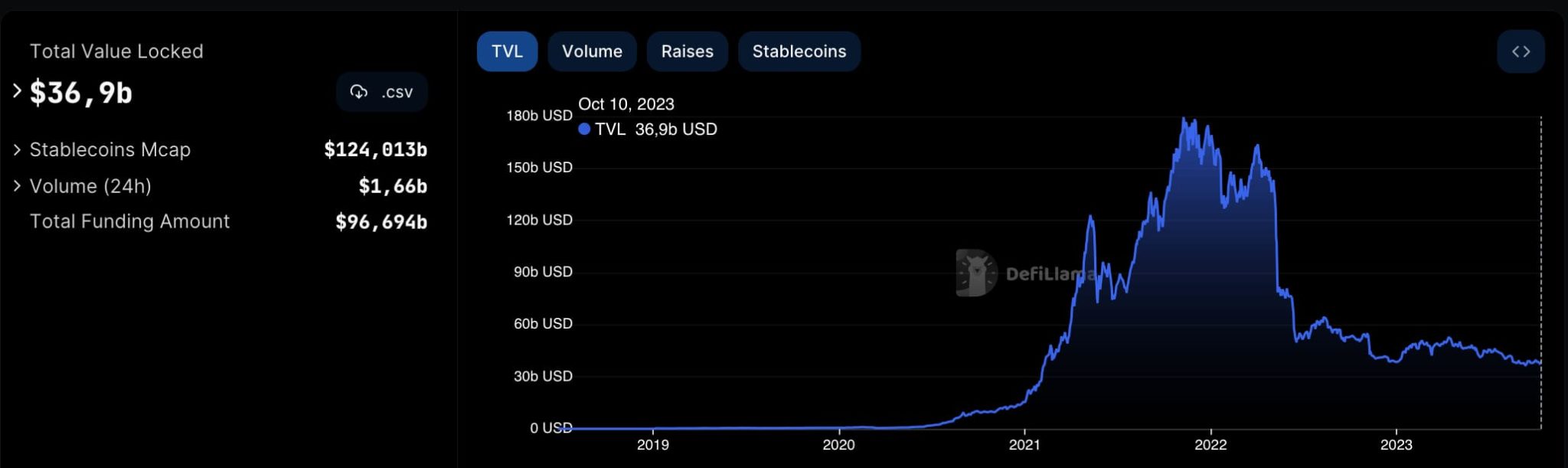
On that, ESMA points toward a relatively small size of the Decentralized Finance capitalization in comparison to the total crypto market cap. Citing the $45 billion registered in June 2023 for the Total Value Locked (TVL) in DeFi, corresponds to only 4% of cryptocurrencies market value on the same day.
Interestingly, this relevance is even lower at the time of publication, with a registered $36.9 billion total value locked according to data from DefiLlama, equivalent to 3.5% out of the $1.06 trillion total market cap for the cryptocurrency market.
Article 2: ‘DeFi categorisation of smart contracts’
Nevertheless, ESMA proposes a methodology in order to allow proper categorization and understanding of the DeFi market within the second article named “Decentralised Finance: A categorization of smart contracts.”
The EU’s financial markets and securities regulator categorizes smart contracts into five primary groups. These categories can be labelled as:
- Financial,
- Operational,
- Tokens,
- Wallet, and
- Infrastructure.
Financial: These are smart contracts used mainly to collect and share money, powering basic monetary tasks. They also include activities like online lotteries and other types of online betting activities that collect and redistribute funds.
Operational: These are smart contracts that help in managing how other smart contracts work and use memory. This is important for allocating resources efficiently and making sure everything runs smoothly.
Tokens: These smart contracts let people make, keep track of, and remove digital tokens. Some well-known types are ERC20 and ERC721. ERC20 tokens are the same and can be swapped one for another, like digital money or digital assets. ERC721 tokens (NFTs) are unique and cannot be divided, like digital collectibles, art, or items in video games.
Wallet: The smart contracts in this category handle things like fees, account balances, public access, and permission control, making it easier for people to use the blockchain.
Infrastructure: These smart contracts handle the basic tasks that make up the foundation of other smart contracts and blockchain applications. They deal with things like data, signatures, and how information is coded and decoded. It’s like the infrastructure or the utility services we rely on in cities.
It has observed a notable variation in diversity from the initial to the subsequent wave of smart contract deployments (happening between 2017 to 2018 and then 2021 to 2023). This indicates the growing incorporation of intricate and interconnected protocols that have become a defining trait of Decentralized Finance.

 finbold.com