
 cointelegraph.com

What are crypto synthetic assets?
Blockchain-based financial instruments called crypto synthetic assets imitate the value and behavior of actual assets or financial instruments.
Crypto synthetic assets, also known as “synthetic assets,” are a class of digital financial instruments created to mimic the value and performance of actual financial assets or assets from the real world, such as stocks, commodities, currencies, or even other cryptocurrencies, without actually owning the underlying assets.
These artificial assets are produced using complex financial derivatives and smart contracts on blockchain platforms, mainly in decentralized finance (DeFi) ecosystems. The ability to create decentralized smart contracts on blockchain systems like Ethereum, use collateral to secure value, track target asset prices precisely and create flexible leveraged or derivative products are important characteristics of crypto synthetic assets.
DeFi customers now have access to a wider range of financial markets and assets, which lessens their reliance on conventional intermediaries. Users should take caution, though, as these instruments add complexity and risk, necessitating a thorough knowledge of their underlying workings and effects on investing strategies
Traditional vs. crypto synthetic assets
Traditional assets are tangible or monetary items like stocks, bonds and commodities exchanged on established financial markets. In contrast, crypto synthetic assets are digital representations built on blockchain technology and intended to resemble the value and performance of these conventional assets.
The fundamental distinction between traditional and crypto synthetic assets is that traditional assets are physical or paper-based, whereas crypto synthetic assets only exist in digital form on blockchain networks. While crypto synthetics have advantages over traditional assets in terms of accessibility, liquidity and programmability, they also come with unique risks and complexities.
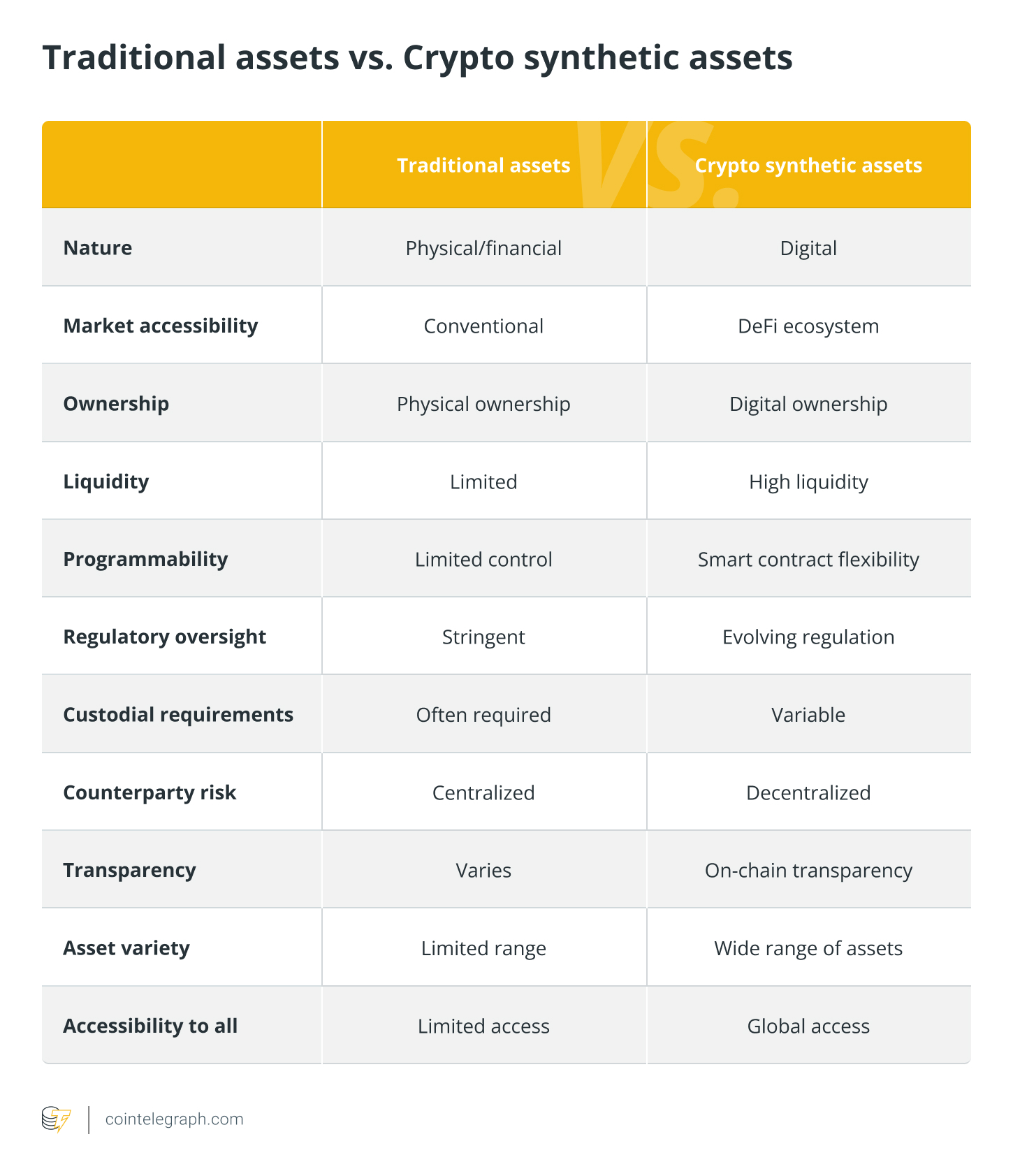
Types of crypto synthetic assets
Crypto synthetic assets come in various forms, like synthetic stablecoins, tokenized commodities and equities, leveraged and inverse tokens, and yield-bearing synthetic assets.
Synthetic stablecoins
Digital tokens known as synthetic stablecoins are intended to mimic the value and stability of fiat money, such as the United States dollar or the euro. They give people a mechanism to exchange goods and services and store value in the cryptocurrency ecosystem without experiencing the volatility of cryptocurrencies.
One example of a synthetic stablecoin is sUSD, which is developed on the Synthetix platform. It aims to provide users with access to a stable form of digital cash that matches the value of the U.S. dollar.
Tokenized commodities and equities
Commodities and stocks that have been tokenized serve as digital representations of real-world assets like gold, oil, stocks and other commodities on blockchain networks. These synthetic assets allow for the decentralized fractional ownership and exchange of conventional assets.
An example of a synthetic asset that tracks the price of crude oil is sOIL, which is also developed on the Synthetix platform. Without really holding any oil, it enables investors to become more exposed to changes in the price.
Leveraged and inverse tokens
Synthetic assets, known as leveraged and inverse tokens, are developed to amplify or counteract the price changes of an underlying asset — inverse tokens profit when the underlying asset’s price decreases, while leveraged tokens magnify profits and losses.
For instance, BTC3L (Binance Leveraged Tokens) seeks to produce daily returns that are three times higher than the price of Bitcoin ($BTC). BTC3L should climb by 3% if Bitcoin increases by 1%.
Yield-bearing synthetic assets
Within the DeFi ecosystem, yield-bearing synthetic assets give holders returns through staking or lending, providing a chance to generate passive income.
An example of a synthetic asset is cDAI, developed by the Compound protocol. Dai (DAI) stablecoins can be given to participate in lending operations on the Compound platform and earn interest. Since cDAI accrues interest to holders over time, it qualifies as a yield-bearing synthetic asset.



