
 crypto-economy.com

TL;DR
- Ripple moves into execution phase with Mastercard, shifting blockchain settlement from pilots to live card payment flows using $RLUSD on the $XRP Ledger, with transactions settling in seconds instead of days.
- Mastercard confirms stablecoins operate as a native settlement asset within its regulated network, keeping consumer payment experiences unchanged while modernizing back-end infrastructure.
-
The rollout begins with the Gemini Credit Card issued by WebBank, signaling broader institutional adoption of on-chain settlement across regulated financial rails.
Ripple Moves Into Execution Phase with Mastercard marks a transition from experimentation to operational deployment in global payments. The collaboration places blockchain settlement directly inside card networks, an area traditionally dominated by slow interbank clearing. For the crypto sector, this development reinforces the role of distributed ledgers as core financial infrastructure rather than auxiliary technology.
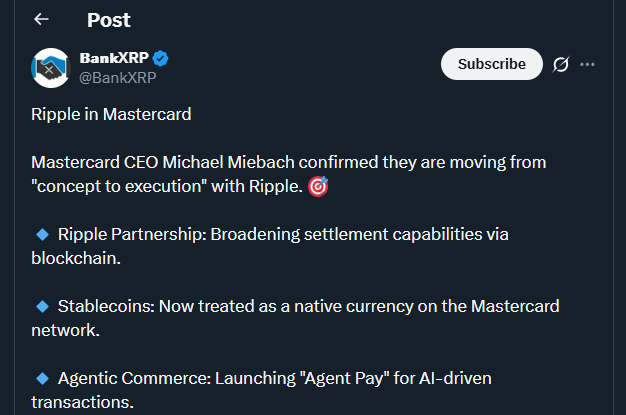
The move follows a pilot launched in late 2025 and enters live execution in February 2026. Mastercard executives confirm that real credit card transactions are now settling through blockchain infrastructure rather than batch-based clearing systems. The process remains invisible to consumers, who continue to tap or swipe as usual, while settlement mechanics evolve behind the scenes.
Ripple Moves Into Execution Phase With Mastercard And Live Card Settlement
At the center of the system sits $RLUSD, Ripple’s regulated stablecoin, operating on the $XRP Ledger. Once Mastercard authorizes a transaction and completes credit checks, settlement occurs on-chain within seconds. This replaces clearing cycles that often stretch from one to three days between financial institutions.
The Gemini Credit Card, issued by WebBank, is the first product running on this structure. WebBank’s role as an FDIC-insured institution provides regulatory oversight, ensuring that blockchain settlement aligns with U.S. banking standards. Mastercard maintains compliance controls consistent with existing card rules, integrating crypto rails without altering consumer protections.
Mastercard leadership frames the collaboration as part of a broader settlement strategy. Stablecoins are now treated as a native settlement currency within the network, enabling efficiency gains while preserving regulatory certainty. Alongside this effort, Mastercard continues advancing initiatives such as Agent Pay, which supports AI-driven transaction execution within established payment frameworks.

Institutional Adoption And On-Chain Settlement Momentum
Ripple reports steady growth in $RLUSD circulation, driven by demand from payment and settlement use cases. Supply surpassed $1.3 billion by January 2026, reflecting increased institutional comfort with regulated stablecoins. Company executives estimate that by the end of 2026, between 5 and 10% of capital market settlements operate on-chain, supported by similar enterprise deployments.
This execution phase reflects a broader industry direction. Financial institutions increasingly embed blockchain technology into existing systems instead of building parallel crypto-only rails. As Mastercard expands on-chain settlement and agentic commerce tools, Ripple’s infrastructure positions itself as a connective layer between traditional finance and crypto-native networks, pointing toward deeper integration in global payments.