How fast? Surge promises to deliver price feeds at a sub-100ms latency — a performance gain of about 8x faster and at roughly 1/100th the cost of existing oracle providers, according to the team’s press release.
That latency falls even lower to 8-25 ms should protocols choose to colocate with a Surge node on their backend, rivaling the oracle speeds of even CEXs.
The performance gain is achieved by key architectural changes under the hood.
Conventional “pull” oracles collect data, post it onchain and wait for network consensus before apps can read it — a pipeline that typically adds 2-10 seconds of delay.
Surge replaces that model with a direct WebSocket stream from the data source to applications, thereby bypassing the consensus step.
Prices are pushed by oracle nodes only when market prices change within a set range. This eliminates the wasteful slot-by-slot polling and gas spend that is standard fare on conventional “on-demand” oracles.
It’s an oracle targeted at high volume use cases in DeFi, in particular “latency-sensitive protocols/products like DeFi derivatives and oracle AMMs,” Switchboard co-founder Chris Hermida told Blockworks.
Surge is built on Switchboard’s open-source SAIL (switch forward attestation inference layer) framework, which uses trusted execution environment (TEE) hardware attestation to verify that each oracle node is running authorized Switchboard software code before it is allowed to onboard the network and serve data.
A snapshot of Solana’s oracle market today shows a fairly competitive market.
In terms of total value secured (TVS), Pyth leads the segment with $2.3b, followed by Edge ($2b) and Switchboard ($1.2b), DefiLlama data shows.
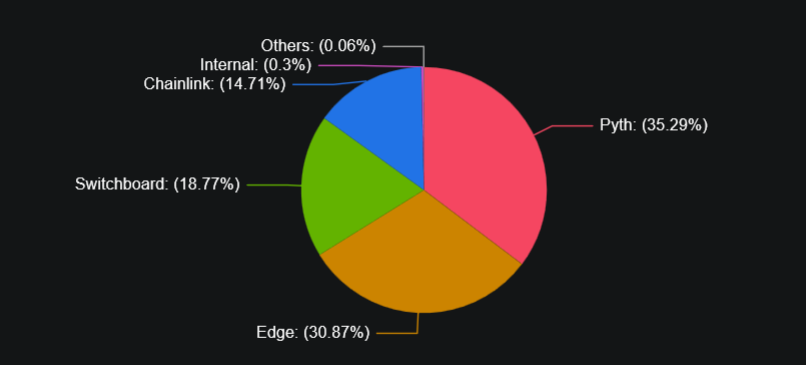
Note, though, that TVS measures the value of collateral that an oracle touches, not how often an oracle feed is consumed.

 blockworks.co