In other words, this is close to the rule many bitcoiners keep preaching: not your keys, not your coins.
According to the report, an unnamed European central bank sees the concentration of much of its gold in London as a real risk, and has discussed moving some of it elsewhere in Europe. Another European central bank said it keeps about half its gold at home. A European central bank also said the dollar is “now within the geopolitical risk framework rather than being a neutral asset,” while another resumed gold buying after a long pause, “following political enquiries.”
Central Banks Move Gold Closer to Home
Some of these moves are already public. In September, the Dutch central bank said it had moved about 86 tonnes of gold out of New York and Ottawa to London, citing “increasing geopolitical unrest” and saying gold held at the Bank of England is the quickest to deploy in a crisis.
It sold about 59 tonnes in New York and bought gold in London. It also physically moved more than 27 tonnes from the U.S. and Canada to its vault in Zeist, Netherlands, while sending a similar amount from Zeist to London. The share of its gold held at home remained almost 31%.
The Banque de France replaced 129 tonnes it held in New York with gold now stored in Paris. Germany’s Bundesbank, which keeps 1,236 tonnes at the New York Fed, says it has no doubts about the Fed’s reliability.
In its previous gold report, published in 2024, OMFIF quoted a “prominent European central banker” who voiced personal skepticism about gold but said there weren’t many ways to escape the dollar, adding that “gold is one of them along with commodities and crypto assets like bitcoin.”
No to Tokenized Gold
Owning gold directly and relying less on third-parties is the main reason why central banks don’t want tokenized gold. None of the central banks in the working group reported holding or using it.
As a European central bank put it, gold “must be an asset that can be owned and accessed directly,” while tokenized gold depends on its issuers and operators, which can fail or block access to it. Another European central bank emphasized that physical gold offers protection if the current market infrastructure breaks. Gold in a vault “would remain usable without the London fixing, counterparties, or online infrastructure.”
Bitcoin Can Be Stolen, So Can Gold
This is also where gold has some advantages over not only its tokenized counterpart but also “digital gold”—bitcoin. Bitcoin largely depends on online infrastructure and introduces cybersecurity threats, as hundreds of millions of dollars in bitcoin were stolen from self-custodial wallets this year.
Such risks can be mitigated, for example, with multisig setups—although AI-assisted criminals, in theory, may eventually find ways to compromise them as well. Similarly, physical gold vaults can also be targets of theft or seizure.
Far more gold has been lost to those controlling the vault than to burglars. One of the largest gold robberies on record, the 1983 Brink’s-Mat raid at Heathrow, involved the theft of about 3 tonnes of a bullion bank’s gold. Meanwhile, in late 1940, Vichy France agreed to hand Nazi Germany the 198 tonnes of gold that Belgium had entrusted to the Banque de France. Now, central banks are again rethinking where they keep their gold as geopolitical tensions rise.
One Bank Is In, 70+ to Go
However, for now, the report—which has several major global gold market players among its partners—largely dismisses bitcoin as an alternative.
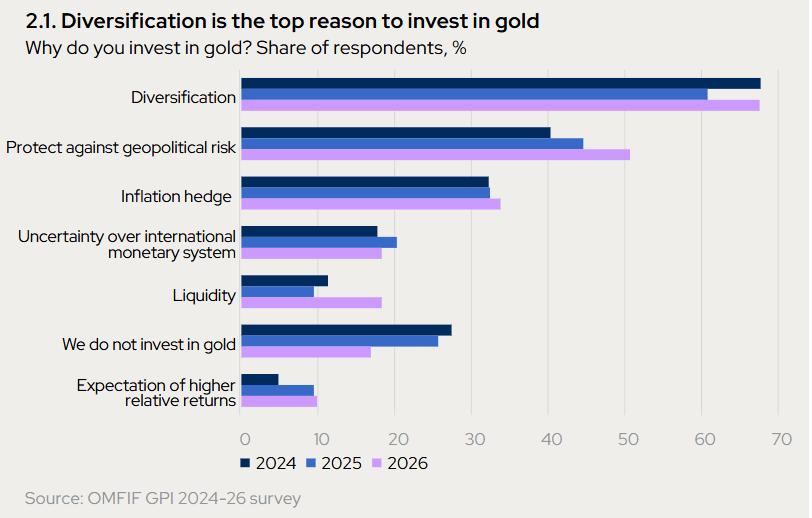
OMFIF’s report shows that 92% of surveyed central banks don’t invest in digital assets, 7% are considering them, and 1% already invest. The Czech National Bank, which bought a $1 million test portfolio of bitcoin, a dollar stablecoin, and a tokenized deposit in November 2025, is one example of a central bank investing in digital assets. The portfolio is held outside its official reserves.
OMFIF said it surveyed 74 central banks for the 2026 report. In its 2025 survey, 7% of the 75 surveyed banks also said they were considering investing in digital assets. However, it’s unknown whether the Czech central bank was among those considering investments in 2025 or whether another bank has since joined the group.
As reported by Bitcoin.com News, in March 2026, the National Bank of Kazakhstan said it would establish a portfolio of up to $350 million in crypto asset companies and other instruments offering exposure to digital assets, funded from gold and part of its foreign reserves.
What’s more, in OMFIF’s 2026 survey, 13% of central banks expected to increase their unspecified digital asset allocations over the next 10 years, up from 10% a year earlier.
Private Gold Buyers Outpace Central Banks
The fact that at least one European central bank has invested in bitcoin could already be considered a significant achievement for an asset that is still relatively young.
Meanwhile, in 2026, the World Gold Council says central banks added 321 tonnes in the third quarter, up 42% year over year, bringing purchases for the first nine months to 675 tonnes—6% more than in the same period of 2025.
Savers have been buying more gold than central banks. Last year, bar and coin demand reached 1,374 tonnes ($154 billion), while central banks added 863 tonnes. In the third quarter of 2026, however, central banks bought more gold (321 tonnes) than bar and coin buyers (268 tonnes).
Alexej Jordanov of Gold Republic, one of the report’s partners, writes that every year since 2010, private savers have bought more gold in bars and coins than central banks have added to their reserves, purchasing about twice as much overall.
“Gradually, one gram at a time, they are becoming their own central banks,” Jordanov writes, adding that a gold bar held in one’s own name “leaves no one between the owner and the metal.” This is similar to how you might keep bitcoin in self-custody rather than hold an ETF share.
Risky Insurance and Safe Havens
Matthew Ferranti of the University of Cincinnati’s Cryptoeconomics Lab, a research fellow at the Bitcoin Policy Institute (recently rebranded the Finney Foundation for Open Technology), argued in a peer-reviewed paper published in 2025 that gold and bitcoin both work as insurance against sanctions for a central bank, with gold doing so only if it sits in the central bank’s own vault.
In an article published by the Foundation in January, Ferranti found that bitcoin’s price rose when the odds of Jerome Powell’s removal as Fed chair increased, suggesting bitcoin may also protect against a loss of Federal Reserve independence.
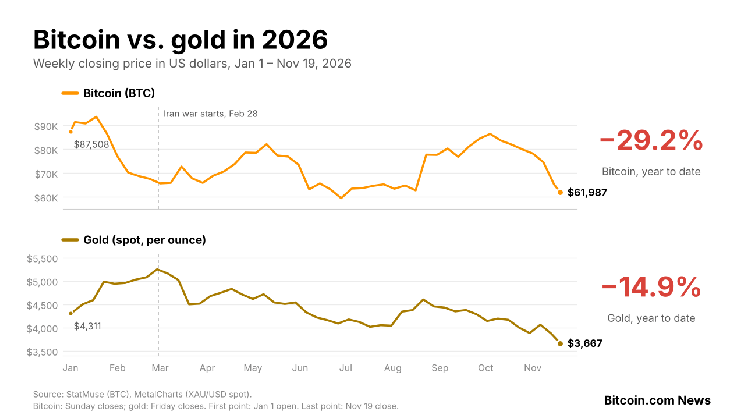
In any case, both gold and bitcoin fell this year, with both supposed safe havens behaving like risk assets during the 2026 Strait of Hormuz crisis. However, while bitcoin initially fell, it later outperformed gold for weeks.
All that said, both gold and bitcoin offer the ability to hold assets without intermediaries, especially during periods of rising uncertainty. Both assets have their own advantages, downsides, and risks, and can serve different user profiles.
Central banks also appear to be warming up to the idea of holding bitcoin in their reserves, albeit slowly. This would give them the opportunity not only to hold it but also to use it, e.g., for payments—something that would be much more complicated with gold bars.

 news.bitcoin.com