
 cryptoslate.com

The US Treasury has formally brought digital assets into the financial sector’s preparations for quantum computing threats.
On Aug. 24, the US Treasury launched its Quantum-Readiness Task Force, with one of three workstreams dedicated to digital assets and emerging-technology risks. The other tracks cover broader post-quantum cryptography adoption and third-party vendor readiness.
Treasury Secretary Scott Bessent said:
“America must lead in securing the technologies that power our economy. This Task Force will help ensure our financial system remains strong, secure, and competitive as new technologies reshape the global landscape.”
This creates a government-industry forum for crypto custodians and infrastructure providers to coordinate on a future migration to quantum-safe technology.
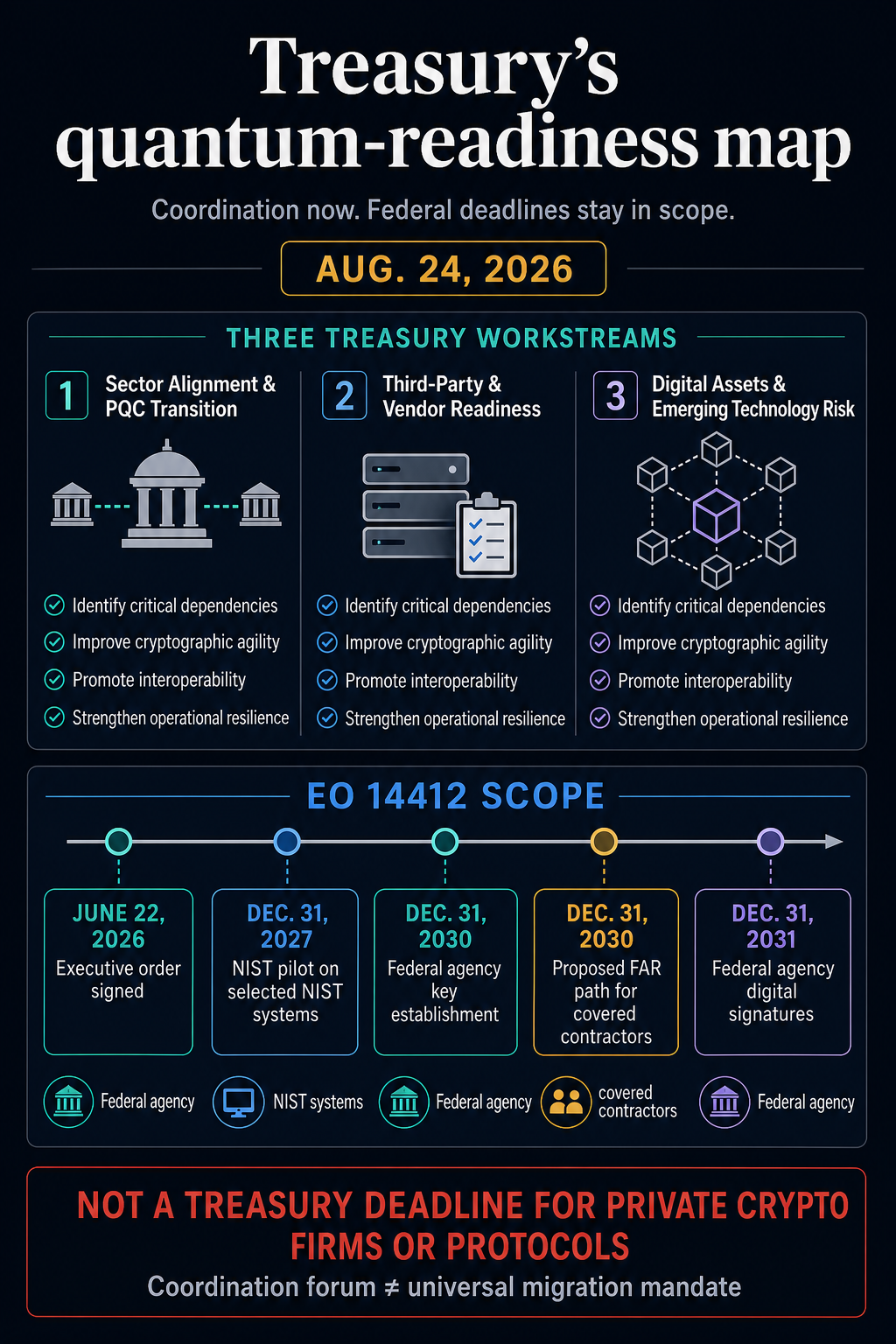
The public-private group will bring together government agencies, financial institutions, market infrastructure operators and technology providers to identify critical cryptographic dependencies, improve interoperability and prepare for implementation challenges as existing encryption becomes vulnerable to more powerful quantum computers.
For crypto companies, that could mean examining how cryptography is embedded across custody systems, transaction signing, authentication and third-party infrastructure, and whether those systems can eventually migrate without disrupting customer access or interoperability.
Treasury did not impose a migration deadline on Bitcoin, Ethereum or private digital-asset companies. Changes to blockchain signature systems would still require separate engineering and governance decisions within individual networks.
The initiative follows President Donald Trump’s June executive order accelerating the federal government’s own transition.
The order calls for high-value and high-impact federal systems to adopt post-quantum key establishment by Dec. 31, 2030, and post-quantum digital signatures by Dec. 31, 2031. Those deadlines apply to specified federal systems, not private blockchains.
Notably, parts of the crypto industry had already begun preparing for the same threat.
Coinbase’s independent quantum advisory council urged blockchain developers in June to begin technical and governance planning well before quantum computers can attack current cryptography.
The council estimated about 7 million Bitcoin are currently considered potentially vulnerable because their public keys are exposed through older address formats or address reuse.
A month later, BlackRock, Coinbase, Strategy and six other institutions formed the Bitcoin Security Consortium, pledging a combined $15 million over three years to support Bitcoin security research, with post-quantum cryptography among its initial priorities. Members direct their funding independently rather than through a pooled fund.
For now, however, the government has created a coordination framework rather than a private-sector countdown. Any binding migration timetable for crypto firms would require rules or other authorities that specifically apply to them.