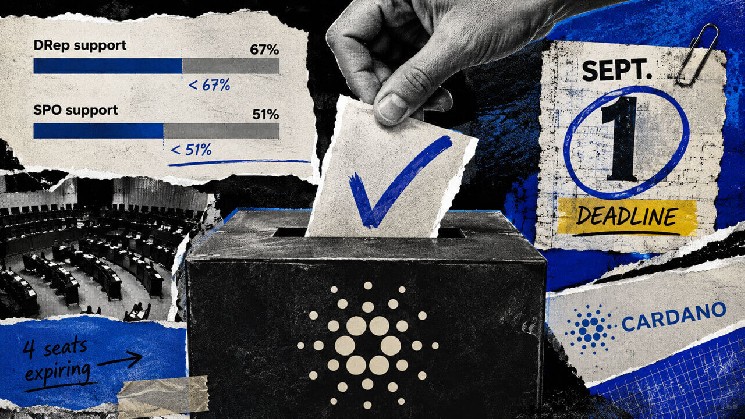
The figures have risen across the dated snapshots available. CryptoSlate’s Aug. 17 GovTool snapshot showed 32.46% DRep support and 1.95% SPO support. Intersect placed the vote at 37.9% and 7.93%, respectively, as of Aug. 21 at 20:00 UTC.
The dated readings show support rising. Exact point-to-point arithmetic remains inappropriate because the Aug. 17 baseline came from GovTool and the latest reading came from CardanoScan. Cardano’s governance system uses role-specific active-stake calculations, leaving the two displays best understood as separate measurements.
Even on CardanoScan’s latest basis, the remaining gaps were substantial: 25.3 percentage points for DReps and 39.0 points for SPOs. Votes and stake distributions can still change before expiry, so passage remains possible. The size of the deficits and the short deadline leave the outcome highly uncertain.
What a failed Cardano committee vote would change
This vote is the switch that would put four winners from Cardano’s 2026 Constitutional Committee election into their seats. If it times out without approval, the committee drops from seven active members to three, leaving it two seats short of Cardano’s five-member floor.
Under CIP-1694, an undersized committee cannot ratify governance actions that require its approval. That would create a governance bottleneck. Cardano’s operating network remains separate from this governance constraint: blocks would continue to be produced and transactions would continue to be processed.
Paths to restore governance would remain. Intersect has said Info Actions and Update Committee actions stay available in an undersized-committee state, allowing a new committee update to refill seats. CIP-1694’s ratification table exempts motions of no confidence from committee approval.
Intersect says any break in governance continuity could slow the road to the planned Dijkstra hard fork. That leaves the vote with a narrow, practical question. Can DReps and SPOs close two big gaps before the committee loses enough members to jam committee-dependent governance?

 cryptoslate.com