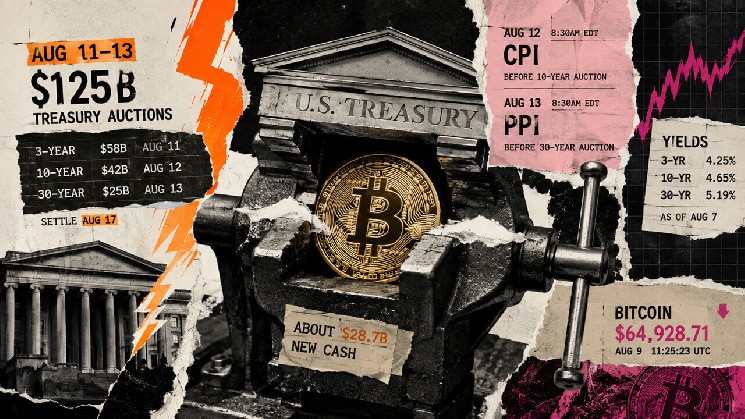
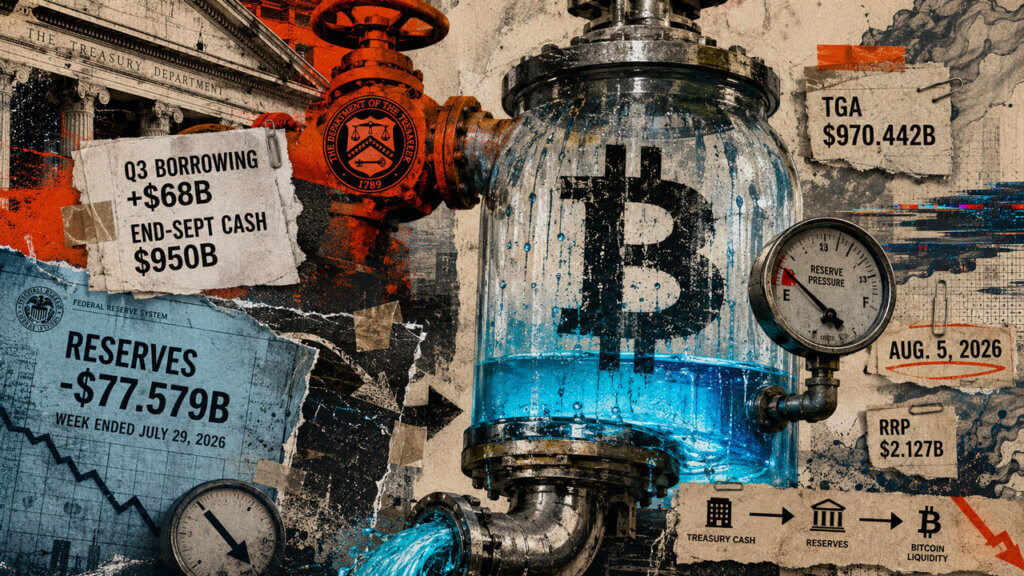
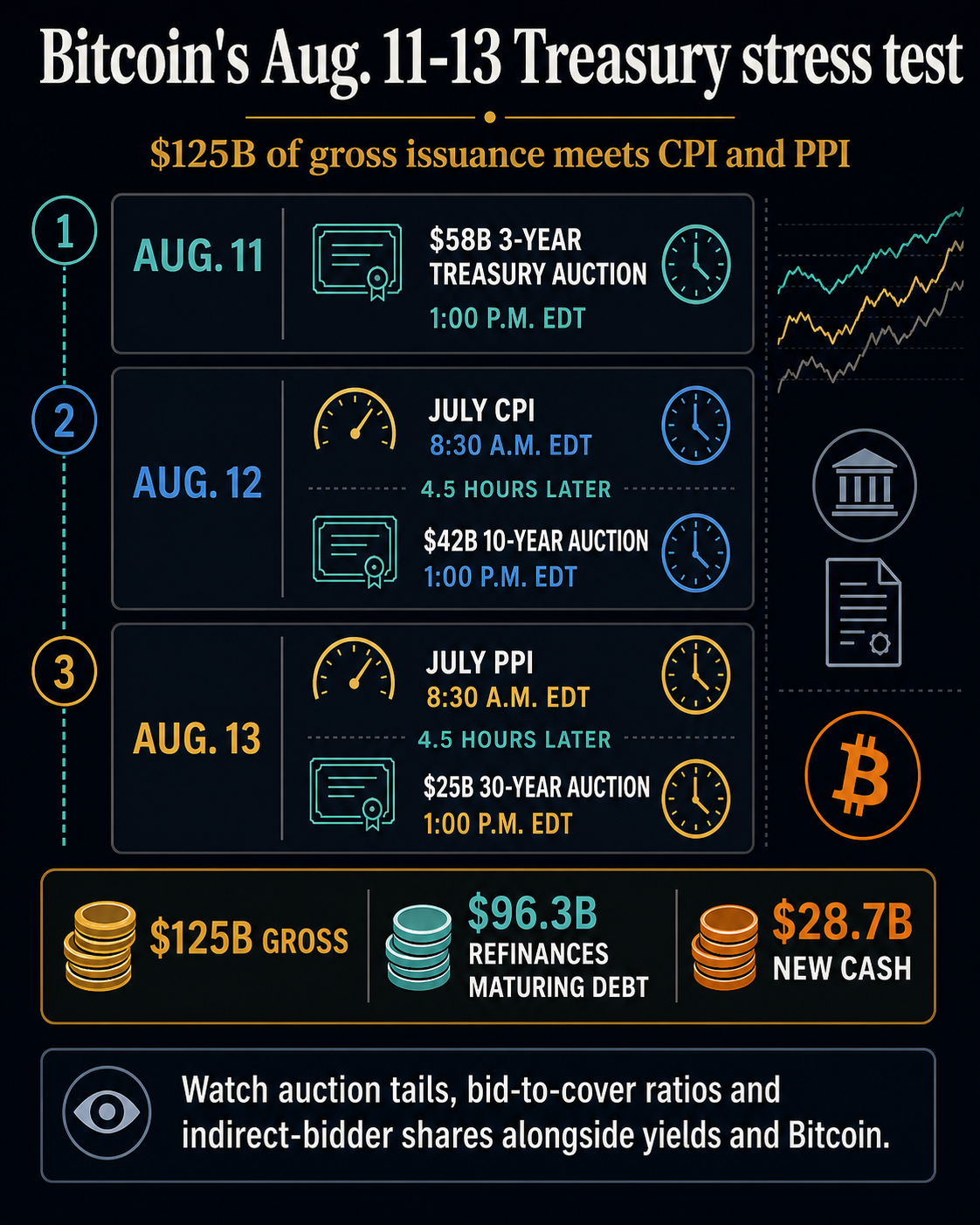
The Bureau of Labor Statistics calendar places July CPI at 8:30 a.m. EDT on Aug. 12, four and a half hours before the 10-year auction. July PPI arrives at 8:30 a.m. the following day, the same interval before the 30-year sale. Together, the releases and Treasury auctions create a tightly timed test of bond demand and Bitcoin’s response.
At the latest official business-day cutoff on Aug. 7, the Treasury's par-yield curve showed 3-year, 10-year and 30-year yields at 4.25%, 4.65% and 5.19%, respectively. A CryptoSlate snapshot retrieved Aug. 9 at 11:25:23 UTC showed Bitcoin at $64,928.71; the live price is timestamp-sensitive.
The Sunday Bitcoin quote and Friday Treasury fixing do not provide simultaneous market evidence. Any link between yields and Bitcoin must be judged around the same inflation releases and auction results.
July sets the demand bar for Treasury auctions
The July results set a baseline for the August Treasury auctions.
FinancialJuice reported that the July 3-year and 10-year sales stopped through their when-issued yields by 0.6 basis point each, while the 30-year sale stopped through by 0.3 basis point. Treasury does not publish when-issued levels, so the tail comparison is a secondary benchmark rather than an official statistic.
A comparatively weak August result would combine a positive tail with a lower bid-to-cover ratio and lower indirect-bidder share than the matching July sale. One reading alone is not decisive, and auction size plus the July reopening status of the longer securities affect the comparison.
The sharper Bitcoin risk case is conditional: inflation pushes yields higher, several auction metrics point to softer demand, yields remain elevated, and Bitcoin falls in the same event window. Firm auctions or a stable Bitcoin price would weaken that case. New York Fed research found Bitcoin broadly disconnected from monetary and macro news in its historical sample, underscoring why the Treasury auctions should be read as a test of conditions, not an automatic sell signal for Bitcoin.

 cryptoslate.com