
 nulltx.com
On Tuesday, Mt. Gox transferred 10,306 $BTC, worth roughly $731 million, to a new wallet address, marking the first major movement from the defunct exchange in two months.
And just like every time before, the crypto market took notice. Questions are already spreading across trading desks and social feeds: is this the beginning of creditor distributions, or simply internal housekeeping? The answer matters, because when Mt. Gox moves, markets move with it.
Why Mt. Gox Still Haunts the Bitcoin Market
To understand why a single wallet transfer sends shockwaves through crypto Twitter, you have to go back to 2011. At its peak, Mt. Gox was the world’s dominant Bitcoin exchange, processing over 70% of all global $BTC transactions. It wasn’t just big , it was the market.
Then, in 2014, hackers attacked. Overnight, 850,000 Bitcoin vanished. The exchange collapsed, and roughly 80,000 creditors lost everything. What followed was a decade-long legal odyssey through Japanese bankruptcy courts, restructuring proceedings, and repeated delays. That Bitcoin is still being returned to this day, in drips, in transfers, and in wallet movements that the entire market watches in real time.
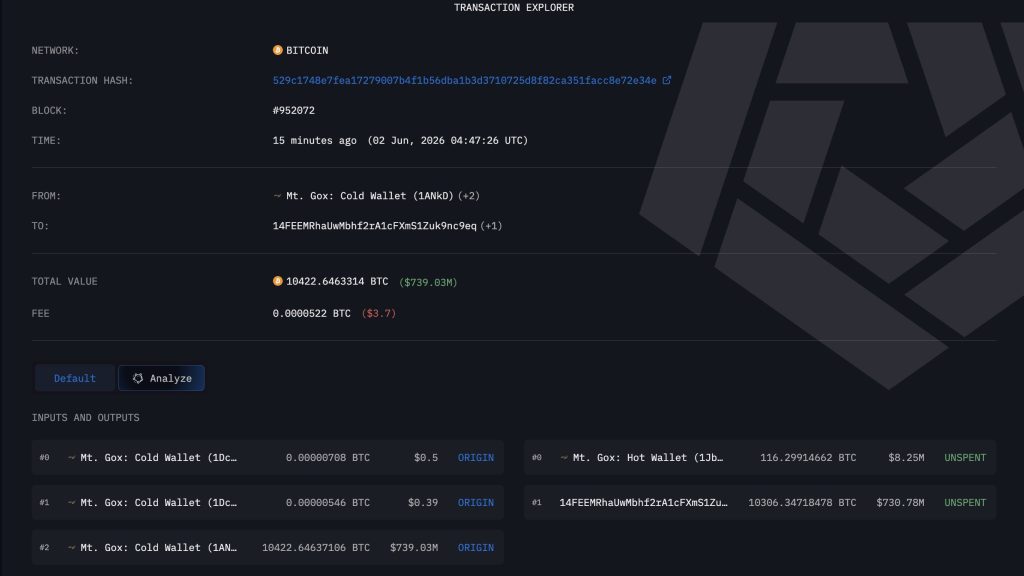
10,306 $BTC Moved for the First Time in Two Months
According to blockchain intelligence firm Arkham, the latest transfer moved 10,306 $BTC to a previously unseen wallet address.
ALERT: MT GOX MOVED $739 MILLION bitcoin:native pic.twitter.com/HzlND2XI78
— Arkham (@arkham) June 2, 2026
The timing stands out: it is the first significant movement in approximately two months, coming at a moment when the broader market is already navigating supply-side pressure from record ETF outflow streaks, 11 consecutive days for Bitcoin ETFs and 15 for Ethereum ETFs.
That context matters. At $739 million, this transfer represents a substantial potential supply overhang. Whether it signals preparation for creditor distributions, a transfer to an exchange for liquidation, or internal restructuring, the market will price in the risk of eventual sell pressure regardless of the actual intent behind the move.
Signs of Internal Restructuring, Not Liquidation
The latest transfer appears to be internal restructuring rather than a precursor to liquidation. The key tells: the funds did not flow into exchange-linked wallets. When Bitcoin is being readied for sale, it typically moves to exchange deposit addresses, a pattern Mt. Gox watchers have learned to identify. That signature is absent here.
The absence of those exchange deposits suggests this is routine preparation rather than imminent selling. But that distinction, while technically meaningful, does surprisingly little to calm nerves. Because the fear surrounding Mt. Gox has never really been about the fund movement itself.
Mt. Gox just moved 10,306 $BTC worth $731 million to a new wallet for the first time in 2 months.
Every time this wallet moves, crypto Twitter panics and this is why.
In 2011. Mt. Gox was the world's largest Bitcoin exchange handling over 70% of all global $BTC transactions.… pic.twitter.com/ISzC7AdCAo
— Mutua.base.eth (@Mutuabrian_M) June 2, 2026
The Real Fear: 80,000 Creditors Sitting on Massive Gains
The deeper anxiety is about what happens the moment those 80,000 creditors finally get their Bitcoin back. These are people who bought Bitcoin at under $1,000 and have spent more than a decade waiting to be repaid. When, not if, their coins land in their wallets, the market has to reckon with one of the most psychologically loaded sell decisions in crypto history.
Even a fraction of those creditors choosing to liquidate their positions could represent billions in sell pressure hitting exchanges in a compressed period. That scenario has loomed over the Bitcoin market for years, and every wallet movement reignites it.
Repayment Deadline Pushed Again, to October 2026
Adding to the uncertainty is the timeline. The creditor repayment deadline has been extended again, this time to October 31, 2026. Mt. Gox still holds approximately $4 billion in Bitcoin that will remain frozen for at least another year under the current schedule. The extension means the market must live with this supply overhang indefinitely, a recurring source of uncertainty that surfaces every time those wallets stir.
It is a pattern the market knows well by now. The wallet moves. Crypto Twitter panics. Analysts clarify. The fear subsides, until next time.
What This Means for The Bitcoin Market
The timing of this latest movement is uncomfortable. Bitcoin ETFs are in the middle of their longest outflow streak in recent memory, and Ethereum ETFs are faring even worse. Stacking a $731 million Mt. Gox transfer on top of those outflows adds another variable to an already uncertain supply picture.
Whether this particular move leads to anything , distributions, exchanges, or simply a different cold storage address, is almost secondary at this point. The psychological weight of Mt. Gox is its own market force. Every transfer is a reminder that billions in ancient Bitcoin remain in legal limbo, waiting to re-enter the market, held by creditors who have had more than enough time to decide exactly what they will do the moment they get the chance. The market knows that. And it prices in that fear every single time.
Disclosure: This is not trading or investment advice. Always do your research before buying any cryptocurrency or investing in any services.