
 financemagnates.com

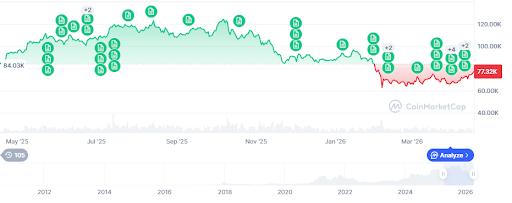
The first quarter of 2026 delivered a harsh reality check to digital asset markets. CMC data shows the combined cryptocurrency market capitalization fell 22.30%—dropping from $2.96 trillion to $2.3 trillion.
Bitcoin absorbed heavy pressure, sliding 23.8% to close the quarter at $66,694. By February 5, Arkham Intelligence recorded a market sentiment reading of "5", signaling extreme fear among participants.
Amid this severe contraction, major platforms had to prove their structural resilience. The recent announcement that Binance completed a $1B SAFU Bitcoin purchase fundamentally changed how emergency reserves operate in crypto markets by securing exactly 15,000 $BTC for its Secure Asset Fund for Users.

The Flight to Trust During Market Contractions
Capital behaves predictably when market conditions deteriorate. Investors abandon speculative assets and rush toward established liquidity hubs with proven security infrastructure. Glassnode data confirms the severity of the Q1 selloff, revealing that the supply of tokens at a loss reached 16% of the total Bitcoin market capitalization.
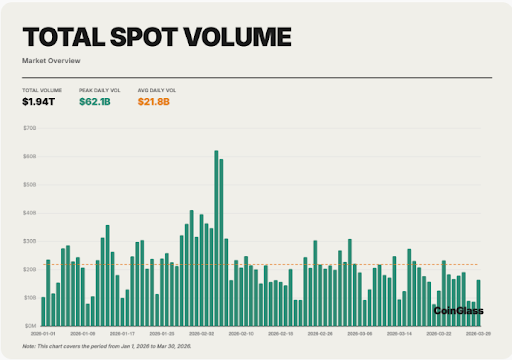
This marked the highest threshold of market pain recorded since the Terra collapse in May 2022. While overall spot market trading volume fell 23% according to CoinGlass, capital aggressively concentrated upward into trusted custodians.
Faced with intense volatility, market participants prioritized security over yield. User asset reserves on Binance climbed to $152.9 billion, representing 73.5% of all major centralized exchange assets combined.
"When markets become uncertain, users make decisions based on trust. The fact that $152.9 billion in assets remain on Binance reflects something we've built deliberately over years — transparency in our reserves, consistency in our protections, and a commitment to putting user security above everything else," explains Binance Co-CEO Richard Teng. Investors clearly prefer platforms that maintain fully transparent proof-of-reserves and robust emergency funds when the broader macro environment looks unstable.
Anatomy of a $1 Billion Acquisition
Executing a $1 billion market order is complex and requires careful fragmentation to avoid severe price slippage. On-chain data tracked the 15,000 $BTC acquisition. This confirms that the purchasing occurred across multiple staggered tranches to mitigate market impact.
The initial buys included two separate blocks of 1,315 $BTC executed at $76,045. As prices adjusted, the exchange capitalized on the volatility, acquiring 3,600 $BTC at $69,444 and a much larger tranche of 4,545 $BTC at $66,006.
By averaging into the position, the final blended acquisition price settled near $70,000. Converting a massive cash position into Bitcoin represents a bold treasury rebalance, but it aligns perfectly with a much broader security ethos.
Emergency funds must hold assets that cannot be debased or easily manipulated by central intermediaries. Upgrading the safety net reinforces a proactive user protection infrastructure that already operates at a massive scale.
To put this into perspective, the latest security reports show the platform actively prevented over $4.2 billion in potential user losses throughout 2024 alone, effectively shielding 2.8 million individuals from fraud. Moving the emergency fund fully into Bitcoin simply anchors that defensive posture to the strongest digital commodity available.
Spot Market Resilience Amid Institutional Cooldown
The broader institutional cooldown was starkly visible across trading venues. CryptoQuant data indicates that total centralized exchange trading volume cooled sharply by about 48%, falling to $4.3 trillion in March. Despite this industry-wide contraction, capital flow data from CoinGlass reveals that Binance actually expanded its spot market share, climbing from 34.0% in January to 35.4% in March.
"As trading activity normalized in Q1, market structure became clearer: derivatives continued to lead price discovery, while liquidity consolidated on platforms able to support scale. In a lower-volume environment, Binance's consistent leadership across both spot and perpetual markets reflects the value users place on deep liquidity and reliable execution," noted Teng.
Providing an emergency fund backed entirely by Bitcoin offers institutional players the additional assurance they demand during volatile market conditions.. When macroeconomic conditions tighten, traders migrate away from fragmented regional platforms and consolidate their capital where insolvency risks are effectively neutralized by verifiable digital commodities.
Redefining Emergency Reserves in Digital Finance
The decision to convert a $1 billion safety net entirely into Bitcoin establishes a new structural benchmark for the crypto market. Digital asset platforms can no longer rely on opaque reserve structures or fiat-pegged mechanisms alone to guarantee users’ protection during severe market downturns. The key is holding a decentralized, highly liquid, and widely recognized asset as a reserve backstop that can strengthen an exchange’s resilience during shifting macro cycles or localized liquidity stress.
Binance tied its emergency reserves directly to the strongest asset in the ecosystem. By doing so, the exchange signals that true financial resilience requires hard and verifiable assets. As regulatory frameworks mature and institutional capital continues to evaluate market infrastructure, this transparent approach to treasury management will likely become the mandatory standard for any platform aiming to secure long-term user trust.