
 bsc.news
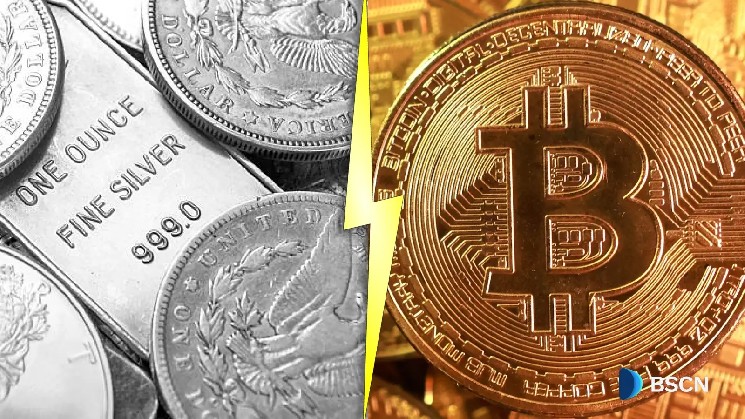
Table of Contents
Silver has outperformedBitcoin by a substantial margin in recent months, with the precious metal surging 104% since late October 2025 while Bitcoin crashed 30% from its $126,000 peak to around $87,000. The shift represents a historic reversal where silver has become more volatile than Bitcoin, challenging long-held assumptions about risk assets in the cryptocurrency era.
How Much Has Silver Gained Compared to Bitcoin?
Silver closed at $48.68 per ounce on October 31, 2025. By late January 2026, it had crossed the psychological $100 threshold, currently trading near $110 per ounce after establishing session highs above $109. This 104% surge in three months added approximately $2.83 trillion to silver's total market value.
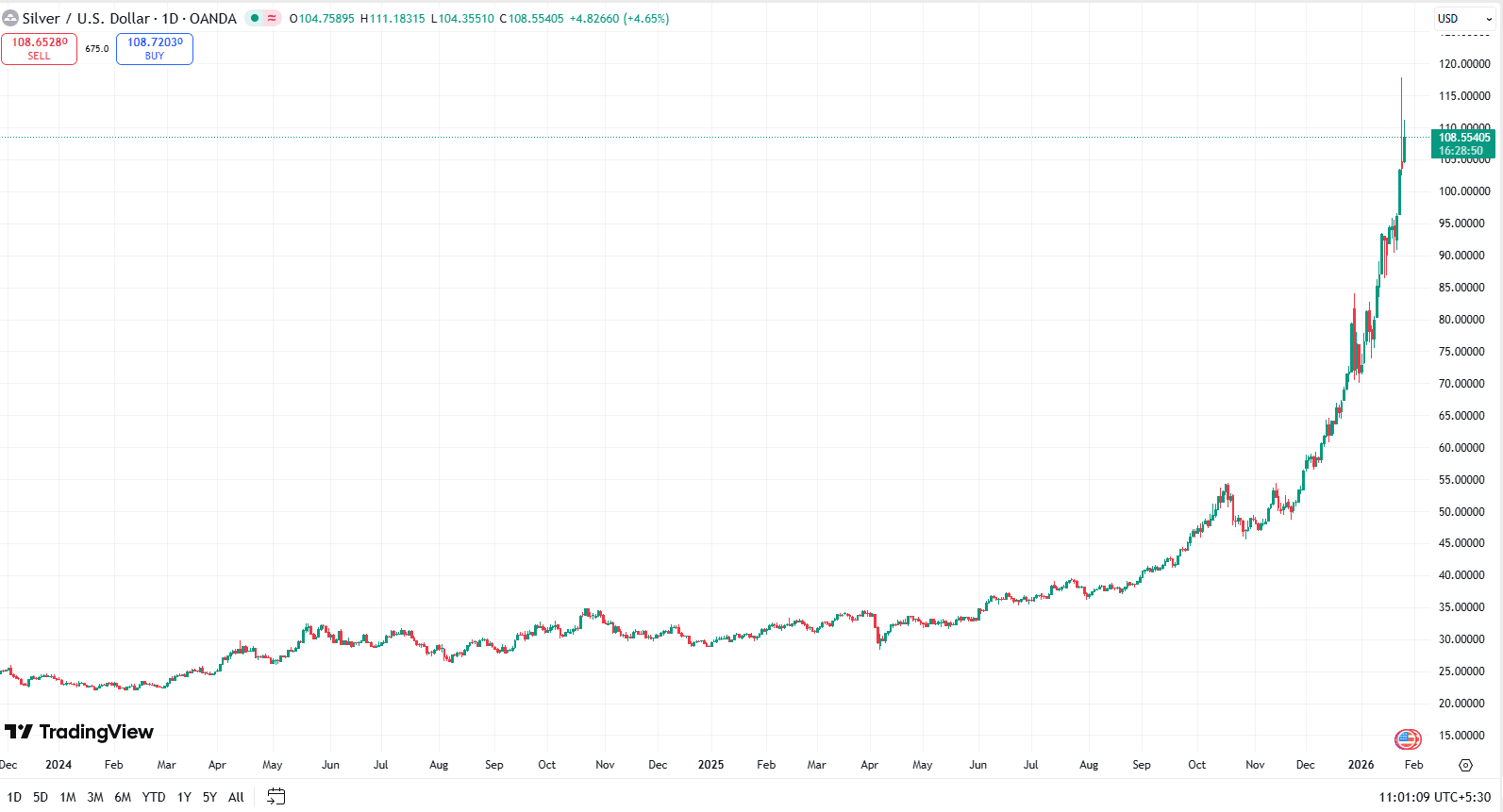
The total above-ground silver supply is estimated at approximately 56 billion ounces, including bullion, coins, jewelry, and industrial products. At October's price, silver's total market value stood at roughly $2.73 trillion. At current prices above $105, that valuation has exploded to approximately $6.09 trillion.
That increase of $2.83 trillion represents 1.5 times Bitcoin's entire current market cap of $1.75 trillion, added to silver's value in just 90 days.
Meanwhile, Bitcoin tumbled from above $126,000 in October to roughly $89,000. The cryptocurrency's market cap fell from over $2.4 trillion to $1.84 trillion, shedding more than $600 billion in value.
What Is Driving the Silver Rally?
The silver rally stems from industrial necessity colliding with a structural supply crunch. Solar panels now account for 29% of industrial silver demand, up from just 11% in 2014, according to the Silver Institute's World Silver Survey 2025.
Industrial Demand Fundamentals
Each solar panel requires 15-25 grams of silver, and global solar capacity is forecast to hit 665 gigawatts in 2026. Electric vehicles use 25-50 grams of silver versus 15-28 grams in conventional cars. This demand is accelerating as the green energy transition shifts from future trend to current reality.
The supply side reveals even tighter conditions. The Silver Institute reports 2024 marked the fourth consecutive year of supply deficits:
- Mine production: 819.7 million ounces
- Total demand: 1.16 billion ounces
- Industrial demand: 680.5 million ounces (record high)
The deficit is structural. Over 70% of silver is produced as a byproduct of mining lead, zinc, and copper, meaning production cannot simply ramp up when prices spike.
Research from Ghent University and Engie Laborelec projects that by 2030, global silver demand could hit 48,000-52,000 metric tons annually while supply reaches only 34,000 metric tons. The solar industry alone could consume 29-41% of projected global supply by decade's end.
Did Silver Become More Volatile Than Bitcoin?
In December 2025, silver emerged as the more volatile asset over Bitcoin, marking a sharp reversal of long-held assumptions about where macroeconomic risk manifests. While Bitcoin remained stuck near $87,000 in a tight range through late last year, silver surged to $84 per ounce.
Silver's 30-day realized volatility surged into the mid-50% range while Bitcoin's compressed into the mid-40s. This represents a historic reversal, as Bitcoin has historically run three to five times more volatile than the precious metal.
The volatility gap matched performance trends. Silver finished 2025 up 151%, while Bitcoin ended down 7%. For an asset long treated as a fast-moving macro trade, Bitcoin's subdued behavior stood out amid heightened global uncertainty.
Market Structure and Physical Supply
China's January 2026 export licensing restrictions tightened physical availability expectations, pushing spot prices in major hubs above futures benchmarks. Backwardation in London's forward curve signaled immediate scarcity, where near-term prices trade above longer-dated contracts due to tight physical supply.
The Trump administration's decision not to impose tariffs on critical minerals, including silver, which was added to the U.S. critical minerals list in 2025 due to its role in green energy and electronics, removed downside pressure from the rally.
How Are Investors Responding?
Bitcoin continued to move in line with broader risk markets rather than safe-haven assets. Technology stocks weakened, with the Nasdaq-linked QQQ ETF down about 1% in pre-market trading, reinforcing Bitcoin's correlation with equities.
Strategy, led by executive chairman Michael Saylor, bought $2.13 billion worth of Bitcoin in one of its largest purchases. The company now holds approximately 709,715 Bitcoin. However, this major institutional purchase has not prevented Bitcoin's decline.
Crypto-Native Silver Products
The tokenized silver market has grown to approximately $375 million in market capitalization, led by Kinesis Silver (KAG) with $284 million, according to CoinGecko data. Bitunix exchange launched XAG/USDT perpetual futures on January 9, offering up to 20x leverage on silver price movements, signaling growing institutional interest in crypto-native silver products.
Analyst Michael van de Poppe noted that both gold and silver have hit new all-time highs, showing strong momentum in traditional safe assets. However, he warned that if the breakout loses speed, markets could slide lower and bearish signals may take over. Van de Poppe emphasized this is a critical moment for Bitcoin, which now needs to show strength.
Conclusion
Silver has decisively outperformed Bitcoin in recent months, adding $2.83 trillion in market value while Bitcoin shed over $600 billion. The reversal in volatility patterns, with silver's 30-day realized volatility exceeding Bitcoin's for the first time in years, reflects a fundamental shift in how investors are positioning for risk.
Structural supply deficits driven by solar panel and electric vehicle demand support silver's continued strength, while Bitcoin's correlation with risk assets rather than safe havens has contributed to its underperformance. The contrast shows investors favoring tangible assets with industrial utility over digital alternatives during periods of political and monetary uncertainty.
Resources
-
Silver chart on TradingView: Silver price action
-
Bitcoin chart on CoinMarketCap: Bitcoin price action
-
Silver Institute Research: World Silver Survey 2025
-
Report by PV Magazine: PV industry could account for 40% of global silver demand by 2030
-
Report by Reuters: Bitcoin hoarder Strategy buys $2.13 billion in bitcoin in eight days
-
Report by Discovery Alert: China’s Silver Export Restrictions Transform Global Supply Chains in 2026