
You should see how much Aster I stacked. 😁
10:52 pm · 23 Jan 2026
 invezz.com
27 January 2026 13:32, UTC

Aster ($ASTER) has seen renewed momentum in recent days.
The cryptocurrency is currently trading at around $0.653, marking a 5.8% gain over the past 24 hours, adding to its 8.6% weekly gain, though it remains down 9.2% over the past month.
Copy link to section

 Point your phone camera to install
 4.8 based on 40K reviews in the App Store and Google Play


On January 19, 2026, Aster activated a new on-chain buyback program, allocating up to 40% of daily fees from perpetuals and Shield Mode toward $ASTER repurchases.
Combined with the existing Stage 5 buybacks, up to 80% of daily fees now support token demand.
These mechanisms have already burned 209 million $ASTER tokens, reducing supply and boosting scarcity.
Since the buybacks started, over $140 million has been spent on buybacks so far, and all activity is fully trackable on-chain.
The transparency involved in the buyback programs has helped restore confidence in $ASTER amid concerns over supply concentration.
With 97% of tokens held by the top 100 addresses, market participants had feared manipulation.
But CZ’s recent post on X of his Aster staking activity has reassured traders.
You should see how much Aster I stacked. 😁
The Binance founder’s involvement is seen as a bullish signal by many in the crypto community.
Copy link to section
$ASTER’s price has stabilised above the 7-day SMA at $0.619 and the 78.6% Fibonacci retracement at $0.623.
Momentum indicators show bearish momentum, with the Relative Strength Index (RSI) at 43 and the MACD histogram, though above zero, still signals weak momentum.
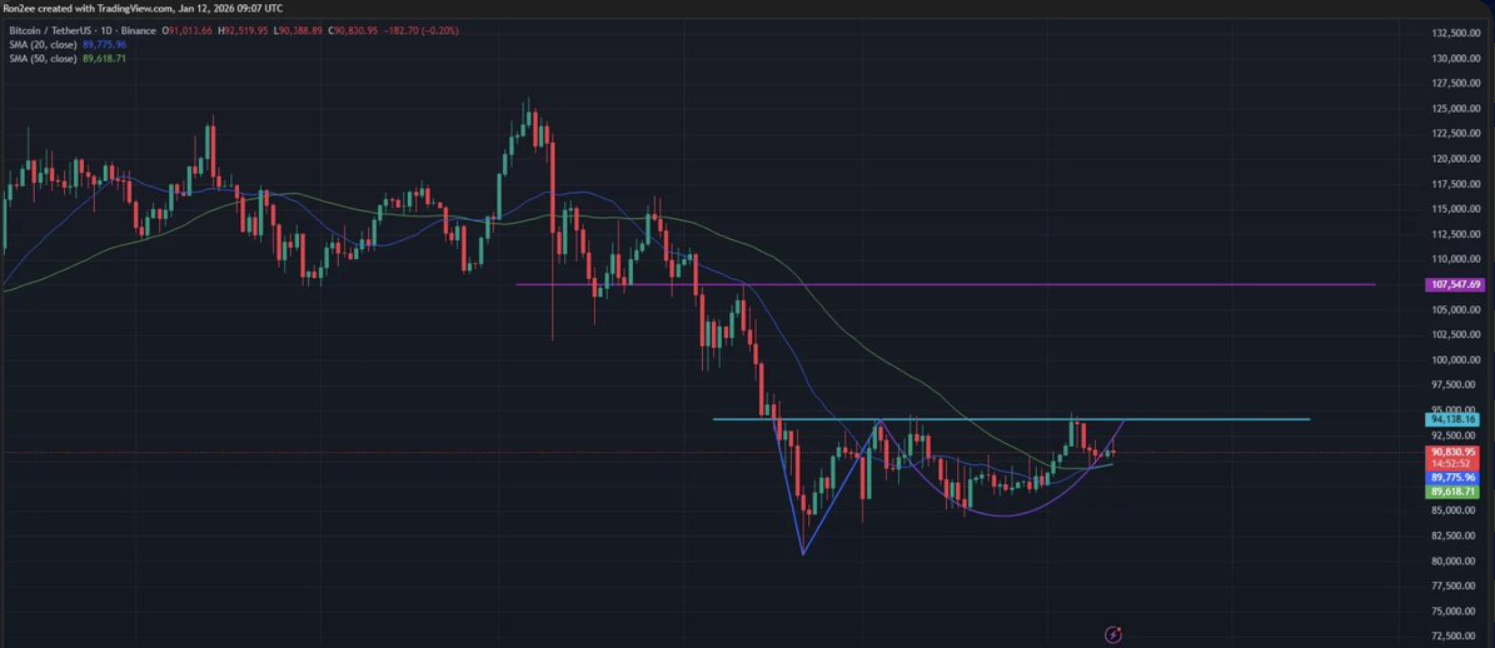
While analysts are capitalising on the oversold bounce potential, the resistance near $0.69 and $0.718 could cap the resulting gains.
Meanwhile, the upcoming Q1 2026 mainnet launch and staking integration add longer-term narrative support.
Despite $ASTER’s 39% 90-day decline, these developments may attract accumulation from holders betting on Aster Chain’s growth.
Circulating supply stands at 2.57 billion $ASTER, with 6.35 billion tokens yet to unlock, highlighting ongoing risks.
Copy link to section
As January 2026 comes to an end, traders should monitor the support at $0.65, as holding above this level is crucial for any further bullish momentum.
In case of a sustained bull rally, the key resistance levels to watch include $0.69 (which corresponds with the 50% Fibonacci retracement level) and $0.718 (which corresponds to the 38.2% Fibonacci retracement level).
A breakout above these levels could signal a more sustained bullish reversal.
However, in case of a pullback below $0.65, the next support lies at $0.573.
Looking further ahead, long-term forecasts suggest $ASTER could reach between $1.06 and $3.56 by the end of 2026.
This range reflects the potential upside if buybacks, CZ backing, and ecosystem growth align favourably.
Volume trends are also important, as $148 million in 24-hour trading activity shows growing interest.
Investors should track fee revenue, buyback execution, and mainnet updates for clues on whether the rally can be maintained.