However, the report noted that this surface-level stability masks market exhaustion that warrants careful attention.
On-chain metrics paint a concerning picture of capital flow dynamics. This cycle has absorbed $678 billion in net inflows through realized cap growth, nearly 1.8 times larger than the previous cycle.
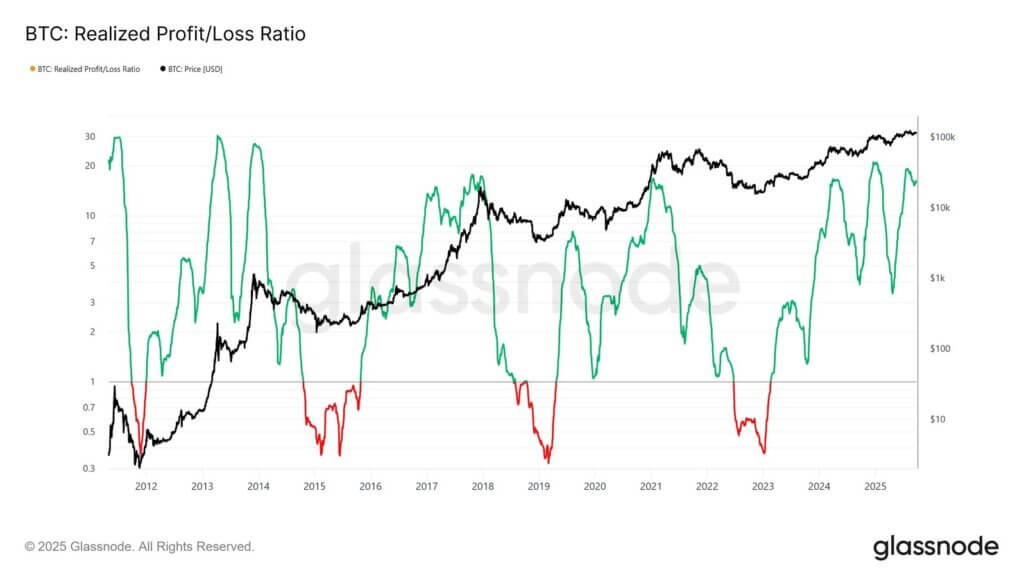
Long-term holders have distributed 3.4 million $BTC in profits, already exceeding previous cycles and highlighting the magnitude of selling pressure from seasoned investors. The market structure reveals a fragile balance between institutional demand and the distribution of long-term holders.
US-traded Bitcoin spot ETF inflows, which previously absorbed heavy selling, collapsed from 2,600 $BTC per day to nearly zero around the FOMC meeting.
Meanwhile, the long-term holder distribution surged to 122,000 $BTC per month, creating an imbalance that set the stage for weakness.
Derivatives markets amplified the correction through forced liquidations and deleveraging. Futures open interest fell sharply from $44.8 billion to $42.7 billion as Bitcoin broke below $113,000, with dense liquidation clusters between $114,000 and $112,000 driving aggressive selling.
While this deleveraging reset cleared excess leverage, it also revealed the market’s vulnerability to liquidity-driven swings.
Options markets reflect heightened downside concerns, with put/call skew spiking from 1.5% to 17% following the correction.
Total options open interest near all-time highs creates a gamma overhang that amplifies volatility, particularly to the downside, where dealers are positioned short gamma.
As Bitcoin is now trading at $109,466, the $111,800 level represented the short-term holder cost basis and served as temporary support during recent selling.
This technical foundation becomes crucial as the market navigates between institutional accumulation and long-term profit-taking by holders.
Bitcoin’s ability to maintain the threshold will determine whether this correction represents healthy consolidation or marks the beginning of a deeper cooling trend.
Without renewed institutional demand to offset continued long-term holder distribution, the risk of more significant price declines increases substantially.

 cryptoslate.com