
 coindesk.com
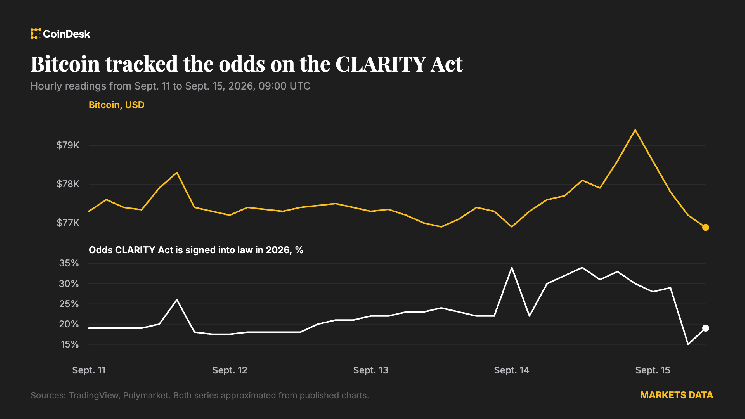
A rally that carried bitcoin $BTC$76,878.05 to $79,427 on Monday unwound on Tuesday, leaving the largest cryptocurrency at $76,862, down 1.7% since midnight UTC and 6.6% below the month’s $82,284 high set on Sept. 4. Ether ETH$2,482.92 fell 1.6% to $2,474.76 and solana ($SOL) lost 2% at $100.43.
Polymarket odds on the U.S. Clarity Act being signed into law this year followed a similar trajectory, reaching 34% on Monday before sliding back to 17%. The drop was caused by news that Democrats had crafted a counterproposal after rejecting a revised draft Republican negotiators circulated on Sunday. The sticking point is the ethics language governing officials' crypto holdings rather than the market structure provisions themselves.
The Senate votes at 2:15 p.m. ET on whether to invoke cloture, or force a vote, on the bill. If the bill passes, that would move the industry closer to its first clear set of U.S. rules on who regulates what. A failure would likely shelve market structure legislation until after the midterm elections in November.
Selling pressure was near universal on Tuesday, with 92 of the CoinDesk 100 constituents lower on the day and the index itself down 1.6%.
Traditional markets moved the other way, with Nasdaq 100 index futures gaining 0.43% and S&P 500 index futures addeing 0.35% as some of Monday's AI-driven selloff reversed. The Dollar Index rose by 0.17%, making Tuesday's decline a crypto-specific affair and reversing the pattern of 24 hours earlier, when crypto was the only major asset class in the black.
Derivatives positioning
- Long-short taker volume hangs in the balance: The long-short taker-volume ratio in crypto futures remains finely balanced ahead of the Senate vote on the Clarity Act. Cumulative open interest declined slightly, falling 1% to $135 billion over the past 24 hours, while trading volume surged 54% to $207 billion. This suggests existing market participants are closing positions faster than new positions are being opened.
- Bitcoin futures show taker selling: Bitcoin’s overnight pullback to $77,000 was marked by taker selling in the futures market, according to analysts at Marex. Takers are traders who remove liquidity from an exchange’s order book by executing trades at available prices. Overall, open interest continues to decline, hovering below 680,000 $BTC and signaling weak demand for leveraged exposure.
- Open interest declines in major tokens: Open interest in ether, solana and XRP futures also remains in a downtrend. In $SOL’s case, open interest recently stood at 58.81 million tokens, the lowest level since May, according to data source CoinGlass.
- Negative CVD signals bearish pressure: The 24-hour open-interest-adjusted cumulative volume delta readings for major tokens are negative, suggesting that bears are driving price action. A negative reading occurs when an increasing share of shorts is executed through market orders rather than passive limit orders.
- $XLM bucks the trend: Stellar’s $XLM token is an outlier in both price performance and open-interest growth. Its spot price remains up 4% over the past 24 hours, while futures open interest has risen more than 10% to 1 billion $XLM. This combination is widely viewed as evidence of long accumulation, or bullish positioning. Annualized funding rates remain a healthy 10%, confirming demand for upside exposure without signs of overheating.
- Funding rates remain mostly bullish: Funding rates are moderately positive and bullish for most major tokens, including bitcoin. Ether and $SOL have mildly negative readings, implying a slight bias toward short positions. However, this positioning could fuel a short squeeze if the Clarity Act procedural vote passes. TRX is an outlier, with deeply negative open interest, a pattern that has persisted in recent days.
- Volatility edges higher ahead of vote: Bitcoin’s and ether’s 30-day implied-volatility indexes, BVIV and EVIV, are higher but remain near recently observed levels and well below the highs recorded in February and June. This shows a slight uptick in demand for hedging, which is expected, as the Clarity Act vote is likely to set the tone for near-term market direction.
- Calls dominate options volume: In Deribit-listed options, the implied-volatility curve remains normal and upward-sloping, suggesting that traders expect relatively orderly market conditions over the next 24 hours rather than a sharp spike in volatility. The 24-hour volume rankings also paint a bullish picture: Higher-strike calls dominate bitcoin’s top-five list, and the same is true for ether.