
 ambcrypto.com
Solana’s deflationary momentum just got another boost.
On the 4th of August, Solana’s Resource and Inclusion Fee proposal cleared the initial voting stage.
If approved, the proposal could increase daily $SOL burns from 650 to 9,000 $SOL, nearly a 14x increase. This could strengthen Solana’s deflationary narrative and become another bullish factor for its tokenomics.
The scale of the change is what makes it notable.
How much could $SOL inflation fall?
As the chart below shows, analysts expect the proposal to reduce $SOL emissions by around 18.9 million tokens over six years, worth $1.39 billion at current valuations.
In simple terms, Solana may reduce the number of new $SOL tokens entering the market by 18.9 million over the next six years. Under the current inflation schedule, Solana would have created these tokens over time.
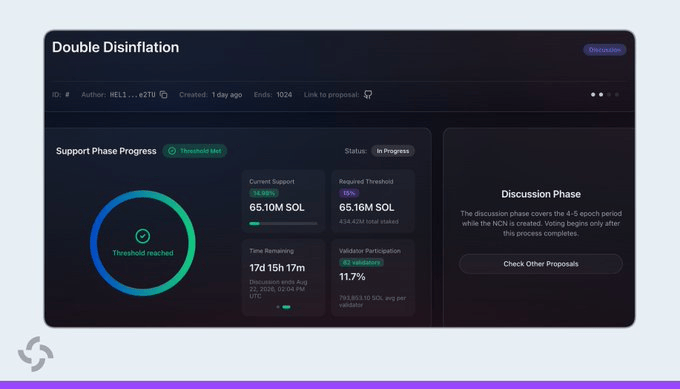
So, by 2032, this could significantly lower $SOL’s supply growth, reducing future inflation pressure. That said, the proposal still needs 15% stake support to advance to the final governance phase.
However, with this potential impact on $SOL’s supply dynamics, it’s no surprise that market participants expect the proposal to move forward smoothly.
As a result, the focus after the recent vote quickly moved beyond whether it will pass and toward how it could shape Solana’s [$SOL] outlook over the next six years. This has shifted attention toward $SOL’s technical strength and long-term market structure.
That said, some analysts believe the market may not wait six years to price in these changes.
The technical case for Solana after a major tokenomics shift
One question has caught the most attention: What happens to $SOL’s price if both proposals pass?
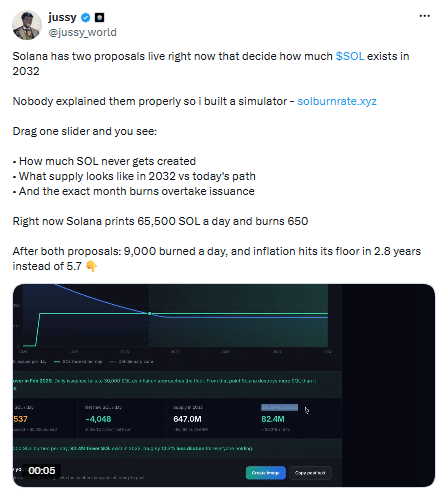
Solana currently has two active proposals that could shape how much $SOL enters circulation by 2032. This is where the discussion gets interesting.
Notably, the market is now looking at whether lower emissions and reduced supply growth could create a stronger long-term setup for $SOL.
One analyst highlighted that Solana currently issues around 65,500 $SOL per day while burning approximately 650 $SOL.
If both proposals pass, daily burns could rise to around 9,000 $SOL, while $SOL’s inflation could reach its minimum level in 2.8 years instead of 5.7 years. Put simply, Solana’s supply growth could slow much earlier than the six-year timeline suggests.
This is where the numbers start to matter.
Can lower supply push $SOL toward $100?
If Solana burns 9,000 $SOL per day, there could be 36.9 million fewer $SOL in circulation by 2032.
At the same market valuation, that alone could make each $SOL worth about 5.3% more. If daily burns increase to 27,000 $SOL, the potential upside rises to 11.7%. At Solana’s previous all-time high, that would translate to about $32 more per $SOL, assuming demand remains unchanged.
Looking at Solana’s fundamentals, this thesis doesn’t seem far-fetched. If anything, it puts even more focus on the upcoming governance vote as a potential catalyst.
A successful vote could strengthen the case for a solid Q4 rally, with a move back toward $100 becoming increasingly realistic.
Final Summary
- Solana’s burn proposal has advanced to the next voting stage. If approved, daily $SOL burns could jump from 650 to 9,000, strengthening its deflationary tokenomics.
- Analysts believe the reduced supply could become a key catalyst for $SOL, with the upcoming governance vote potentially setting the stage for a stronger Q4 rally.