
 ambcrypto.com

A malfunctioning trading bot briefly overwhelmed Lighter’s $HYPE and $ZEC markets, creating a rare stress test for the exchange’s infrastructure. Within five minutes, the bot executed $27 million in $HYPE trades, representing 74.2% of the total volume.
As buying intensified, the value of Hyperliquid [$HYPE] rose from $56.31 per token to $60.96, while on other exchanges it remained near $58. The bot then traded $220.8 million in Zcash [$ZEC], accounting for 86.7% of market activity.
The rapid action caused the price of $ZEC to rise from $478.00 to $521.00. Other coins did not see similar changes in price.

The two events illustrated how extreme order flow concentration may create short-term distortion in asset prices that is not reflective of real interest or demand for the asset. Worth noting, however, that both Hype and $ZEC returned to their normal pricing levels shortly after.
That rapid recovery confirmed healthy external price discovery. It also demonstrated how Lighter’s risk engine successfully isolated the disruption instead of allowing broader market contagion.
Lighter’s risk engine contained the disruption
The bot-driven price swings ultimately tested Lighter’s risk engine more than its markets. Although $HYPE had hit a high of $56.31 and a low of $60.96 at one point, there were no reported liquidations, which are used to limit damage during large price swings.
Thus, as opposed to using the last traded price of an asset for margin calls, Lighter employed a risk-resistant fair price value for calculating margins. This eliminated the possibility of healthy accounts being forced into liquidation due to temporary price spikes.
As a result, the incident remained isolated. It demonstrated that Lighter’s risk architecture can withstand severe order-flow disruptions without threatening broader market stability.
Liquidity providers captured the biggest gains
Although the bot lost $482,000, the losses largely became profits for liquidity providers and disciplined limit-order traders. The Lighter Liquidity Pool (LLP) earned roughly $143,000, making it the largest beneficiary of the event.
Meanwhile, the top independent trader captured nearly $38,000, while several others earned between $3,000 and $22,000. Overall, 40 unaffiliated accounts each generated more than $1,000 by filling resting limit orders.
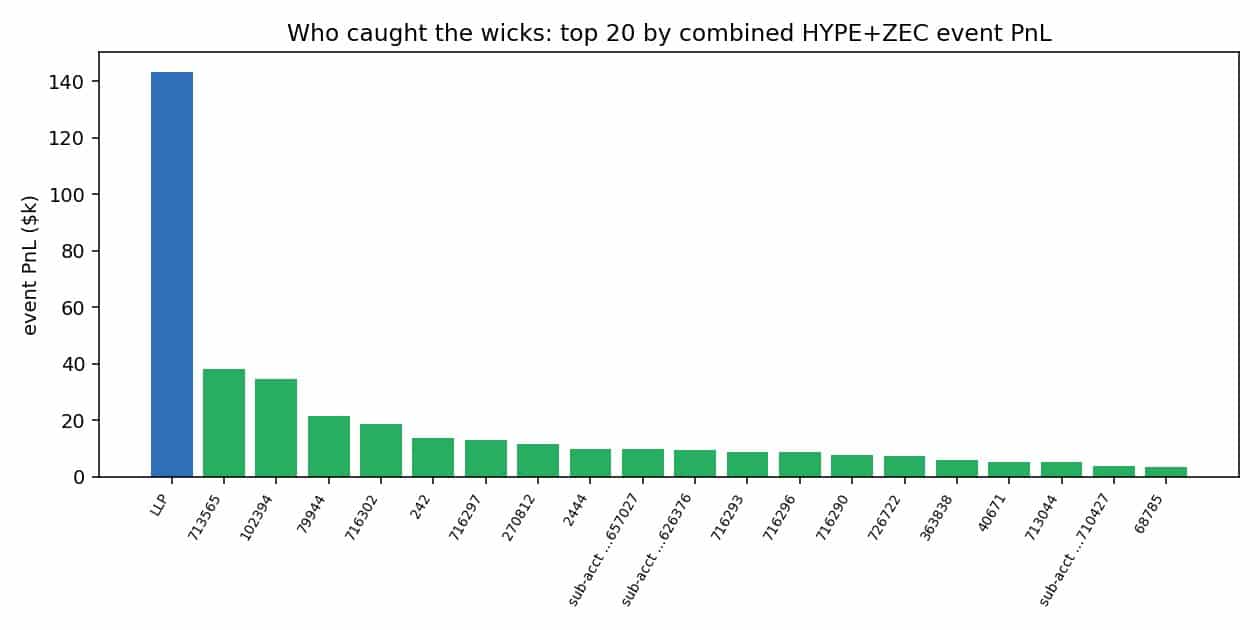
This distribution is evidence that liquidity providers benefited from temporary price dislocations, instead of suffering from them. Furthermore, a hike in the use of chase limit orders suggested that traders quickly adapted to the unusual volatility.
Put simply, the outcome simply reinforces that orderly market structure can redirect losses towards prepared participants rather than spreading systemic damage.
Final Summary
- Lighter [LIT] contained a bot-driven market disruption, preventing liquidations and limiting losses to the faulty trading account.
- Lighter’s risk controls redirected bot-driven losses to liquidity providers, reinforcing confidence in its market infrastructure.