Machine learning algorith sets XRP price for July 1, 2026
finbold.com
19 June 2026 16:25, UTC
$XRP price continues to decline, and Finbold’s AI Agent projects further downside for the cryptocurrency by the end of the month.
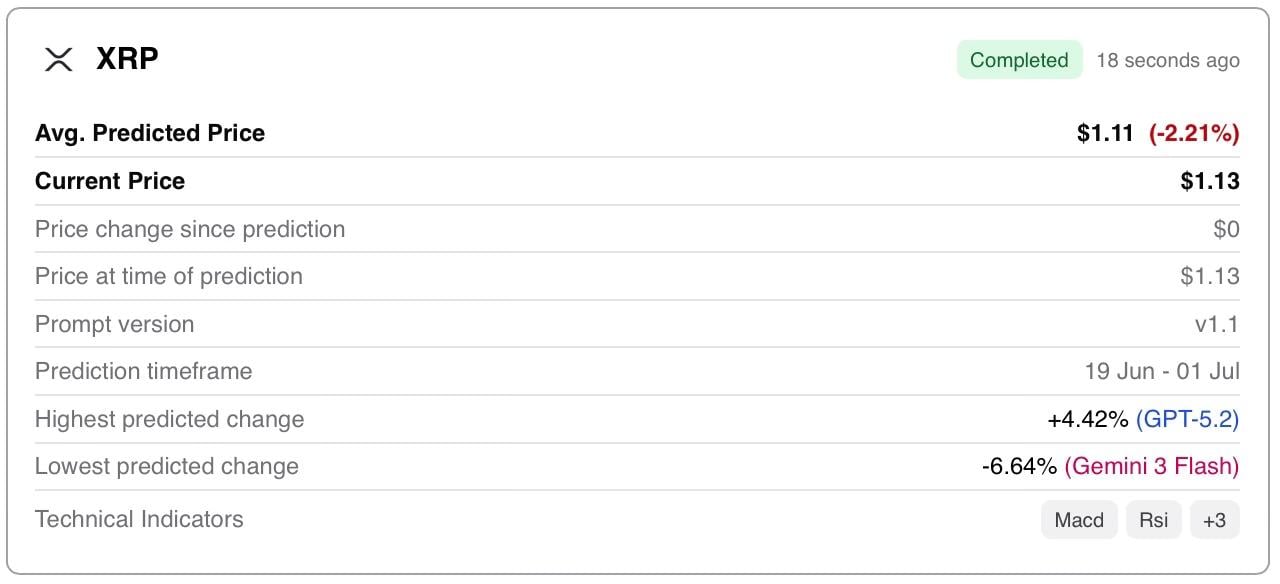
Namely, the machine learning algorithm estimates that $XRP is going to trade at $1.11 on July 1, 2026. With the asset changing hands at $1.13 at the time of publication, the prediction implies a 2.21% decline from the current price of $1.13.
$XRP price prediction for July 1. Source: Finbold
Know when your coins move
Alerts, real-time prices, and market news — all in one app
Point your phone camera to install
4.8 based on 40K reviews in the App Store and Google Play
AI sets $XRP price for July 1
The Finbold AI Agent leveraged three large language models (LLMs) to generate the price – Gemini 3 Flash, ChatGPT5.2, and Grok 4.1 – all of which used several technical indicators in their analysis, including the Moving Average Convergence Divergence (MACD), the Relative Strength Index (RSI), and the 50-day Simple Moving Average (SMA).
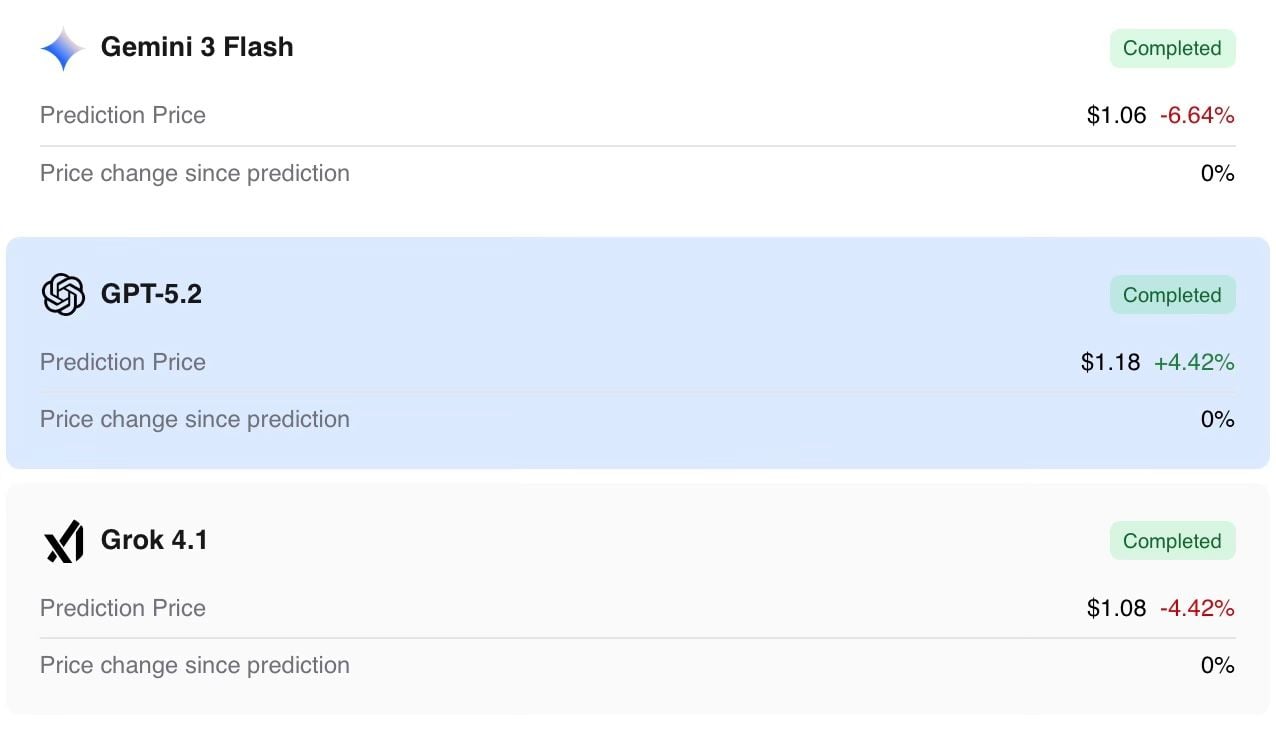
The highest $XRP price prediction for July 1, 2026, came from ChatGPT, which actually anticipates that the digital asset will climb back 4.42%, to $1.18. In complete contrast, Grok predicts a 4.42% downside and a price of $1.08.
The most bearish prediction, howeve, comes from Gemini, which sets the July 1 $XRP price target at $1.06, which implies another 6.64% correction over the next 11 days.
AI predicts $XRP price on July 1. Source: Finbold
Why is the AI $XRP July price forecast so bearish?
$XRP has fallen 3.33% over the past 24 hours to $1.13, underperforming a broadly weaker cryptocurrency market as $XRP network activity collapsed.
At the same time, wallets holding at least 1 million $XRP have sold more than 30 million tokens over the past five days, much of the supply being sent directly to exchanges.
What’s more, $XRP’s losses were amplified by a derivatives market shakeout. Namely, open interest in $XRP futures has dropped nearly 15% in the past 24 hours, triggering more than $6 million in long liquidations.
Overall, then, the negative AI $XRP forecasts largely reflect a combination of whale redistribution and weakening derivatives positioning.

 finbold.com