Are overvalued U.S. equities signaling the next crypto market risk? Assessing…
ambcrypto.com
08 May 2026 19:02, UTC
In terms of capital flows, crypto and equity markets continue to exhibit strong co-movement.
Following the Q1 correction, during which both equities and crypto posted notable losses, Q2 has opened with a clear rebound in risk appetite.
The S&P500 has gained over 12% and recently reached a new all-time high, while Bitcoin [BTC] has risen more than 16%, indicating a broad return to risk-on positioning.
Know when your coins move
Alerts, real-time prices, and market news — all in one app
4.8 based on 40K reviews in the App Store and Google Play
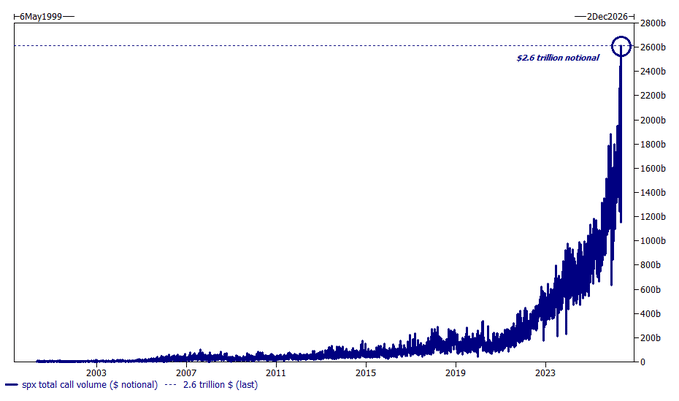
This, however, raises the question of whether accelerating capital inflows into risk assets are contributing to bubble-like conditions. As shown in the chart below, over $2.6 trillion in S&P500 call options were traded on the 6th of May, marking a new all-time high.
In addition, call options accounted for nearly 60% of all S&P500 options activity, the highest share observed in at least seven years.
Source: X
Together, this suggests elevated speculation and possibly stretched equity market conditions.
In fact, one analysis notes that U.S. equities are among the most expensive in 150 years of data. The P/E10 ratio is currently 37.9, the second-highest level on record, behind only the peak of 44.2 in March 2000.
In simple terms, current equity valuations are about 114% above their long-term average, a level historically followed by market pullbacks, a risk that broader markets now appear to be pricing in more explicitly.
This naturally shifts attention to the crypto market. So far, crypto has largely moved in tandem with equities, as capital has rotated across risk assets under similar liquidity and risk appetite conditions.
If equities experience a valuation unwind, could that downside pressure transmit into crypto through tighter liquidity and reduced risk exposure?
Fuel coincidence narrative?
On the technical front, crypto assets appear to have already begun following equities.
Following elevated options activity, the S&P500 closed the 7th of May session down 0.38%, aligning with Bitcoin’s 1.7% correction.
At the macro level, however, the correction remains relatively contained. The magnitude of the move is still modest, and it is too early to interpret it as a clear warning signal.
That said, on-chain data already points to early signs of weakening market conditions.
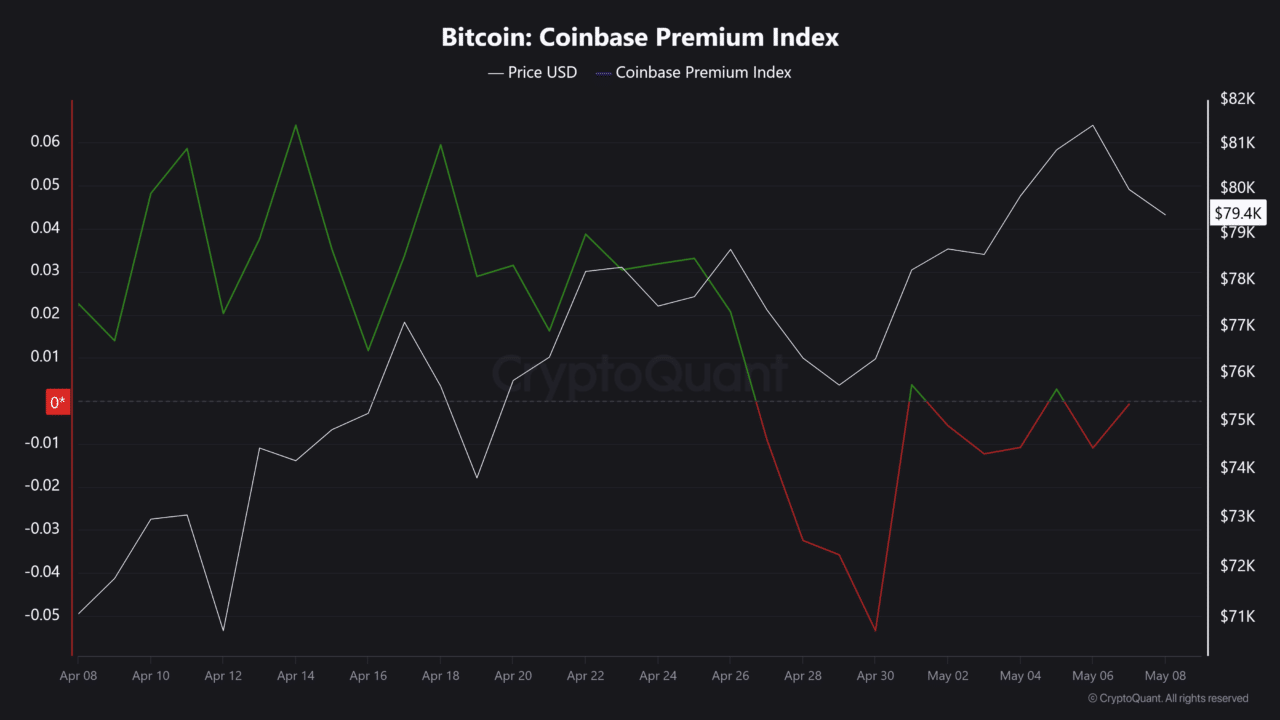
As the chart below shows, Bitcoin’s Coinbase Premium Index (CPI) has remained in negative territory for more than 10 straight days, signaling sustained selling pressure or weaker spot demand from U.S.-based institutional participants.
Source: CryptoQuant
In essence, the combination of stretched equity valuations and weakening U.S.-based crypto demand is unlikely to be a coincidence.
Instead, it suggests that institutional participants may already be reducing risk exposure, causing capital flows to turn increasingly defensive even as prices remain elevated.
From a technical standpoint, this shift increases the likelihood that broader risk assets are entering the late stage of a potential bubble cycle.
A correction, therefore, could spill into the crypto market, with this defensive positioning serving as an early warning signal of weakening risk appetite.
Final Summary
Stocks and crypto are moving together, supported by strong risk-on capital flows.
Weak Bitcoin demand signals rising caution, increasing the risk of a spillover if equities correct.

 ambcrypto.com