
 u.today
Technically and fundamentally, $XRP is in a weaker position than others, and the gap between it and the top three assets is not getting smaller.
Ethereum way too far
The market capitalization is still in the ~$80-85 billion range, far behind Ethereum and even further from Bitcoin, while the price is currently at $1.30, down on several time frames. Technically speaking, the chart displays a steady decline since late 2025. Key moving averages have not been reclaimed by $XRP, and it has been printing lower highs.
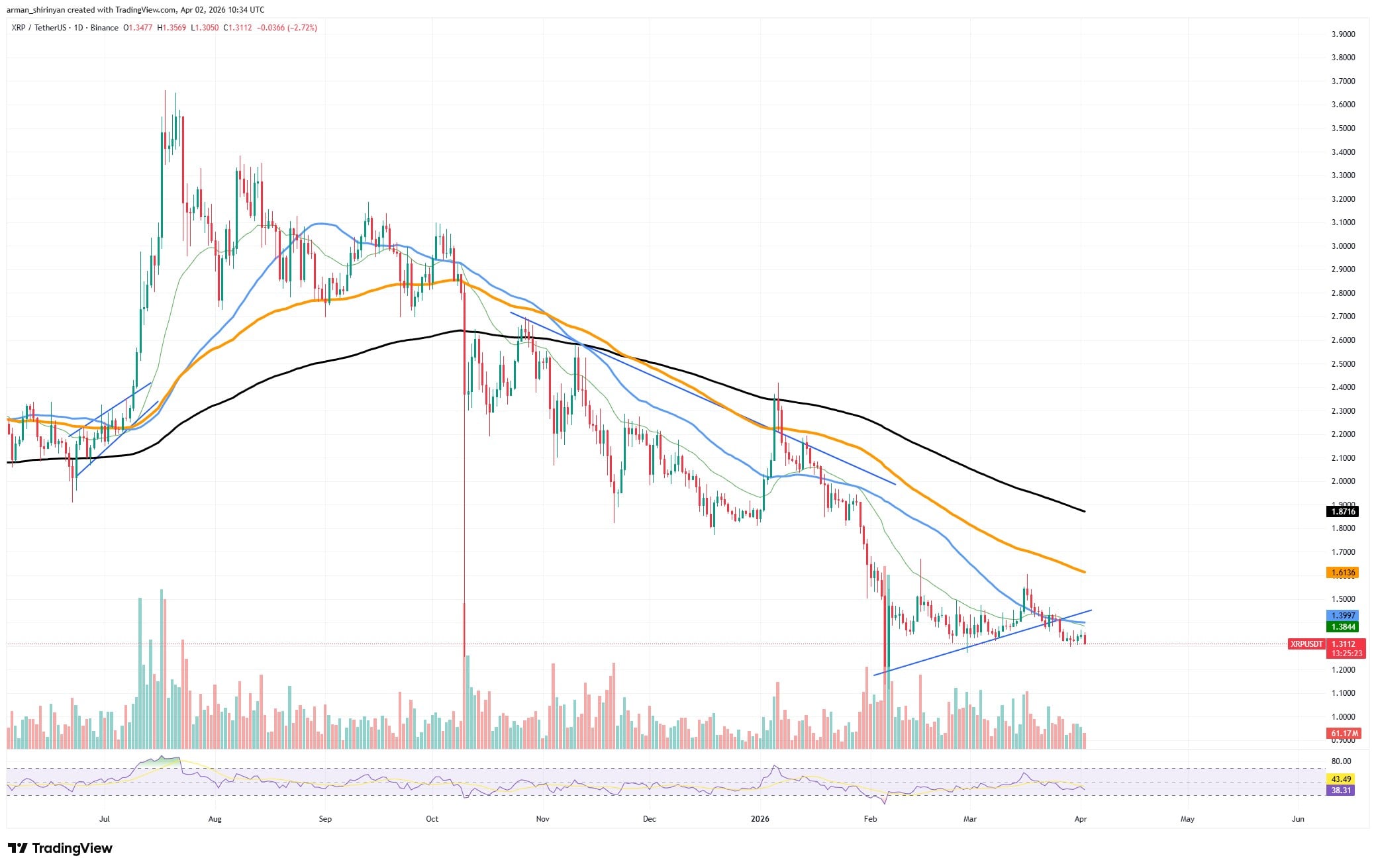
A breakdown from a short-term ascending structure followed the recent attempt to break upward, which was rejected around the $1.50 area. Now that the price is falling below local support, it appears to be continuing rather than reversing. There is no obvious accumulation signal, and momentum indicators are neutral to weak.
The structural problem is more significant. The amount of $XRP in circulation is currently over 60 billion tokens, and escrow releases are causing it to steadily rise. This restricts the potential for price expansion and generates ongoing sell-side pressure. $XRP needs much greater capital inflows to move significantly, in contrast to assets with tighter supply dynamics.
$XRP's capitalization unlikely to explode
The issue is brought to light by the prospect of $XRP’s market capitalization reaching $183 billion. That would necessitate more than doubling its valuation at current prices. Strong narrative dominance and consistent institutional inflows would be necessary for that kind of growth, neither of which are currently apparent.
When supply is taken into account, even more ambitious estimates like multitrillion valuations quickly become impractical. Even a $1 trillion valuation, for instance, would only place $XRP at about $16, assuming extremely high adoption rates.
A positioning issue also exists. A significant amount of the $XRP supply is currently underwater, according to data indicating that many holders are waiting to sell at breakeven points. Instead of encouraging rash moves, this produces overhead resistance that stifles rallies and strengthens grinding price action.
Relative performance is an additional component. The majority of capital flows and institutional interest are still drawn to Bitcoin and Ethereum, while stablecoins like $USDT control the liquidity infrastructure.