Funding rates reinforce that tone. Across exchanges, rates remain mildly positive, with recent readings around 0.0036. Translation: long positions still pay shorts, but not aggressively. Earlier in March, funding briefly flipped negative below -0.01, hinting at short-term bearish pressure that now fades.
This back-and-forth in funding reflects a market that struggles to pick a direction. Bulls remain active, but they are no longer chasing momentum. Traders probe both sides, with sentiment shifting between cautious optimism and defensive positioning.
Order flow metrics echo that indecision. The taker buy-sell ratio sits near 0.91, meaning sell-side aggression slightly outweighs buying pressure. That does not signal panic, but it does show buyers are less aggressive than during $XRP’s earlier run toward the $3 range.
Zooming out, $XRP’s price cools alongside derivatives activity. Open interest peaks near $10 billion during prior highs but now retreats toward the mid-$2 billion range. The contraction shows capital stepping aside, reducing the chances of extreme volatility in the near term.
Still, the distribution of that open interest tells a layered story. CME leads with roughly $658.9 million, accounting for about 23.99% of total exposure, followed by Binance at $507.4 million. Other venues like Bybit, OKX and Gate continue to hold meaningful shares, while CME’s lead highlights steady institutional involvement.
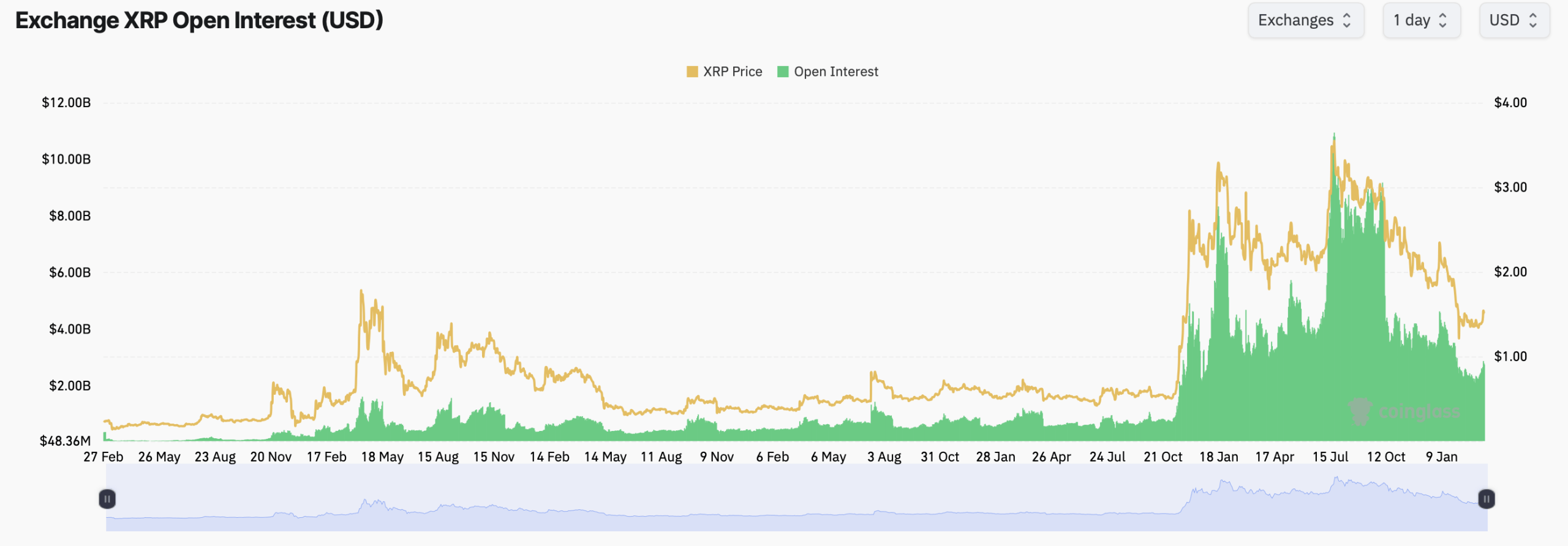
$XRP futures open interest on March 18, 2026. Image source: Coinglass.com
Short-term flows lean slightly negative. Aggregate open interest drops 3.04% over the past 24 hours, with Binance down 4.64% and Kucoin off 5.71%. At the same time, MEXC records a 13.65% increase, showing that speculative pockets still emerge even as broader positioning softens.
Options markets add another layer. Calls dominate positioning, accounting for roughly 77.37% of open interest versus 22.63% for puts. In notional terms, call exposure sits near 206,237.96 $USDT, compared with 60,326.50 $USDT in puts—clear upside bias.
Volume follows a similar pattern. Over the past 24 hours, calls make up 64.72% of traded contracts, while puts account for 35.28%. Traders continue to favor upside exposure, even as futures positioning cools—a sign of hedging downside while keeping bullish bets alive.
Among the most active contracts, the $XRP-260320-1.6-C leads both open interest and volume, placing the spotlight on the $1.60 strike. Nearby strikes at $1.55 and $1.70 also draw attention, suggesting traders focus on near-term levels rather than distant price targets.
Mid-week data shows $XRP’s derivatives market sits in a transitional phase. Leverage trims, funding stabilizes and open interest resets—but options traders remain quietly bullish. It is less of a frenzy and more of a calculated setup, with participants waiting for the next decisive move.
FAQ 🔎
-
What does $XRP’s falling leverage ratio mean?It shows traders reduce borrowed exposure, lowering overall risk in futures markets.
-
Are $XRP funding rates bullish or bearish?They remain slightly positive, indicating mild bullish sentiment without aggressive positioning.
-
Why do options show more calls than puts?Traders position for upside while managing downside risk.
-
What is the key $XRP price level traders are watching?The $1.60 strike stands out as the most active near-term options level.

 news.bitcoin.com