After spending most of the weeks following the late January bloodbath at depressed values, the total valuation of digital assets rocketed nearly $250 billion from the March 8 and 9 lows at $2.25 trillion to the press time levels at $2.49 trillion.
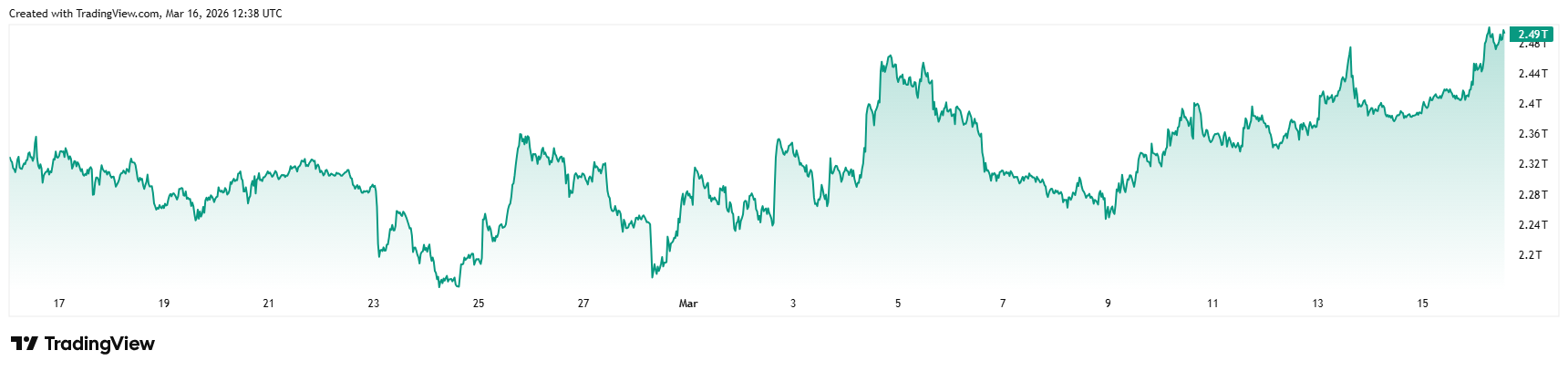
Within the same timeframe, $XLM’s market capitalization soared from $4.94 billion to $5.66 billion.
What is next for $XLM price?
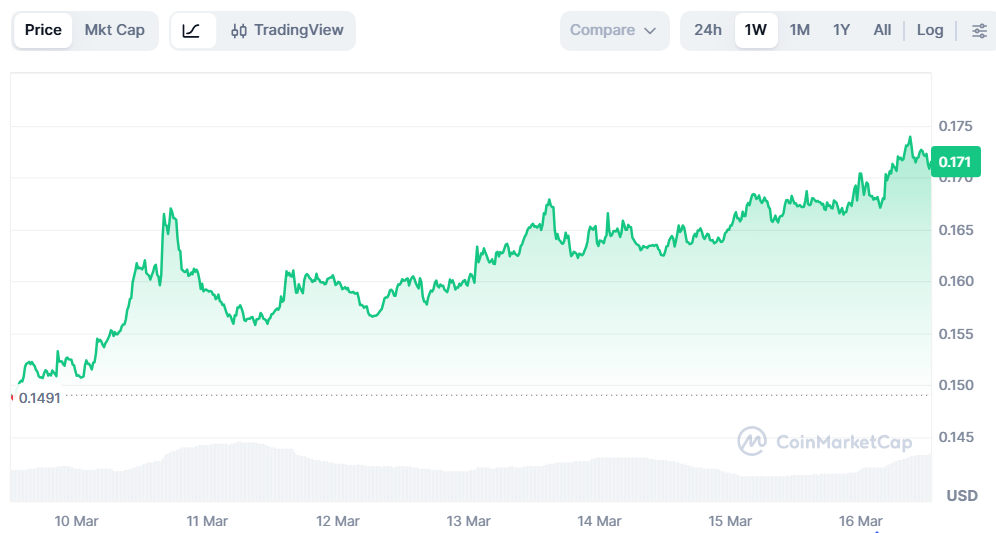
Looking ahead, Stellar appears relatively safe from a substantial crash as it is trading far closer to its next resistance at $0.1734 than to its nearest support of $0.1659, and it, in fact, recently broke above its previous closest barrier at $0.1711.
$XLM’s relative strength index (RSI), which, at press time on March 16, stands at 58.17, also indicates that the price is unlikely to collapse, though the reading isn’t an outright bullish indicator given that it hints at the cryptocurrency being neither overbought nor oversold.
Still, despite the generally promising technical analysis (TA), Stellar’s historical patterns mean that the digital asset’s future is most likely to depend on the performance of its biggest rival, $XRP.
Fortunately, the bigger token is, at press time, trading with relative stability following the latest, limited correction, and appears to be tracing Bitcoin (BTC) – the traditional market leader – which, following a brief period of uncertainty, again appears to be rising in the daily chart.
Featured image via Shutterstock

 finbold.com