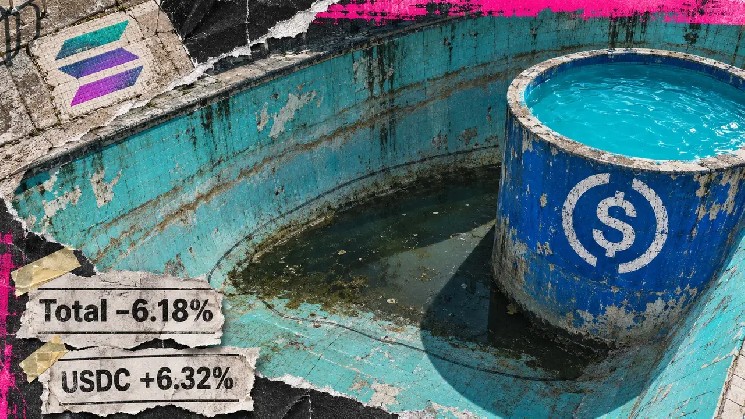
The approximate dollar changes are back-calculated from rounded current market caps and reported 30-day percentages. They measure shifts in tracked value, rather than identified cash withdrawals or deposits.
The contraction extended beyond $USDT. USD1, the World Liberty Financial stablecoin, was down 26.0% to $1.046 billion, implying an approximately $368 million decline. USDGO fell 15.5% to $1.064 billion, or roughly $195 million on the same calculation.
Global Dollar, or $USDG, declined 26.0%, while Ethena's $USDe fell 40.2%. Their estimated reductions were about $156 million and $187 million, respectively. Together, these large declining balances explain why $USDC's expansion could coexist with a smaller chain-wide total. The percentage fall alone does not show an asset's contribution: $USDe's steeper contraction represented a smaller dollar change than $USDT's.
$USDC also was not the only large stablecoin growing on Solana. PayPal USD rose 14% to $782.99 million over the displayed 30-day window, implying an increase of about $96 million. The issuer breakdown shows both expansion and retreat within the same network.
Solana's $USDC growth also contrasts with the same asset elsewhere. On DefiLlama's Ethereum dashboard, $USDC stood at $41.386 billion, down 7.6% over the displayed 30-day period. The global table showed $69.2 billion, down 4.9%.
These Nov. 14 comparisons use the provider's displayed 30-day windows, rather than independently matched blockchain endpoints. They show where tracked balances changed, without identifying the transactions behind those changes.
The result supports a narrower conclusion than a uniform retreat from $USDC: its tracked balance expanded on Solana while declining on Ethereum and globally. Opposite changes alone do not establish that Ethereum holders moved those funds directly to Solana.
That distinction adds to CryptoSlate's Nov. 11 Solana coverage, which examined concentrated derivatives turnover and aggregate stablecoin contraction using Nov. 10 observations. The current issuer split shows what the chain-wide figure conceals.
What the balances measure
DefiLlama's definition measures circulating stablecoins multiplied by price, excluding burned and non-issued tokens. Chain totals include assets issued or bridged onto the network. These figures therefore differ from a native-only token count or the reserve assets held by an issuer.
DefiLlama's $USDC tracking code distinguishes locally issued tokens, tokens held back from circulation and bridged assets on Solana. The dashboard total does not reveal which component explains the 30-day increase.
Circle's Cross-Chain Transfer Protocol illustrates why a chain-level increase need not mean new cash entered the system. CCTP moves $USDC through burn-and-mint transfers between blockchains without traditional bridge liquidity pools. That is a possible mechanism for relocating existing $USDC, not evidence that CCTP caused the increase measured here.
Treasury inventory introduces another distinction. Tether says authorized but unissued tokens remain outside circulating market capitalization, and redeemed tokens can stay in treasury rather than being burned. A mint or burn count alone would not reconcile the change in circulating balances.
Solana consequently has a smaller tracked stablecoin base with a different composition. $USDC's expansion cushions the overall decline, without reversing it. That is evidence of an uneven contraction across stablecoins; the balance data alone cannot show fresh SOL buying or deeper trading liquidity.

 cryptoslate.com