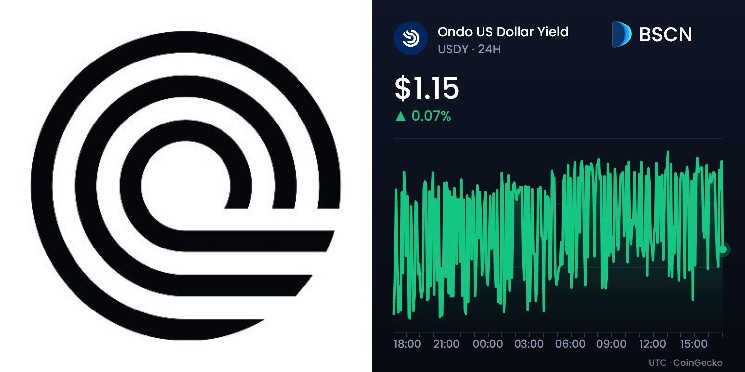
Until now, the product's yield was reflected in a daily price step. Ondo's own product page describes $USDY as accruing yield daily, whether a holder is staking, borrowing, pledging or simply holding. Moving to continuous pricing removes the gap between daily updates, so the token's value tracks accrued interest more closely.
The change affects pricing and timing rather than the underlying assets. $USDY is a tokenized note. According to Ondo's launch announcement, it is secured by short-term US Treasuries and bank demand deposits. Holders have economic exposure to Treasuries but do not own the securities directly.
Who Can Hold $USDY
$USDY is not open to everyone. Ondo says the product is offered under Regulation S, an exemption that requires it to be sold only to non-US individuals and entities. Data provider RWA.xyz lists $USDY as a tokenized note for non-US individuals and institutions.
Access can be narrower still in some markets. A guide from Altstreet Investments says $USDY is closed to US persons, Canada and sanctioned jurisdictions, and limited to professional or qualified investors in places such as the EEA, the UK and Switzerland. Prospective buyers should check their own eligibility.
Tokenized Treasuries have become a growing part of onchain finance, and $USDY is among the larger products in the category. Third-party data cited by the explainer site whatisondo.com put $USDY at about $2.32 billion in October 2026, based on Ondo and RWA.xyz figures. The yield comes from interest on short-term US government debt, minus fees, so it moves with US interest rates.
Continuous pricing does not change that link. It changes how quickly the token's price reflects interest as it builds up.

 bsc.news