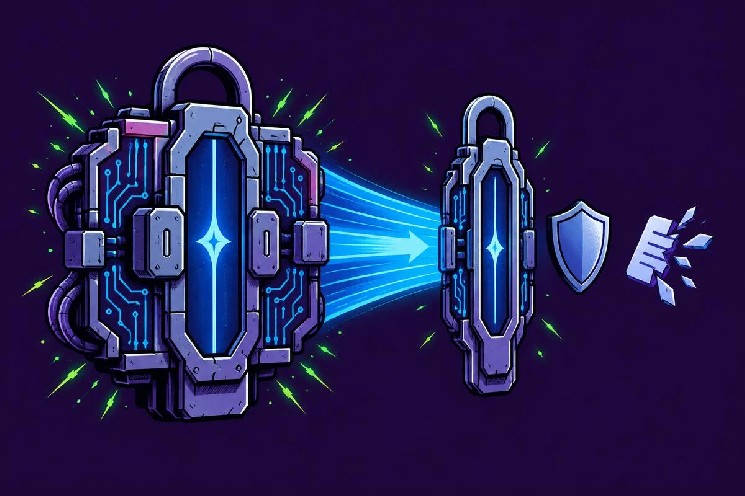
OpenZeppelin supplied the starting verifier, which required 48.4 million gas for each verification. The leading implementation brought that requirement down to approximately 25.9 million gas.
Participants and their AI agents set 434 records during the challenge, with AI playing a significant role in the results. Each submission is checked, and its producer receives public credit.
Where quantum-safe blockchain transactions fit into Starknet
Starknet is an Ethereum layer-2 scaling network that uses advanced cryptographic proofs. Its quantum-security initiative aims to strengthen blockchain transactions against emerging threats from quantum computing.
The work addresses two different parts of transaction security. StarkWare points to Starknet’s STARK-proof architecture as the basis for its quantum-resistance claims. Those proofs secure how the network proves computation, while user accounts still require signatures, the function addressed by Falcon-512.
Making those signature checks cheaper is the specific target of the contest. Its benchmark concerns verification within Starknet, rather than the cost of every operation involved in quantum-safe blockchain transactions.
The $0.023 benchmark is not a fixed transfer fee
The approximately $0.023 figure translates the leading verifier’s gas consumption into dollars at recent $STRK token prices. Its dollar value changes as $STRK’s price moves.
This difference is also relevant when the outcome is set against Starknet’s prior Falcon-512 test. Back in July 2026, executing a mainnet transfer with a Falcon-512 account cost roughly $0.06. The July amount covered a full account transfer; the October benchmark covers only the signature-verification step.
Article produced with the assistance of artificial intelligence and reviewed by the editorial team.

 en.cryptonomist.ch