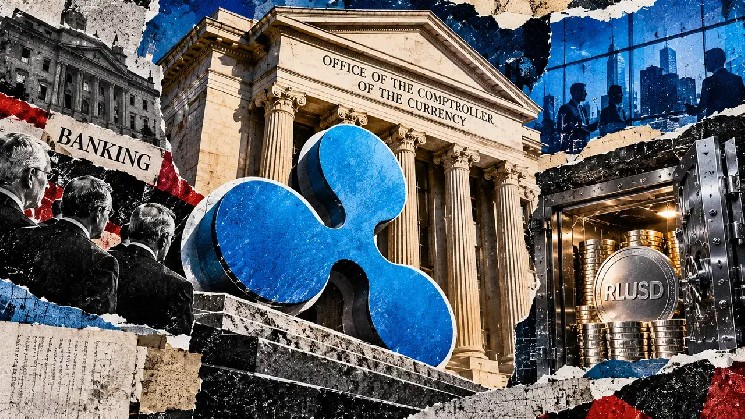
“We’ve spent over a decade building regulated financial infrastructure that institutions can actually use at scale. A national trust charter gives us an even stronger foundation for $RLUSD and the institutional products we’re building across payments, custody and capital markets.”
However, the implications for $XRP remain less straightforward, with the bank's immediate responsibilities centered on stablecoin reserves and custody rather than the token itself.
Ripple overcomes opposition from traditional banking groups
The approval follows a prolonged dispute over whether crypto companies should be permitted to establish federally chartered trust banks without meeting all the requirements imposed on conventional lenders.
In July 2025, the American Bankers Association (ABA) and four other banking and credit union groups urged the OCC to postpone applications involving Ripple and several other digital asset firms.
The organizations questioned whether their proposed activities qualified as traditional fiduciary services and argued that approving the charters could represent a significant departure from established banking practices.
The Independent Community Bankers of America (ICBA) subsequently opposed Ripple's application directly, warning that allowing nontraditional companies to provide deposit-like services without equivalent regulatory safeguards could threaten financial stability.
Despite those objections, the OCC granted Ripple conditional approval in December 2025 before completing the chartering process this week.
Ripple Chief Legal Officer Stuart Alderoty portrayed the decision as validation of the company's longstanding regulatory approach. He said:
“Final OCC approval for Ripple National Trust Bank is the result of a simple choice we made years ago: build within the regulatory perimeter, not around it.”
The charter nevertheless comes with restrictions. Ripple National Trust Bank will not operate as a conventional commercial lender offering ordinary deposit accounts or loans.
Instead, it will oversee segregated $RLUSD reserves and act as collateral trustee for token holders.
$RLUSD issuance will remain with Standard Custody & Trust Company, Ripple's subsidiary regulated by the New York Department of Financial Services. BNY will also remain the stablecoin's primary reserve custodian.
Institutional expansion raises questions over $XRP demand
The banking approval comes as Ripple builds a broader financial services business around its stablecoin, custody infrastructure and institutional trading operations.
On Oct. 12, Standard Chartered launched institutional custody for $RLUSD on the $XRP Ledger for eligible clients through its DFSA-regulated DIFC branch. The bank also announced plans to work with Ripple and LMAX Group to enable the stablecoin's use as trading collateral.
The proposed arrangement would allow institutions to deploy $RLUSD-backed collateral on LMAX's trading platforms while keeping the underlying assets in Standard Chartered's custody, reducing the need to transfer funds between counterparties. The planned integration remains subject to documentation, testing and applicable approvals.
Three days later, Ripple Prime expanded into real-world asset perpetual swaps, allowing institutional clients to trade products linked to equities, commodities and currencies around the clock, with $RLUSD available as collateral where permitted by jurisdiction.
$XRP is used to pay transaction fees and can facilitate transfers between different currencies on the network. Increased $RLUSD settlement on the ledger could therefore generate additional $XRP-related activity, particularly where institutions use it as a bridge asset.
Yet $RLUSD also operates on Ethereum, where transactions do not require $XRP. Even on the $XRP Ledger, institutions can transfer $RLUSD directly without converting the stablecoin into $XRP, although $XRP is needed for network fees and account reserves.
This distinction means that Ripple's custody and stablecoin operations can grow without requiring institutions to accumulate $XRP in proportion to the value of assets they manage or transfer.

 cryptoslate.com