Crypto investors can assess income-generating protocols by comparing earnings and distributions with market capitalization while accounting for supply inflation, Grayscale stated. Zach Pandl, head of research at the digital asset manager, outlined the framework in Grayscale’s earnings-based valuation approach, published Oct. 21.
Trading, lending, and other financial activities generate fees for onchain applications, with payments to liquidity providers, lenders, and other suppliers representing costs. Subtracting those expenses leaves earnings that can be compared across protocols. Pandl wrote:
“Crypto valuations don’t have to rely on narratives alone.”
Know when your coins move
Alerts, real-time prices, and market news — all in one app
Point your phone camera to install
4.8 based on 40K reviews in the App Store and Google Play
Tokenholder yield adds staking rewards and buybacks, subtracts issuance, and divides the result by circulating market capitalization. Adjusted earnings yield divides total earnings by that same market value, then subtracts circulating supply inflation. Together, the measures distinguish the income an application produces from the economic benefit attributable to its holders.
Buybacks and Staking Interact With Supply Growth
Buybacks, token burns, and staking distributions return value through different mechanisms, while issuance and unlocks can offset their benefits. Hyperliquid’s revenue-funded $HYPE buybacks illustrate how trading activity funds repurchases. The amount available for those purchases depends on the fees the exchange collects, connecting capital returns with its operations.
Supply changes also distinguish repurchases from permanent destruction: Grayscale describes buybacks as reducing circulating supply, while burns reduce total supply. Its framework assesses those mechanisms alongside new tokens entering circulation.
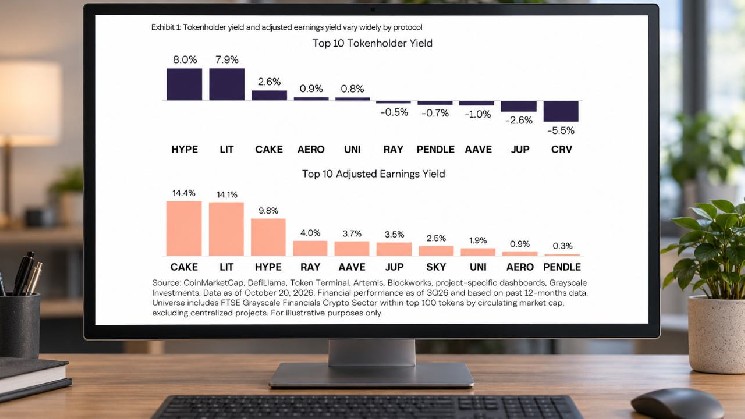
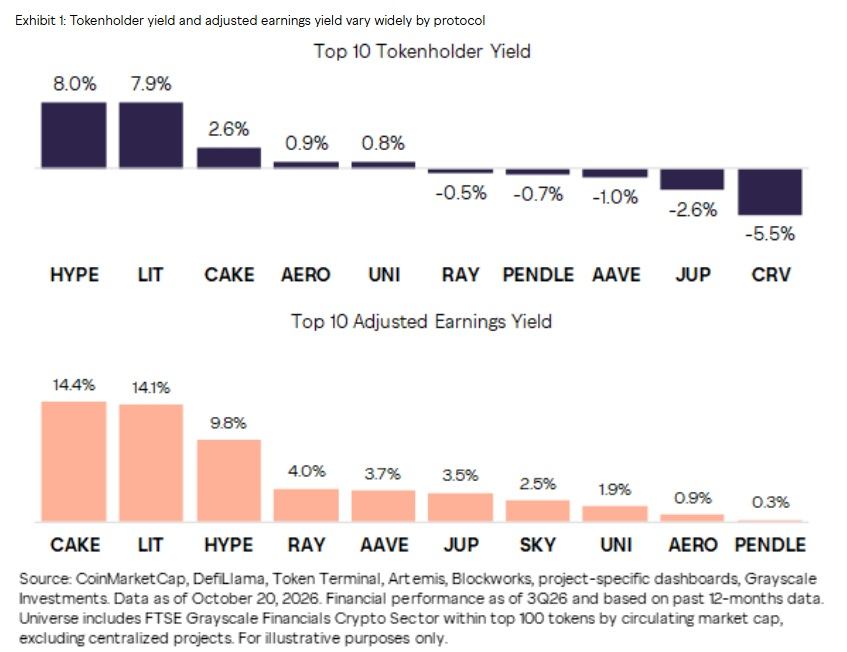
Grayscale’s charts cover tokens in the FTSE Grayscale Financials Crypto Sector that rank within the top 100 by circulating market cap, excluding centralized projects. Among the 10 protocols shown for each measure, $HYPE led tokenholder yield at 8.0% and CRV ranked last at -5.5%, while CAKE topped adjusted earnings yield at 14.4%, using data as of Oct. 20.
Tokenholder and adjusted earnings yields by protocol, past 12 months. Source: Grayscale Investments. Data as of Oct. 20.
Crypto staking rewards compensate participants who commit assets to support a network or protocol. Those distributions enter Grayscale’s tokenholder yield calculation alongside buybacks. Subtracting issuance accounts for the supply created during the period, making the distribution rate one component of the assessment.
Ethereum validators earn rewards for participating in network consensus, including proposing blocks and checking other validators’ work. This illustrates the activity behind staking payouts. The network also imposes penalties for missed duties and slashing for specified misconduct, linking compensation to participants’ performance.
Bitcoin’s Monetary Role Calls for a Separate Approach
Bitcoin receives different treatment in Pandl’s analysis as a digital commodity and decentralized alternative to fiat currencies. Grayscale argues it should be valued as digital gold. Its bitcoin valuation indicators have drawn on blockchain activity and historical benchmarks.
Monetary assets can also be assessed through comparisons within their category, as Grayscale demonstrated in its relative valuations of XRP and Zcash. That analysis compared market capitalizations with bitcoin using 30-day averages, examining their relative scale within the firm’s digital currency sector.

 news.bitcoin.com