en
Back to the list

Polygon Shatters $3 Trillion Stablecoin Milestone After Year of Bold Upgrades

source-logo  crypto-economy.com 3 h
image
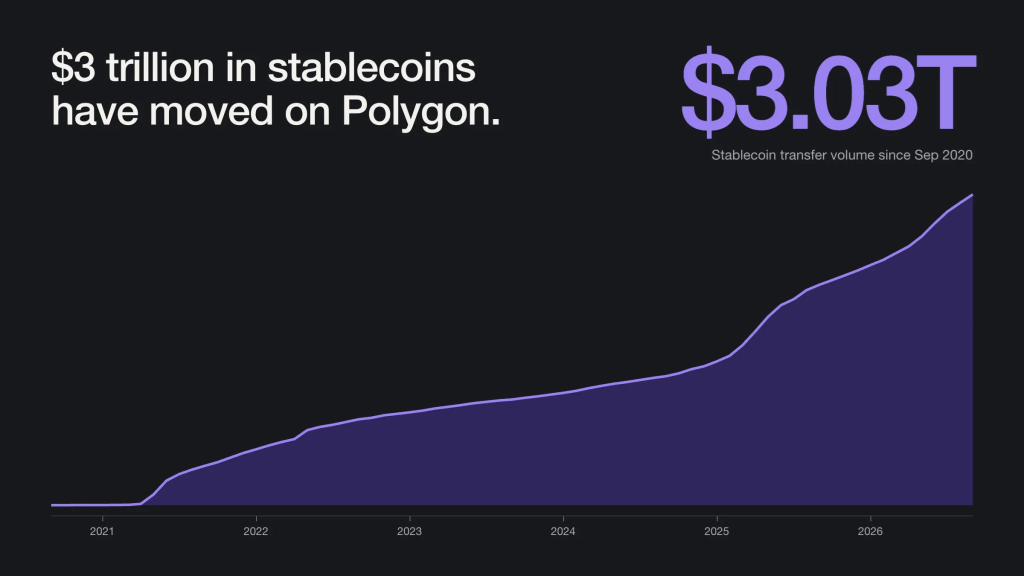
  • Polygon surpassed $3 trillion in cumulative stablecoin transfer volume since September 2020, recording $933 billion in 2025 alone.
  • Companies like Revolut, Mastercard, PayPal, and Cash App used the network for payments. Activity grew 32% year-over-year in 2026.
  • The Ithaca upgrade, capacity increase to 5,000 transactions per second, and the launch of Open Money Stack strengthened the infrastructure.

Polygon surpassed $3 trillion in cumulative stablecoin transfer volume since September 2020, according to data published by the network’s own team. This milestone comes alongside a year of sustained technical improvements and notable expansion in adoption by payments companies.

Volume did not grow evenly over the years. In 2025, $933 billion in stablecoin transfers were recorded, compared to $276 billion the previous year. So far in 2026, another $741 billion has moved through the network. Altogether, more than half of the historical total was processed since January 2025, reflecting a significant acceleration in the use of the network as payments infrastructure.


More Than Just News
Content, live market tracking, portfolio management, and price alerts — everything you need in the Crypto News app.
Download now, stay on top of the crypto market, and take control of your information.

Polygon: Payment Rails Across the World

Among the companies that operated on the network during this period is Revolut, which moved $810 million in stablecoins on Polygon in 2025 and began issuing its first euro stablecoin, EURR, in August of that year.

PayPal began native issuance of PayPal USD on the network during the northern hemisphere summer, while Mastercard selected Polygon as one of its extended settlement rails, covering weekends and public holidays. Stable.com, for its part, offers support for users holding USDT and PYUSD to initiate bank transfers directly from their wallet.

An Infrastructure Built for Scale

The volume growth was backed by significant network improvements. In February, the chain’s overall capacity was expanded. In June, an upgrade raised that limit to 5,000 transactions per second and introduced changes to the fee mechanism to make costs more predictable.

In July, the Ithaca upgrade added automatic recovery in the event of a block producer failure and protections against transactions that could slow down the network.

Internal tests also demonstrated the ability to process more than 11 million verified payments per second through agent payment channels, with final on-chain settlement in batches. In September, the community also completed a burn of 100 million POL tokens sourced from accumulated base fees.

On the complementary infrastructure front, the team announced in January the acquisitions of Coinme and Sequence, which provide regulated access to fiat in the United States, wallet infrastructure, and cross-chain routing. The resulting stack, called Polygon Open Money Stack, completed a SOC 2 Type 1 audit in September and entered a technical preview phase.

crypto-economy.com