
 thecryptobasic.com
The $XRP Ledger (XRPL) saw a major change in trading activity in the second quarter of 2026 alongside $RLUSD.
Trading became more concentrated among fewer accounts, while $RLUSD balances on the network increased sharply, according to a report from Evernorth, the largest public $XRP treasury company.
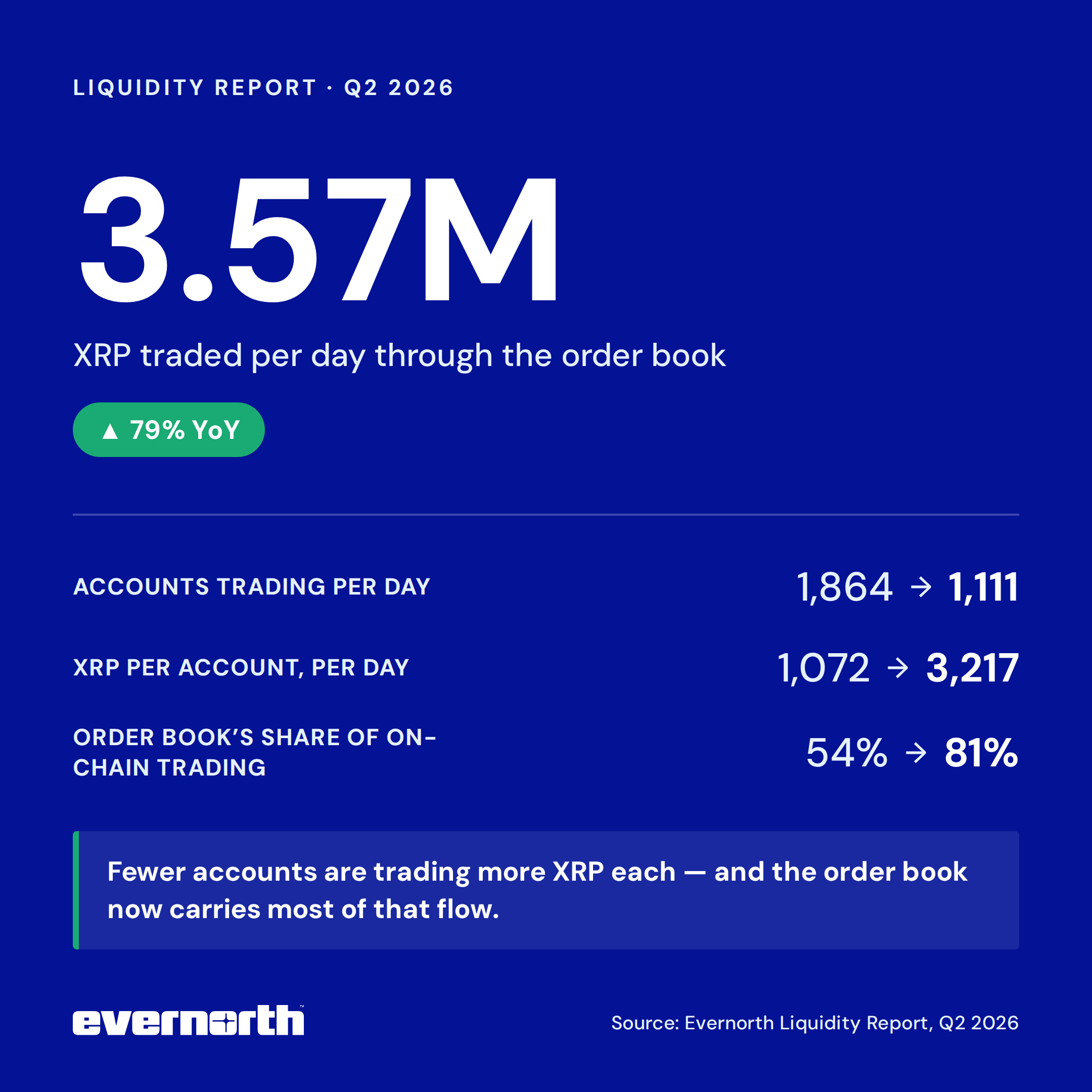
Evernorth’s Q2 2026 $XRP Liquidity Report found that order-book trading averaged 3.57 million $XRP per day, up 79% from the same period last year. However, the number of accounts making these trades fell from 1,864 to 1,111 per day.
As a result, the average daily trading volume per account nearly tripled, increasing from 1,072 $XRP to 3,217 $XRP. Order-book trading also made up 81% of all decentralized exchange (DEX) trading on XRPL, compared with 54% in Q2 2025.
$XRP Trading Becomes More Concentrated
$XRP trading on the XRPL became more concentrated in Q2 2026, with fewer accounts handling more $XRP.
Fewer accounts traded on the order book, but those that remained traded much larger amounts. Evernorth said this could mean that professional and institutional traders are becoming a bigger part of the market.
Overall DEX trading averaged 4.42 million $XRP per day in Q2, up about 20% from the same period last year. However, trading was 16% lower than in Q1, when activity was unusually high because of strong trading in February.
This change comes as the XRPL adds more tools for institutional and advanced traders. Permissioned domains and trading venues launched in February, along with other network upgrades.
$RLUSD Supply on XRPL Surges
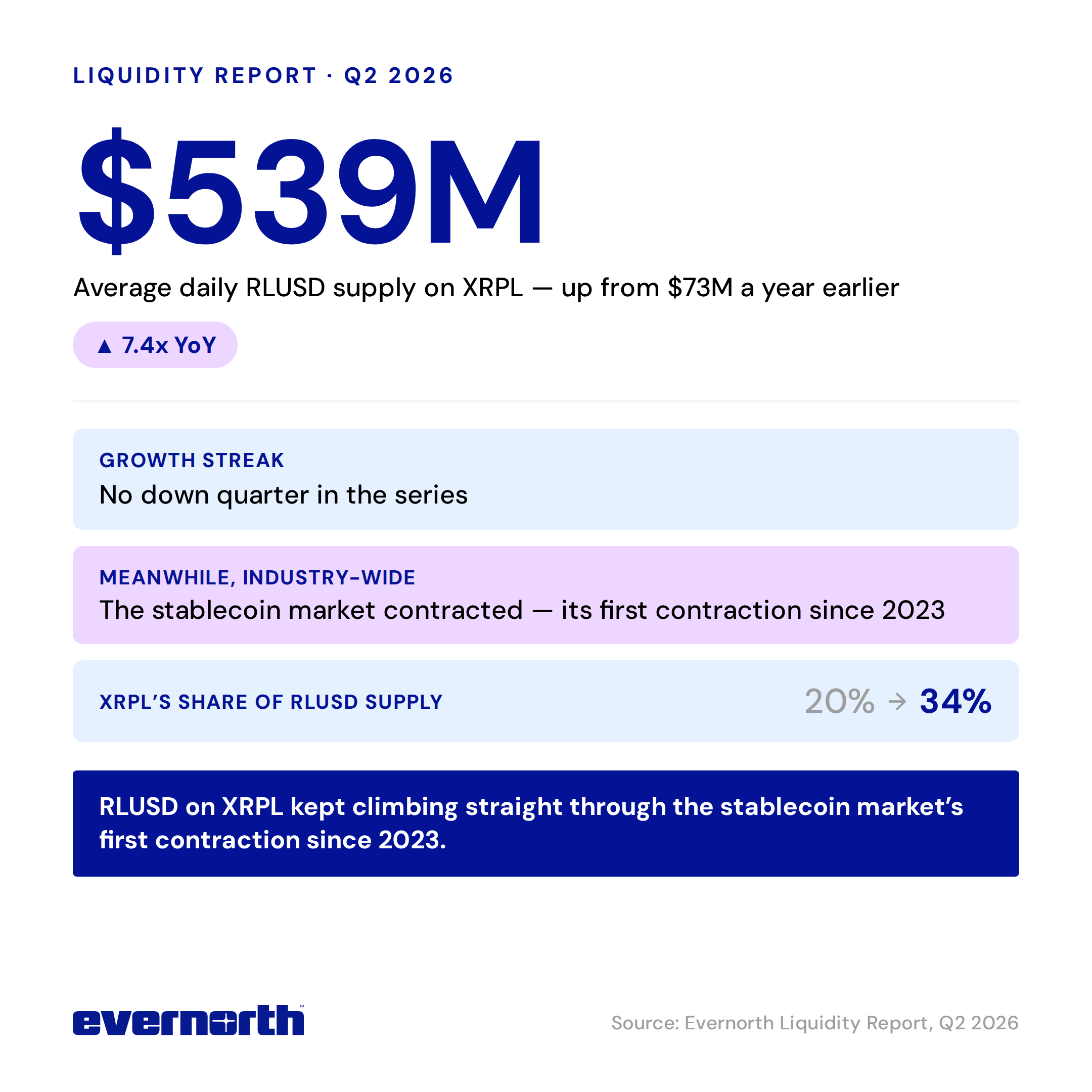
Meanwhile, $RLUSD liquidity on the $XRP Ledger grew sharply in Q2 2026. $RLUSD balances averaged $539 million during the quarter, up from just $73 million a year earlier. That’s a 642% increase. Evernorth also said the figure has increased every quarter since it began tracking it.
The amount of $RLUSD transferred also jumped, rising 925% year over year. This growth happened even as the overall stablecoin market shrank for the first time since 2023.
As a result, the $XRP Ledger’s share of total $RLUSD supply grew from 20% to 34%.
Evernorth said that having more stablecoins on the network could help support larger payments and more tokenized-asset transactions.
$RLUSD also expanded to more networks during the quarter. On June 4, Ripple’s stablecoin became available across several additional blockchains, including Base, Optimism, Ink, Unichain and the XRPL EVM sidechain, as well as XRPL and Ethereum.
Retail Activity Falls Across Crypto
Retail activity on the $XRP Ledger (XRPL) weakened in Q2 2026, even as liquidity grew in other areas. The XRPL averaged 16,587 active accounts per day, while new accounts averaged 2,783 per day. Both numbers were about 25% lower than a year earlier.
This decline was part of a wider trend. Across the crypto market, on-chain exchange trading fell 46% year over year, while transaction fees on seven major blockchains dropped 38%.
Evernorth said account numbers are a good measure of retail activity, suggesting that fewer retail users were active across the market—not just on XRPL.
However, the total value held on the $XRP Ledger continued to grow. It averaged $4.26 billion in Q2, the highest level in the six-quarter period studied. Network value increased every quarter, rising from $99 million at the start of the period.
XRPL Infrastructure Continues to Improve
Several technical upgrades also took place during Q2. In May, the XRPL EVM sidechain released version 9.0.0, moving to newer and better-supported software and adding updated Ethereum standards.
Another upgrade, called fixCleanup3_1_3, also went live in May. It improved multi-purpose tokens and permissioned domains. Validators were also reviewing new vault and lending features.
Meanwhile, U.S. spot $XRP ETFs brought in $273 million during Q2, with investors adding money in every month.
Overall, the data shows an interesting shift in the $XRP ecosystem: fewer retail users were active, but the users who remained traded more and more money flowed through the network.
In simple terms, XRPL activity became smaller in participation but deeper in capital and trading volume.