
 u.today
Fintech entrepreneur Emi Yoshikawa commented on plans by a consortium of 21 banks to launch its own U.S. dollar stablecoin.
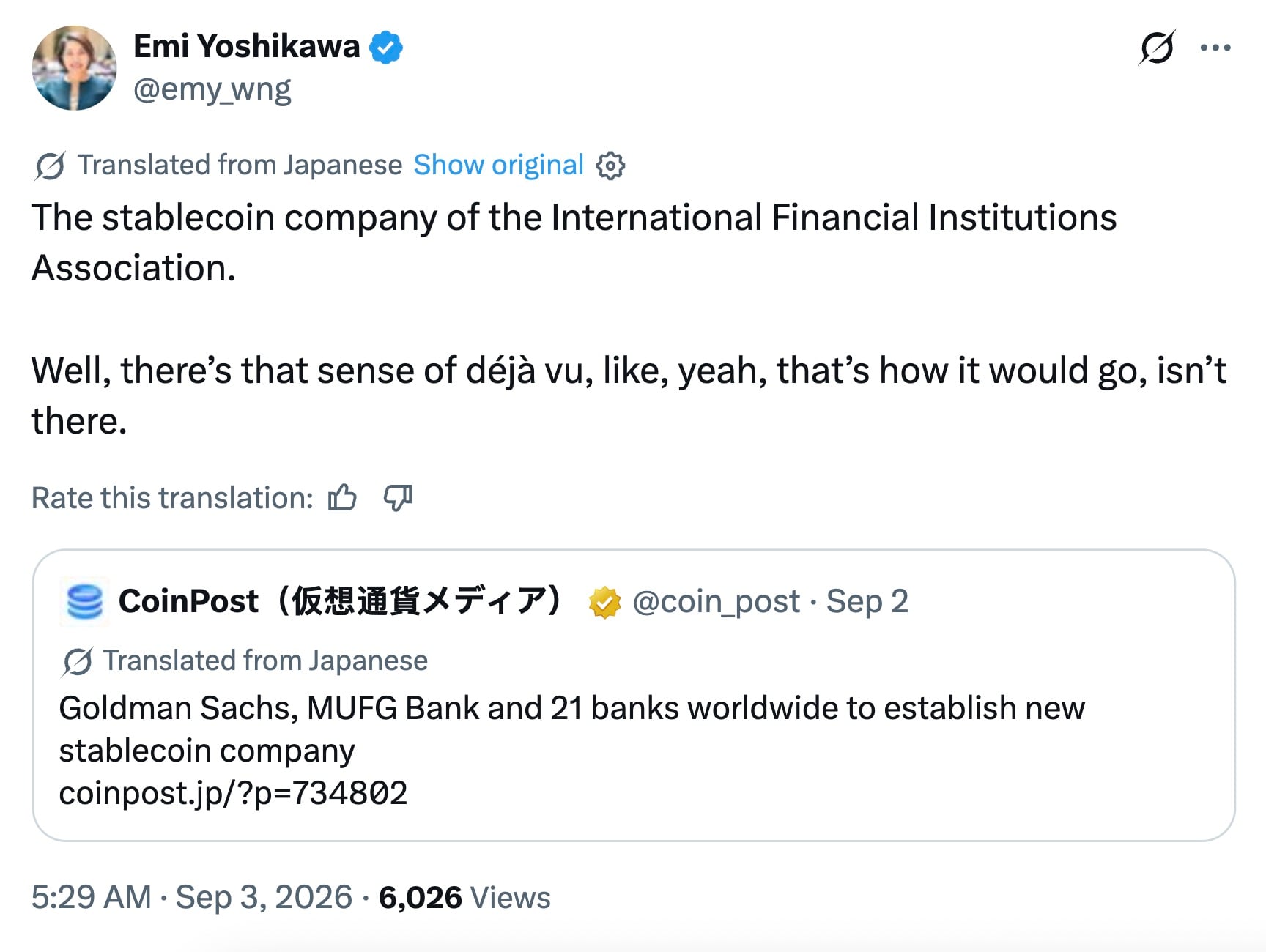
Reacting in Japanese to the official announcement of the megaproject led by Goldman Sachs and Japan's MUFG Bank, the former Ripple vice president of strategic initiatives wrote on X that she felt "a sense of déjà vu," adding that "this is exactly how it was supposed to go."
Behind this comment is Yoshikawa's eight years of experience at Ripple from 2016 to 2024, during which she developed $XRP's institutional presence in Asia.
Such a reaction points to a pattern typical of TradFi: the world's largest banks spent years exploring third-party blockchain solutions but ultimately chose to create isolated structures that allow them to control liquidity, compliance, and transaction fees instead of integrating with networks such as the $XRP Ledger.
What is behind the former Ripple strategy executive's "déjà vu"
This context overlaps with developments in Japan, where MUFG Bank, the only Asian participant in the dollar project, is simultaneously involved in a domestic initiative. By March 2027, MUFG, together with megabanks SMBC and Mizuho, plans to launch settlements using a yen-denominated stablecoin based on Progmat, a platform originally created within MUFG.
This could potentially allow the bank to conduct international yen-to-dollar conversions entirely within a controlled banking blockchain environment.
At the same time, the banking consortium is targeting use cases already covered by regulated crypto-native instruments such as Ripple's $RLUSD. By September 2026, $RLUSD's market capitalization had exceeded $2 billion, with more than $1 billion issued on the XRPL, while in June the asset was officially approved by Japanese regulator JFSA for trading through the SBI VC Trade exchange.
This overlap in objectives could lead to market segmentation. The banking token is aimed at internal settlements between consortium members and large corporations that require direct interbank auditing.
The technology won, but there's a catch
Meanwhile, tokens such as $RLUSD and USDC could maintain their positions in the open fintech sector, retail payments, and DeFi ecosystems, where rapid implementation without excessive coordination is critical.
Yoshikawa's position combines recognition of the viability of blockchain-based settlements with skepticism: historical experience shows that alliances comprising 21 major stakeholders face complex governance challenges.
While the consortium works to agree on internal rules ahead of its planned 2027 launch, independent regulated stablecoins could retain their time advantage.