This institutional endorsement fueled $ZEC’s sharp surge in the final week of August, leaving it with an 82% 30-day gain. Overall, the coin’s upward momentum lifted its market capitalization from approximately $8 billion at the start of August to over $14 billion, cementing its position as the leading privacy coin by market capitalization.
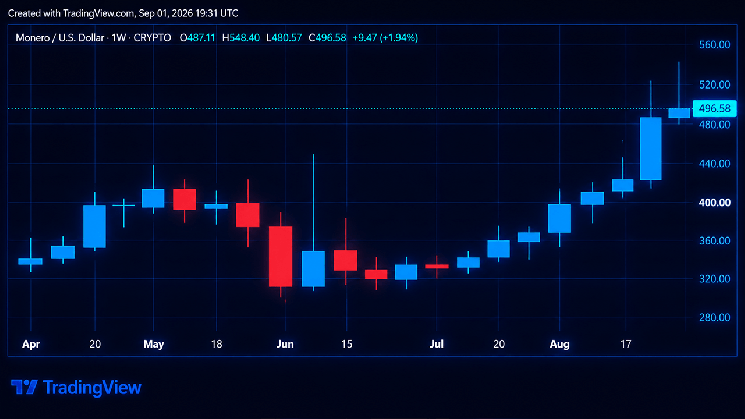
Monero, on the other hand, started the month slowly before seeing its daily gains build as August drew to a close. Market data show that in the last week of August alone, $XMR gained nearly 20%, bringing its total monthly gain to approximately 40% and pushing its market cap toward $10 billion. Unlike its main rival, Monero was boosted by reported upgrades across cross-chain decentralized exchanges, including native swap capabilities integrated into Thorchain that provide seamless, permissionless liquidity pools for $XMR.
Broader category tailwinds extended to smaller-cap protocols, including DASH (up 38.3%), RAIL (up 37.6%), and ZANO (up 26.7%). However, a handful of privacy coins posted losses in August, including beldex (BDX), which closed 4.2% lower, and humanity (H), which fell 4.4%.
While regulatory agencies maintain close oversight of anonymity-enhancing protocols, August’s market action demonstrates that decentralized liquidity options and technical developments continue to anchor baseline demand for privacy-first architecture.
Looking ahead, the sector’s momentum faces a dual test of technical development and tightening compliance mandates. Privacy networks are advancing technical capabilities to boost anonymity sets and node efficiency. However, upcoming compliance frameworks, including the OECD’s Crypto-Asset Reporting Framework (CARF) in 2026 and stricter anti-money laundering regulations, will place greater scrutiny on anonymity-enhancing features.

 news.bitcoin.com