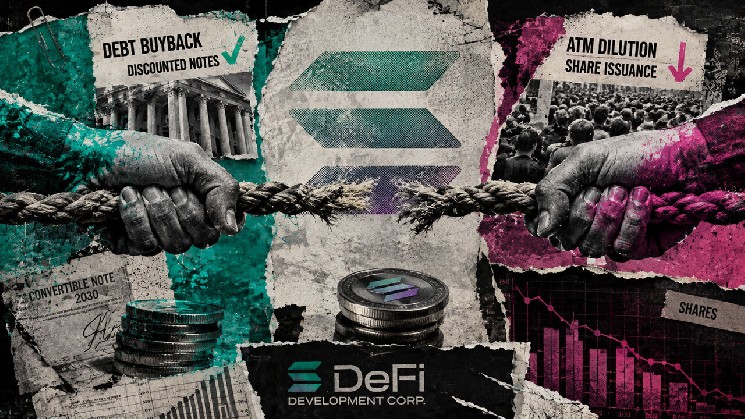
Debt buybacks help, but share sales dilute
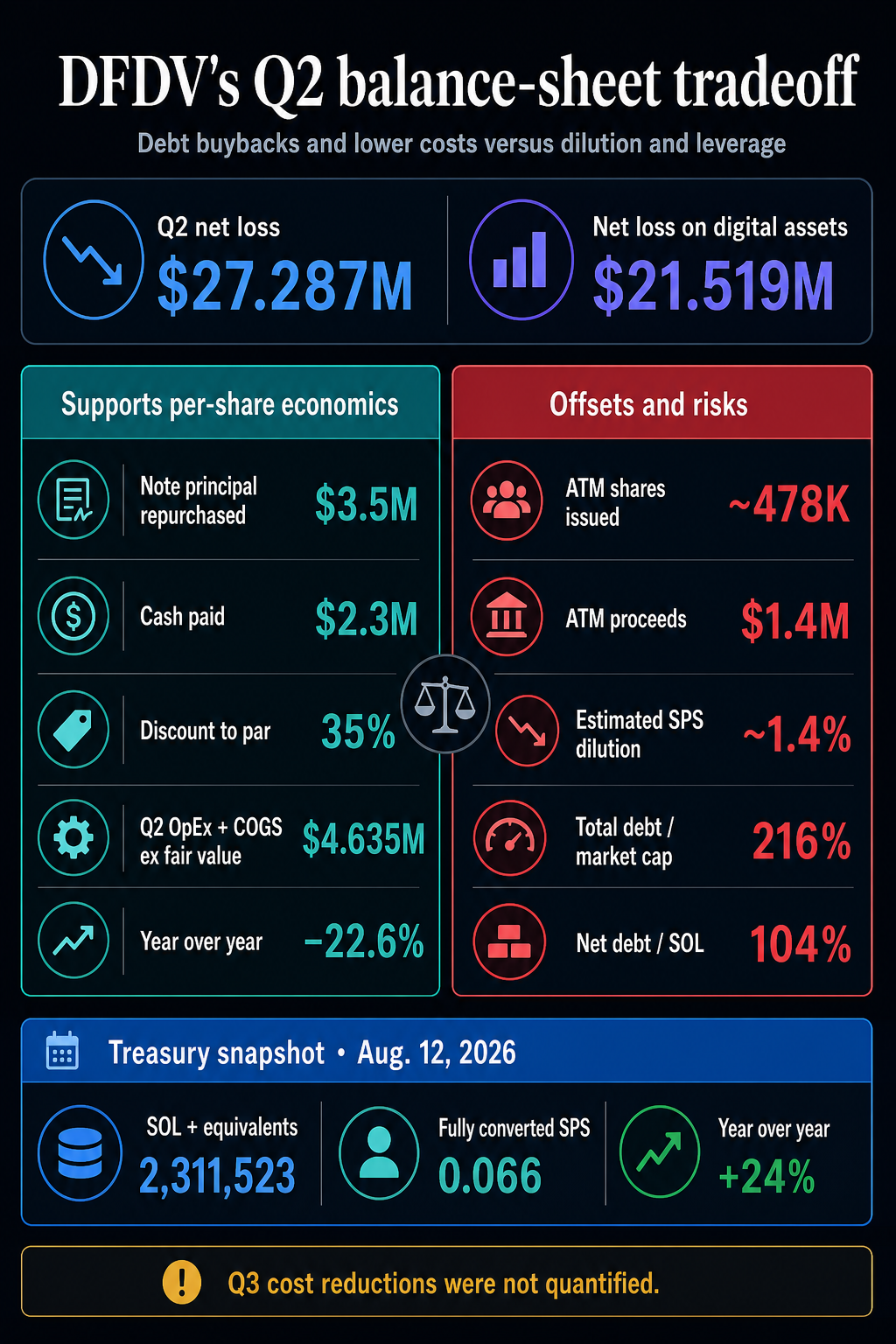
Since its previous shareholder update, DFDV repurchased about $3.5 million of July 2030 convertible-note principal for $2.3 million in cash, a roughly 35% discount. It said cumulative repurchases had reached about $7.9 million of principal for $5.0 million, with estimated annual interest savings above $400,000.
The latest transaction retired $1.2 million more in principal than the cash DFDV spent, before transaction costs, while reducing the amount that could later convert into shares. The July notes pay 5.5%, mature in 2030 and are unsecured, with no $SOL collateral-maintenance or margin-call mechanism in their indenture. That description applies only to the July notes; DFDV's March 31 filing described other company financing as collateralized.
Beginning in late June, DFDV issued approximately 478,000 shares through its at-the-market facility for $1.4 million to cover cash operating costs. Management estimated that issuance reduced $SOL per share by approximately 1.4%, offsetting some of the benefit from retiring debt below par.
As of Aug. 12, the company reported 2,311,523 $SOL and $SOL equivalents, 35.3 million fully converted shares and fully converted $SOL per share of 0.066, up about 24% from 0.053 a year earlier. That management metric uses a point-in-time, assumed-conversion denominator. It is separate from the company's roughly 31.0 million common shares and 43.7 million fully diluted shares at that date, as well as its 27.351 million GAAP diluted weighted-average shares for the quarter.
Leverage remains substantial. DFDV reported total debt equal to 216% of its market capitalization and net debt equal to 104% of $SOL and $SOL equivalents as of Aug. 12. The latest package did not state a current face balance for its convertible notes after the repurchases.
DFDV said it will originate no additional Treasury Accelerator transactions. Its ZeroStack and Allied Architects investments remain in place and will be managed or monetized when appropriate, so the closure is not a full liquidation of the program's positions.
Debt repurchases and lower costs support per-share economics, while ATM issuance moves them the other way. Sustained $SOL-per-share growth depends on how DFDV balances treasury accumulation against future share issuance and financing costs; its equity value and net asset value also remain exposed to $SOL's price.

 cryptoslate.com