TaoWeave held 23,335.18 $TAO worth $4.709 million at June 30, about 69.5% of its $6.776 million in total assets. All of the holdings were staked through custodians BitGo and Kraken. The company did not hedge its $TAO exposure and held no other digital assets, leaving its balance sheet concentrated in one volatile token.
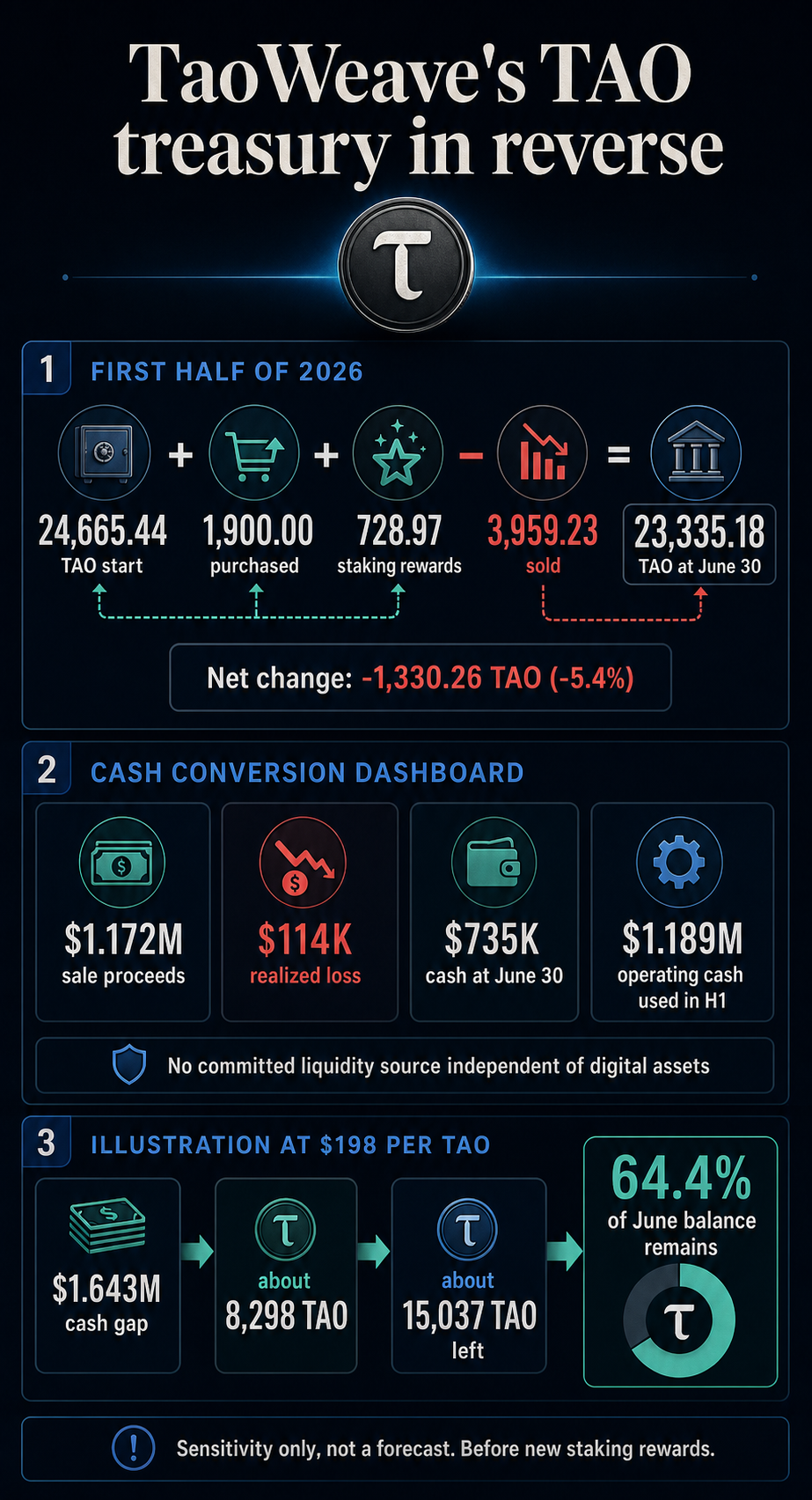
Staking earned 728.97 $TAO and generated $191,000 of revenue during the first half. TaoWeave also bought 1,900 $TAO, but the 3,959.23-token sale still left its balance down 1,330.26 $TAO, or 5.4%, from year-end.
Cash needs put the token balance at risk
$TAO traded near $198 on Aug. 8, according to spot quotes from Coinbase and Kraken. Applying that price to the unchanged June 30 count would value the treasury at about $4.62 million, although TaoWeave has not confirmed its current token balance.
At June 30, TaoWeave held $735,000 in cash; it used $1.189 million in net operating cash during the first half. The company said it expects to sell more $TAO from time to time as operating needs require, with the amount and timing depending on cash needs, market prices, and liquidity. It disclosed no scheduled sale.
TaoWeave also said it had no committed credit facility or other arrangement providing liquidity independent of its digital assets. That makes the number of tokens required for a given cash need sensitive to $TAO's market price.
If the first-half operating-cash-use pace persisted for the next 12 months, with no new financing or other cash inflows and $TAO fixed at a rounded $198, the resulting $1.643 million gap after using June cash would require about 8,298 $TAO. That would leave roughly 15,037 $TAO, or 64.4% of the June balance, before new staking rewards.
This is a sensitivity, not a forecast. Revenue, working-capital changes, financing, purchases, future staking, and a different $TAO price could all change the result.
Management said cash plus $TAO converted to cash should fund operations and working capital for at least 12 months, while also acknowledging that more capital will be needed over the long term. That assessment tempers the liquidity risk but does not remove the conflict between funding the business and preserving the token balance its accumulation strategy is meant to grow.

 cryptoslate.com