Technical Framework and Activation Process in xrpld 3.3.0
The official distribution of the xrpld 3.3.0 code package is scheduled for next week, according to data shared by Ripple’s product development management. Full technical documentation and detailed network architecture specifications have already been published on the organization’s open-source platform.
The $XRP Ledger’s distributed governance model establishes that the entry into force of new features requires direct consensus from the community. According to standard network protocol, independent validators must evaluate the distributed code and maintain backing above 80% for a continuous two-week period for the modifications to be permanently activated on the mainchain.
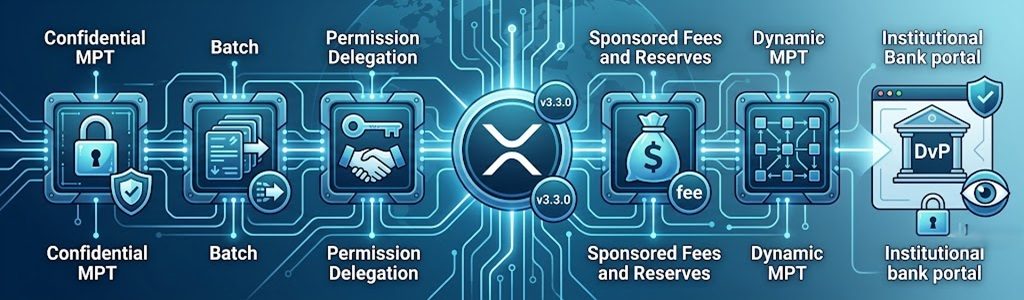
The proposal groups five fundamental modifications into a single software release: Confidential MPT, Batch, Permission Delegation, Sponsored Fees and Reserves, and Dynamic MPT. Information provided by the company indicates that the engineering team will publish additional security reports and technical analyses in the weeks following the release to guide node operators through integration.
Commercial Privacy and Delivery-Versus-Payment Operations
The Confidential Multi-Purpose Tokens (Confidential MPT) amendment introduces mechanisms to manage private balances without revealing amounts publicly on the distributed ledger. According to the report published by Ripple, this feature allows financial entities to protect sensitive commercial information without sacrificing oversight by competent authorities.
In this operational model, banks can configure dedicated access gateways for auditors and regulatory bodies while maintaining balance confidentiality from market third parties. Data presented by Jazzi Cooper suggests that the Permission Delegation module complements this design by allowing the assignment of differentiated roles and permissions within an entity’s operational staff.
This integration of features enables the execution of complex delivery-versus-payment (DvP) operations under institutional standards. According to protocol specifications, the system allows processing sequences of up to eight transactions atomically, guaranteeing that the entire block executes successfully or is canceled completely without leaving partial transactions.
Fee Sponsorship and Dynamic Token Updates
The Sponsored Fees and Reserves proposal modifies the traditional cost structure when interacting with the distributed ledger. According to information provided by RippleX, large corporate institutions will be able to assume transaction fee payments and required account balance reserves on behalf of their end clients.
This functionality aims to eliminate the technical requirement for retail users to directly acquire or hold the native $XRP token to perform transfers with tokenized assets. Official project documentation contends that this measure reduces entry friction during the onboarding process for new users in financial applications.
On the other hand, the Dynamic MPT amendment grants issuing entities the ability to adjust token parameters throughout its operational lifecycle. According to the company’s technical evaluation, this flexibility allows modifying asset configurations to agilely adapt to new regulatory and legal requirements across various global jurisdictions.
Validator Evaluation and Upcoming Ecosystem Milestones
The release of the executable code xrpld 3.3.0 formally marks the beginning of the technical review phase by independent validators deployed across the global network. Each evaluating node will analyze code stability and compliance with security standards before casting its vote in the platform’s consensus mechanism.
In the following weeks, Ripple’s development team will maintain periodic publications with detailed analyses and technical integration guides. These publications aim to accompany the gradual adoption of the update by developers and financial sector institutions.

 crypto-economy.com