
 iota-news.com
How INCUCAI and Extrimian Put Argentina’s Transplant System Onchain
TL;DR:
$IOTA and Latin American decentralized-identity company Extrimian have put Argentina’s national organ, tissue, and cell donation and transplantation authority INCUCAI and its 24 provincial agencies onto a live, publicly verifiable digital-identity system on $IOTA mainnet, with tamper-proof document signing, and $IOTA independently verified every part of it.
Somewhere in Argentina, a patient is waiting for a heart. When a match finally appears, a countdown starts: a donated heart stays viable for only a few hours, and inside that window dozens of people across hospitals, provincial agencies, and a national coordinator have to act in exact sequence. Every authorization, every medical record, every consent has to be correct, and has to be trusted, the first time. A forged signature, a lost form, or a record no one can verify can cost a life.
Argentina’s national coordinator for organ transplants is the Instituto Nacional Central Único Coordinador de Ablación e Implante, INCUCAI, which manages the national waiting list and works with 24 jurisdictional procurement agencies, one for every province plus the Autonomous City of Buenos Aires, alongside the public and private hospitals and transplant centers that make up the national network. Coordinating life-or-death decisions across all of them, quickly and verifiably, is its daily challenge, and INCUCAI is enhancing its digital backbone with decentralized identity and notarization infrastructure.
Helping it in this mission is Extrimian, a Latin American company specializing in decentralized digital identity. Its work centers on self-sovereign identity (SSI), a model that gives individuals and organizations direct control over their own identity and the data they share. Its mission is to bring transparency, efficiency, and user control to digital interactions across health, education, and government.
As the public network underneath INCUCAI’s new decentralized infrastructure, Extrimian chose $IOTA: a neutral, verifiable layer where institutional identities and the integrity of each document can be checked directly, without gatekeepers or friction.
Strengthening a Life-Saving Process
The solution Extrimian developed with $IOTA digitizes and unifies these processes nationwide. As of June 10 2026, it is live on the $IOTA Mainnet, and its identities and proofs can be independently verified by anyone:
- Verifiable identities, from the nation to every province. INCUCAI and each of its 24 provincial agencies hold a verifiable digital identity anchored on the $IOTA Mainnet.
- A full chain of trust. INCUCAI sits at the root of a single onchain trust federation, vouching for all 24 agencies. That hierarchy of 25 verifiable identities mirrors how the institution actually works, instead of leaving each credential isolated.
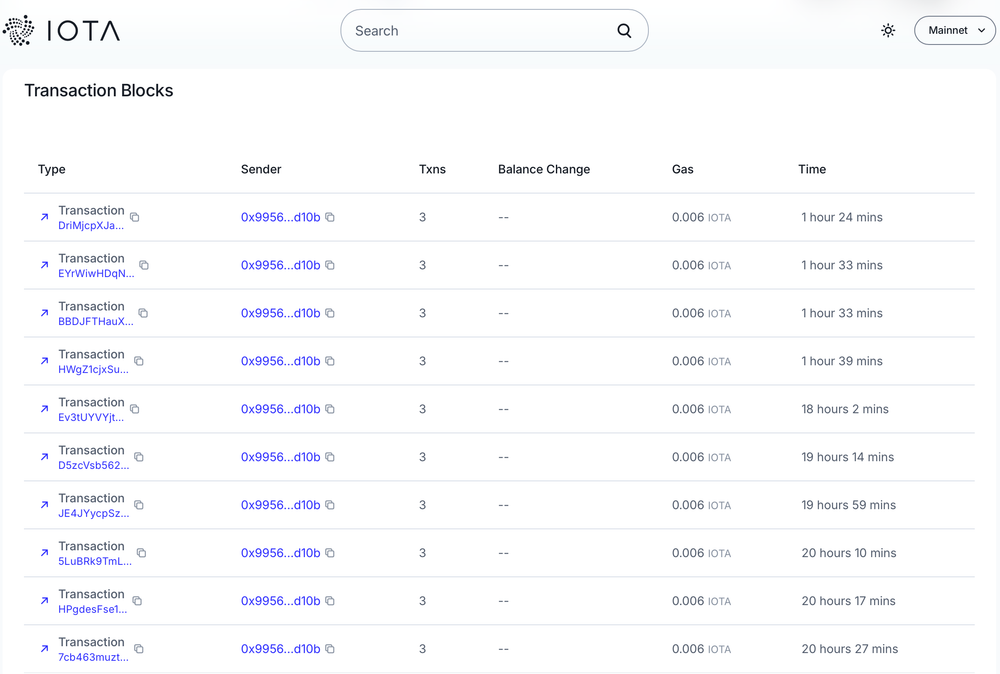
- Tamper-proof document signing. Accredited officials can digitally sign documents and notarize them on $IOTA, producing an immutable, timestamped fingerprint that anyone can verify, without ever placing the document’s contents onchain. The full sign, notarize, and verify flow has been demonstrated end to end.
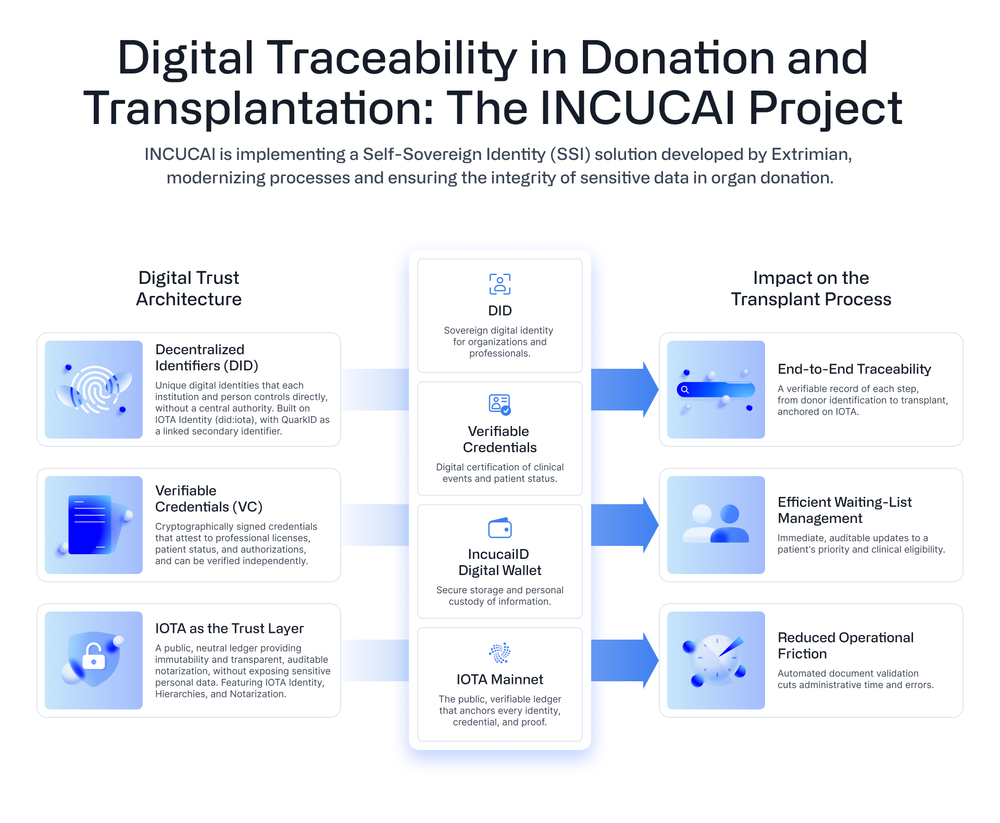
Crucially, no patient-identifiable information is ever stored onchain. Only cryptographic proofs (hashes) of documents and process steps are anchored to the ledger, guaranteeing integrity without exposing any of the underlying data. Those proofs protect the most private and painful details of people’s lives: the medical information that patients and grieving families entrust to the system at the hardest of moments. Doctors, agencies, and families can confirm that every step happened as recorded, while those details stay private.
The Technology Behind a National Mission
Extrimian and INCUCAI needed transparency, interoperability, and resilience. A centralized database alone cannot provide the neutrality or verifiability that such a sensitive national process demands. Extrimian chose $IOTA because it offers those qualities within a scalable, cost-efficient public ledger that no single party owns or controls, neutral infrastructure built for real-world adoption.
According to Esteban Musso, Professional Services Manager & Partner at Extrimian: “At Extrimian, we believe that trust is the foundation of every digital transformation. By combining open standards with privacy-preserving technologies, we’ve helped build a solution that enhances traceability, security, and interoperability while respecting the privacy of every participant. Projects like this demonstrate that decentralized technologies are no longer a vision for the future – they are delivering tangible value today in critical public services.”
The deployment draws on several $IOTA building blocks:
- $IOTA Identity lets INCUCAI and its 24 provincial agencies issue and manage decentralized identifiers (did:iota) built on open W3C standards, within a verifiable framework.
- $IOTA Hierarchies organizes those institutions into a single trust federation with INCUCAI as the root, and lets the root grant, suspend, and restore each agency’s accreditation across the national network.
- $IOTA Notarization anchors documents and decisions immutably, while revealing no sensitive data onchain.
- The $IOTA Gas Station sponsors network costs, so officials and citizens never hold tokens or think about transaction fees. The blockchain stays invisible to the people using it.
Everything here is built on open, verifiable standards. The identities and credentials follow W3C specifications, and INCUCAI’s onchain identity is cryptographically linked to its official government domain, so anyone can confirm it belongs to the real institution and not an impostor. Part of the system also runs on ARSAT, Argentina’s state-owned infrastructure, keeping critical components under national control.
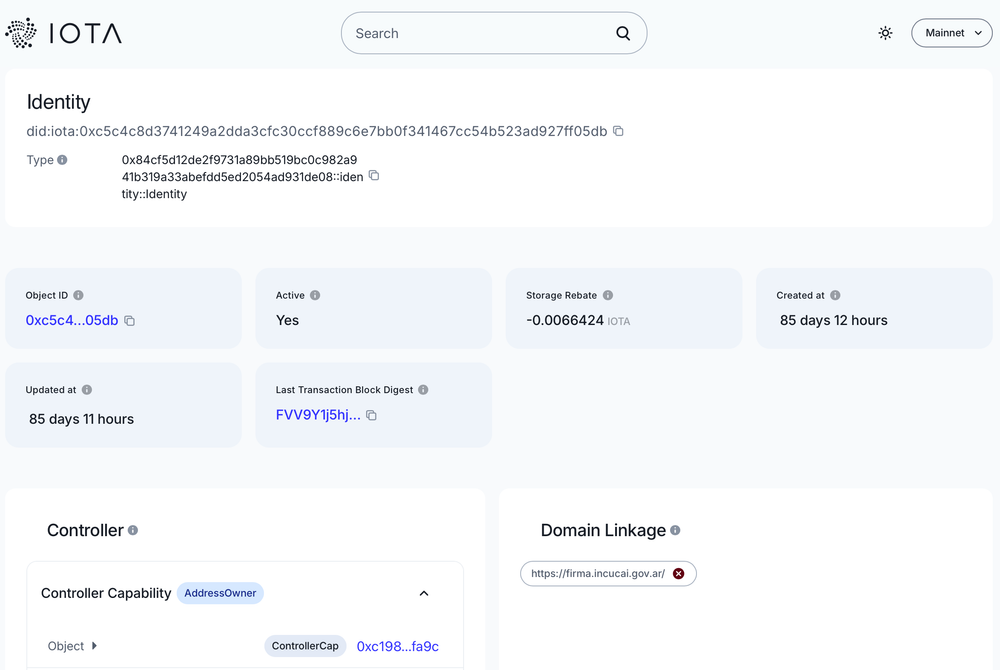
True to the principle of “don’t trust, verify,” the $IOTA Foundation reproduced these results independently, working only from public endpoints and the $IOTA Explorer. All 24 provincial identities resolved, all 24 Explorer links checked out, the trust federation matched the onchain data, and direct onchain calls confirmed that the entity controlling each identity is the one accredited in the federation.
Going Live: Electronic Signatures for the National Transplant System
In June 2026, the system moved into official adoption. Through Resolution 199/2026, published in the national Official Gazette (Boletín Oficial), INCUCAI rolled out electronic signatures across every process managed through SINTRA, Argentina’s National Procurement and Transplant Information System, and its associated institutional systems. The goal is to give each act of certification, authorization, and validation greater traceability, transparency, and legal certainty, leaving immutable, blockchain-backed evidence of every step.
At the center of the rollout is IncucaiID, the ecosystem’s official wallet, now available to download on the App Store and Google Play. Through it, patients, healthcare professionals, and other authorized users receive their verifiable credentials, prove their identity, and electronically sign the documents tied to donation and transplant processes, with every interaction cryptographically secured and recorded so it can be audited later. In keeping with self-sovereign identity principles, each person holds their own credentials in the wallet and shares only what a given step requires.
Implementation begins with the waiting-list registration process, starting with the heart and lung lists before extending to the remaining lists and, in time, the rest of SINTRA’s processes and documents. The aim is a fully digital, paperless workflow that removes the need to move physical documents or rely on manual provincial steps.
No todos los días trabajas en un proyecto donde una mejora de proceso puede tener impacto en la vida de una persona.
Nos enorgullece haber acompañado a INCUCAI incorporando identidad digital, credenciales verificables y firma electrónica para fortalecer procesos vinculados a… pic.twitter.com/WL2Hy93BAk
— Extrimian (@Extrimian) June 18, 2026
Verifiable Trust, Embedded at the Source
This is the shift $IOTA exists to enable: a public, neutral infrastructure where data and identity can move freely and securely, trusted at the source and verifiable by anyone, without gatekeepers or friction.
Daniela Hansen Krogh, Director of Information Technology and Information Systems at INCUCAI, stated: “Trust is at the heart of every organ donation and transplantation process. Our responsibility is to ensure that every decision is supported by reliable, secure, and verifiable information. By incorporating decentralized identity and cryptographic verification into our national systems, we are strengthening the integrity, traceability, and legal certainty of every critical stage, while safeguarding sensitive patient information. This initiative reflects INCUCAI’s ongoing commitment to modernizing Argentina’s transplant system through secure, transparent, and citizen-centered digital innovation.”
Dominik Schiener, Co-Founder and Chairman of the $IOTA Foundation, said: “This is what $IOTA’s open technology can do for critical public services at national scale: real infrastructure, already coordinating decisions that save lives.”
Verifiable trust is becoming core infrastructure for public services. To explore what $IOTA’s open identity and notarization stack could do for your organization, visit $IOTA Identity.
The post A National Health Authority, Live and Verifiable on $IOTA appeared first on $IOTA News.