
 coindesk.com

The $XRP Ledger’s newest server software, v3.2.0, designed to make the network cheaper to run, more stable, and more attractive for institutional use, is gaining adoption. However, it has yet to overtake the previous version (3.1.3) across the wider network, and the key security fixes that come with it remain in the voting process.
Of the approximately 833 active nodes on the $XRP Ledger, the machines that store and relay the ledger, about 43% are running v3.2.0 and 51% are still on v3.1.3, XRPSCAN data shows.
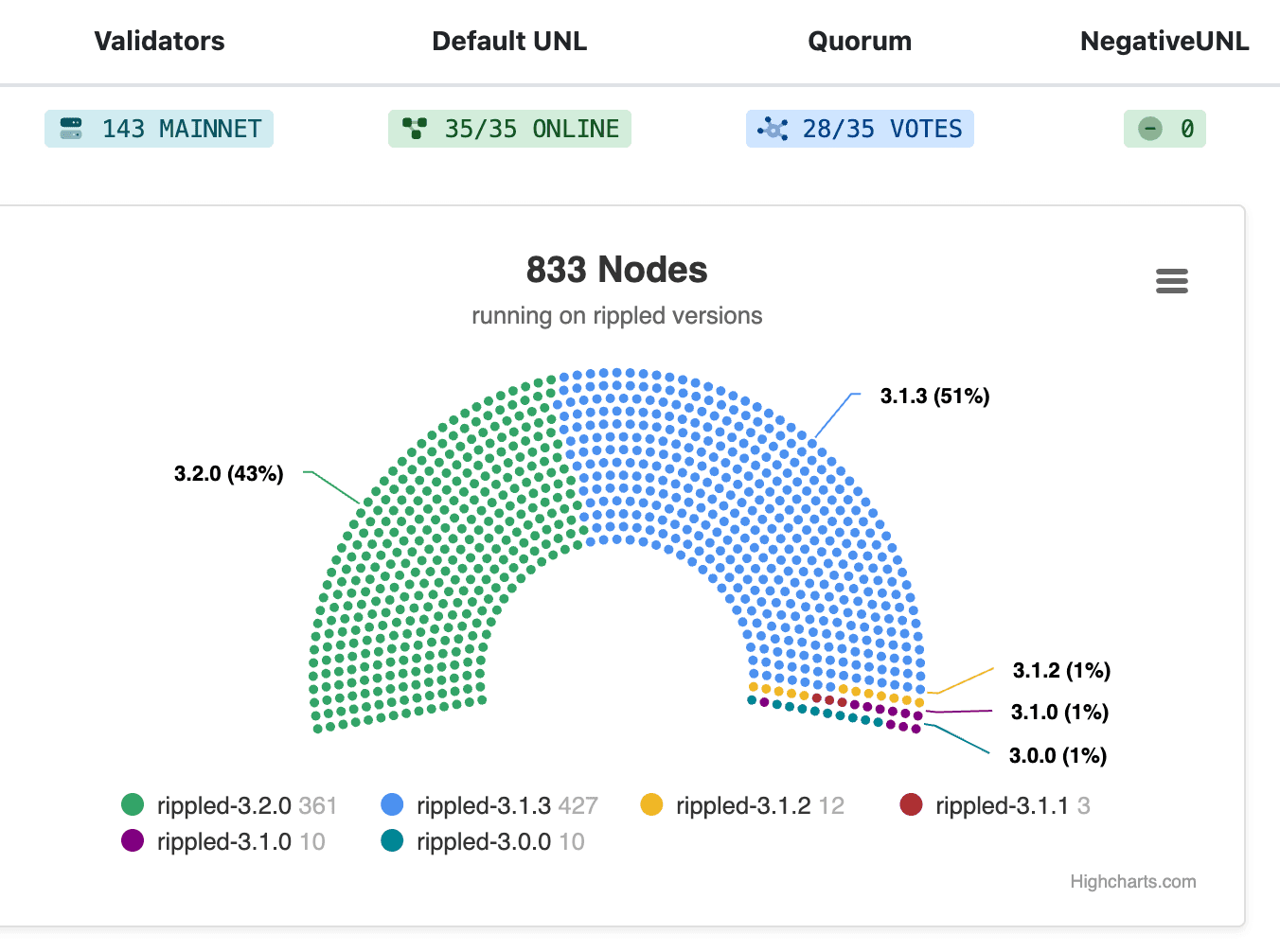
While overall node adoption appears relatively slow, validators, or entities that matter most to the network, have largely already upgraded.
The $XRP Ledger runs on a trusted set of validators known as the Unique Node List (UNL). For a new software version or amendment to activate, it needs sustained support from more than 80% of validators on that list for two straight weeks.
On the default UNL of 35 validators, 31 are running v3.2.0, about 89%, clearing the threshold the network treats as sufficiently updated. That figure, not the raw node or all-validator percentages, is what determines whether the upgrade completes.
The amendment lagging behind
Bundled with the software is a separate matter that sits well behind it.
An amendment called fixCleanup3_2_0 is currently under voting. Unlike a regular software upgrade, this is a formal on-ledger vote. It bundles several security fixes and improvements for the network’s newer features, including single-asset vaults, permissioned decentralized exchanges, multi-purpose tokens (MPTs) and the lending protocol. The lending protocol is the on-chain lending system CoinDesk covered last month that lets users take out loans against pooled funds.
It also adds internal checks designed to prevent deleted accounts from leaving behind stray data. That amendment is polling far lower than the software adoption, however, so upgrading a validator and voting the amendment through are two distinct steps.
Ripple, the payments company whose founders created the $XRP Ledger, has voted in favor of the fixCleanup3_2_0 amendment. Validators that fail to upgrade before the amendment activates risk being cut off from the ledger in what the ledger calls an amendment-blocked state.



