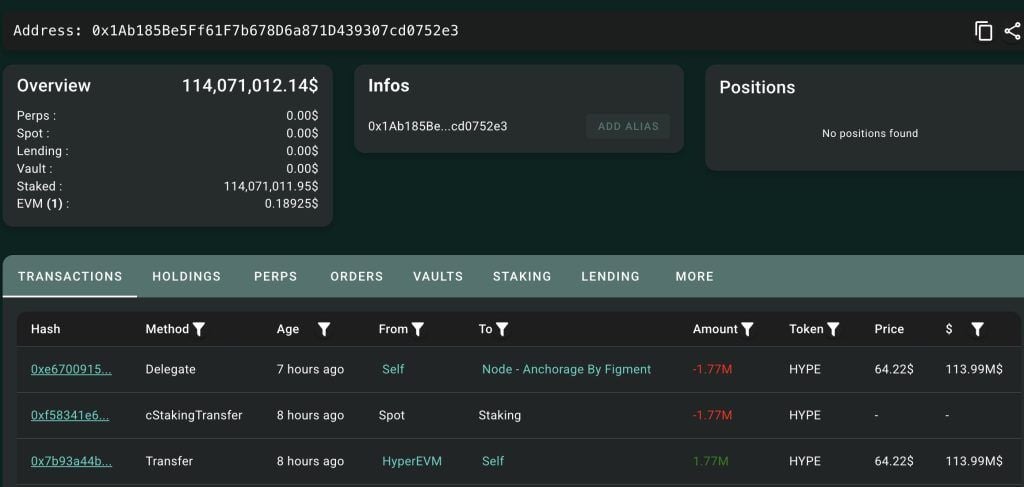
The deposit builds on a position the manager has been accumulating for weeks, with Bitcoin.com News reporting earlier purchases, including a single buy of 77,097 $HYPE worth about $5.18 million, as the firm steadily converted fund inflows into staked tokens.
How the ETF Feeds the Position
The accumulation is tied to a product given Bitwise runs the Bitwise Hyperliquid ETF (BHYP), which began trading on NYSE Arca on May 15. It is one of the first U.S. spot Hyperliquid exchange-traded funds (ETFs) to offer in-house staking through its Bitwise Onchain Solutions division.
The fund is designed to channel part of its revenue back into the toke with Bitwise directing 10% of BHYP’s management fees toward buying and staking $HYPE on its own balance sheet, creating a feedback loop in which fund demand translates into onchain accumulation. The ETF debuted with the largest opening day for a U.S. spot altcoin fund this year, triggering a short squeeze that lifted $HYPE around 5%.
That mechanism helps explain the size of the latest stake because, as assets in BHYP grow, the share of fees routed into $HYPE grows with them, giving the firm a structural reason to keep adding to its position rather than treating each purchase as a one-off trade.
A Crowded Race for Hyperliquid Exposure
Bitwise is not alone in chasing Hyperliquid as 21shares, with its THYP product, and Grayscale, which has entered the $HYPE ETF competition with a Nasdaq listing plan, are also vying for a slice of the same market. Not only that, spot $HYPE ETFs collectively logged one of the strongest altcoin debuts on record, absorbing a meaningful share of the token’s circulating supply within their first weeks.
The competition has highlighted how quickly Hyperliquid has moved from a niche derivatives venue to a mainstream institutional target. With $HYPE’s market value in the billions, even small allocations from regulated funds can translate into large onchain flows, as Bitwise’s $114 million stake illustrates.
In any case, the firm’s growing pile of staked $HYPE is now a public signal of that conviction, and rivals racing to launch competing products suggest the contest for Hyperliquid exposure is only beginning.

 news.bitcoin.com