Cardano Now Ranks as the 4th Most Decentralized Network
thecryptobasic.com
23 June 2026 15:08, UTC
The Cardano network ranks as one of the most decentralized networks in the crypto space, as the chances of compromise become nearly impossible.
Decentralization in this context refers to the even distribution of control and authority among network participants.
A well-decentralized network has broader participation in decision-making and is censorship resistant. Currently, Cardano ranks among the top four in crypto networks with these features.
Know when your coins move
Alerts, real-time prices, and market news — all in one app
Point your phone camera to install
4.8 based on 40K reviews in the App Store and Google Play
Cardano Nakamoto Coefficient at 23
This ranking was determined by the Nakamoto coefficient. Named after Bitcoin founder Satoshi Nakamoto, the metric measures how decentralized a network is using multiple factors. One is the minimum number of independent entities that have enough control to disrupt consensus.
Disrupting consensus for a Proof of Stake mechanism requires 33% of the total stake or voting power. For Proof of Work, a miner would need 50% of the total hash power to achieve censorship.
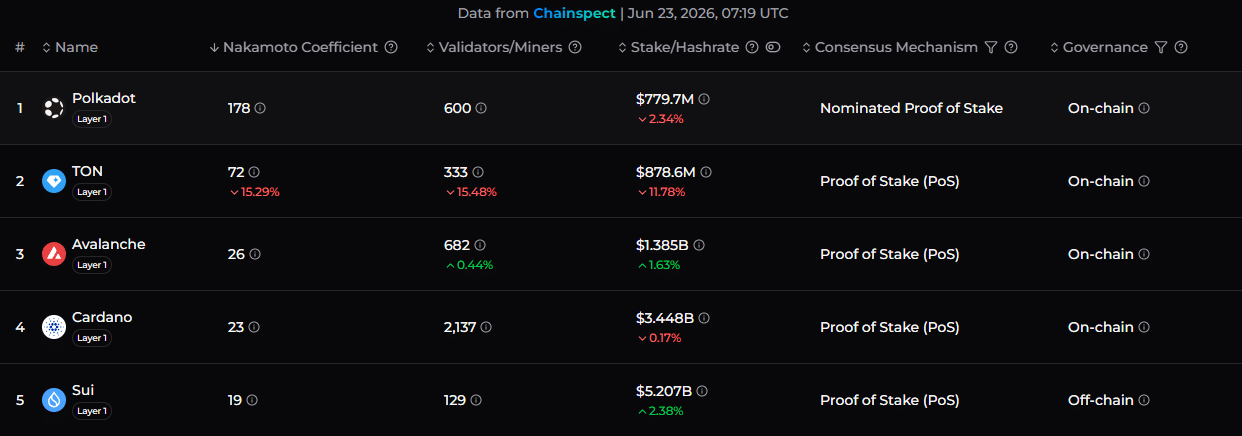
The higher a network’s Nakamoto coefficient, the more decentralized it is. As of June 23, Cardano has a score of 23, the fourth-highest among all blockchains. This means that it would take the agreement of 23 independent network contributors to compromise the network. Analysts view this as a nearly impossible scenario in practice.
Notably, only three networks are more decentralized than Cardano using this metric. Polkadot ranks first with a Nakamoto coefficient of 178, the Ton Network ranks second at 72, while Avalanche ranks third at 26.
Cardano Ranks as the 4th Most Decentralized Network
The debut of the fully decentralized governance system on Cardano through the Plomin hard fork played a major part in its ranking. The transition moved control of the network to $ADA holders, allowing them to decide what happens on the network. Notably, this governance system has had its peaks and downsides for the ecosystem.
Cardano Has Its Cheapest Transaction Fees in Months
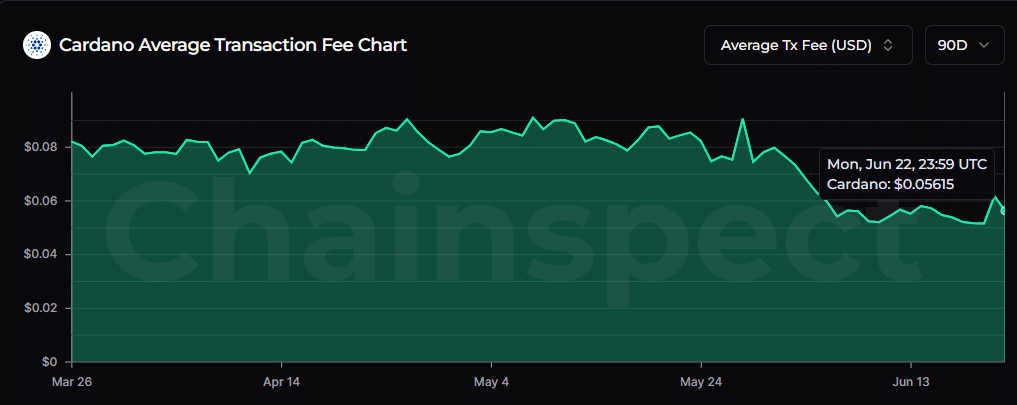
Furthermore, fees on Cardano have dropped to their lowest in months. Data shows that the current average $ADA transaction fee stands at $0.056 as of June 22.
Notably, this has been one of the lowest since March, when the average fees stood around $0.082. Between April and May, Cardano transaction fees crossed $0.09 on multiple occasions but hovered mostly around $0.07-$0.08.
Cardano Average Transaction Fee
However, the dollar value paid to transact on the network started to fall in June. On Saturday, it dropped to a low of $0.051, its lowest since March. The continued decline makes using Cardano cheaper, a scenario that encourages adoption.
Nonetheless, a price decline could also have impacted the fees. The average transaction fee on Cardano is 0.3541 $ADA. In March, when the asset traded at $0.28, this would translate to a dollar fee of around $0.099. At the current price of $0.15, this drops to around $0.053.

 thecryptobasic.com