
 thecryptobasic.com
A recent paper published by the Hong Kong Institute for Monetary and Financial Research (HKIMR) has highlighted $XRP as a prominent example of token embedding in the digital economy.
The June 2026 study, titled Heterogeneity, Tokenization, and Wealth Dynamics in the Digital Economy, was authored by Lin William Cong and Zhiheng He. Although the paper does not focus exclusively on $XRP, it references the digital asset as a representative case of how native tokens facilitate economic activity across blockchain-based platforms.
$XRP Highlighted as a Typical Tokenized Platform
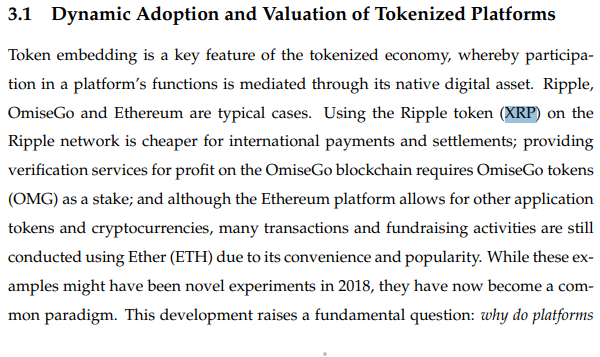
While examining the concept of token embedding, the researchers grouped $XRP alongside Ethereum and OmiseGo as examples of platforms where participation is closely tied to the use of a native token.
According to the authors, $XRP enables cheaper international payments and settlements on the “Ripple network.” They presented this functionality as a practical illustration of token embedding, a framework in which a platform’s economic activity relies on its native digital asset.
The researchers further explained that token embedding occurs when users must utilize a network’s native token to access or participate in its services. In $XRP’s case, the token serves as a mechanism for facilitating cross-border value transfers while helping reduce transaction costs.
From Experimental Concept to Established Economic Model
A notable observation in the study is that blockchain-based token models have evolved far beyond their experimental origins.
The authors noted that projects such as $XRP and Ethereum were widely regarded as novel experiments in 2018. However, they argued that these structures have since matured into a widely accepted paradigm within the digital economy.
This assessment carries particular significance for $XRP supporters. It suggests that the utility-driven framework underpinning $XRP is no longer viewed merely as a speculative concept but as part of an established and increasingly recognized economic architecture.
Academic Recognition Reinforces $XRP’s Utility Narrative
The HKIMR paper has attracted attention because it references $XRP within an academic analysis of digital economies, rather than through industry promotion or marketing materials.
By characterizing $XRP as a platform token that can lower the cost of international payments, the researchers reinforced one of Ripple’s longstanding value propositions.
Beyond this latest academic acknowledgment, $XRP has increasingly emerged as a recognized component of modern financial infrastructure. Regulators, international organizations, and financial institutions have repeatedly cited its potential for low-cost, high-speed value transfer.
For example, the International Monetary Fund (IMF) highlighted $XRP as an example of a private-sector settlement asset in a 2018 presentation. Similarly, the United Nations recognized the $XRP Ledger for offering faster, lower-cost, and more energy-efficient transactions compared with traditional proof-of-work blockchain networks.
These endorsements, alongside the HKIMR paper’s findings, underscore $XRP’s growing recognition as a practical infrastructure layer for digital payments and tokenized economic systems.