BNB Chain Grows RWA Market 60% to $3.6B as Tokenized Treasuries Lead Q1
news.bitcoin.com
07 June 2026 01:39, UTC
$BNB Chain’s first quarter showed a broader network mix, with real-world assets, stablecoins, and artificial intelligence (AI)-native applications gaining ground as trading cooled from Q4’s memecoin surge. The chain also delivered faster block times, lower fees, and stronger developer activity.
Key Takeaways:
$BNB Chain’s RWA market grew 60% to $3.6B in Q1, led by Circle, Blackrock, and Ondo.
Stablecoin supply hit $13.4B as BSC processed 1.29B transactions and 2.71M daily users.
$BNB Chain cut block times to 0.45s and eyes growth in AI agents, RWAs, and stablecoins.
$BNB Chain Processes 1.29B Transactions as Stablecoins and RWAs Gain Ground
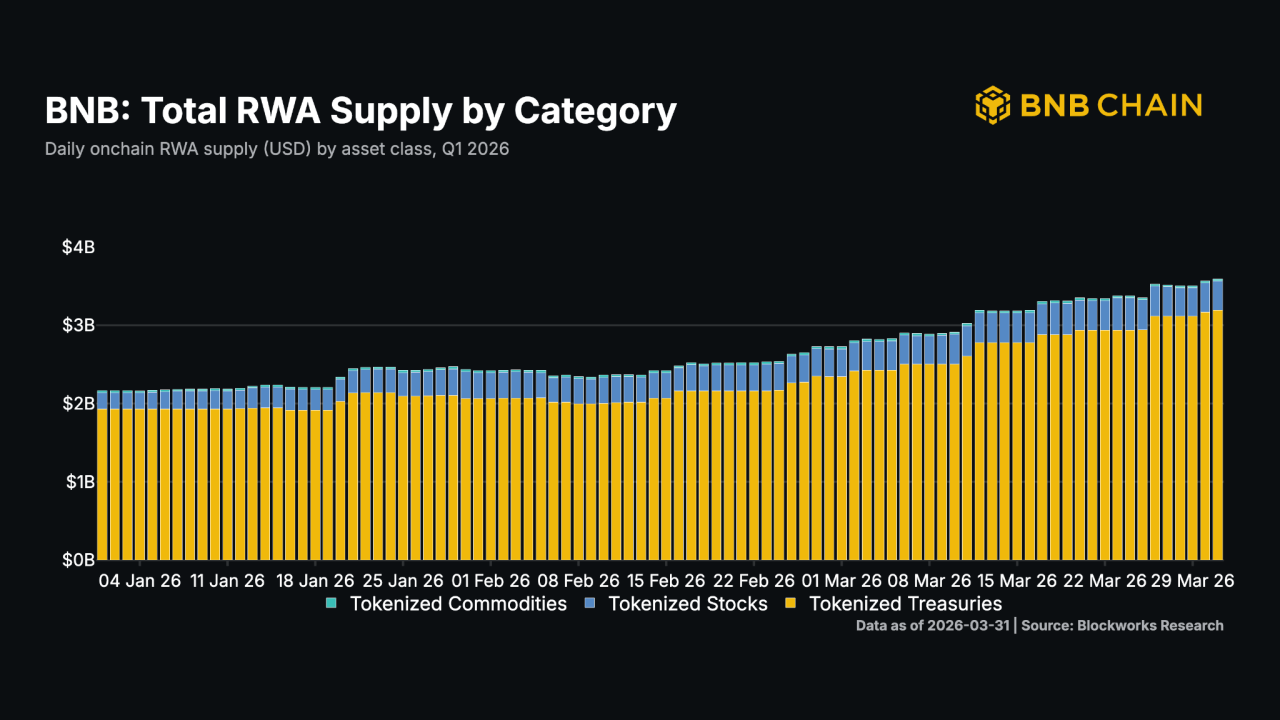
$BNB Chain entered 2026 with a broader story than trading. The network’s real-world asset base grew more than 60% in the first quarter to $3.6 billion, helped by deeper institutional activity from issuers including Blackrock, Franklin Templeton, and Circle.
Know when your coins move
Alerts, real-time prices, and market news — all in one app
4.8 based on 40K reviews in the App Store and Google Play
The expansion came as speculative trading cooled from the prior quarter’s memecoin peak, suggesting $BNB Chain is becoming less dependent on a single market cycle.
Tokenized Treasuries led the advance. Supply rose 65% to $3.19 billion, driven mainly by Circle’s USYC product, which climbed 81% to $2.57 billion. Franklin Templeton’s iBENJI reached $113.5 million after launching on the network, while Blackrock’s BUIDL held at $507 million.
Source: Blockworks
Tokenized equities grew even faster, rising 78% to $371 million. Ondo was the standout, expanding 440% to $221 million and overtaking Backed as $BNB Chain’s largest tokenized-stock issuer by quarter-end.
Nina Rong, Executive Director of Growth at $BNB Chain, said 2026 is the year the network has been building toward. Rong said:
Stablecoins, RWAs, and agentic finance are now core infrastructure layers. The institutional appetite is here, and it’s serious.
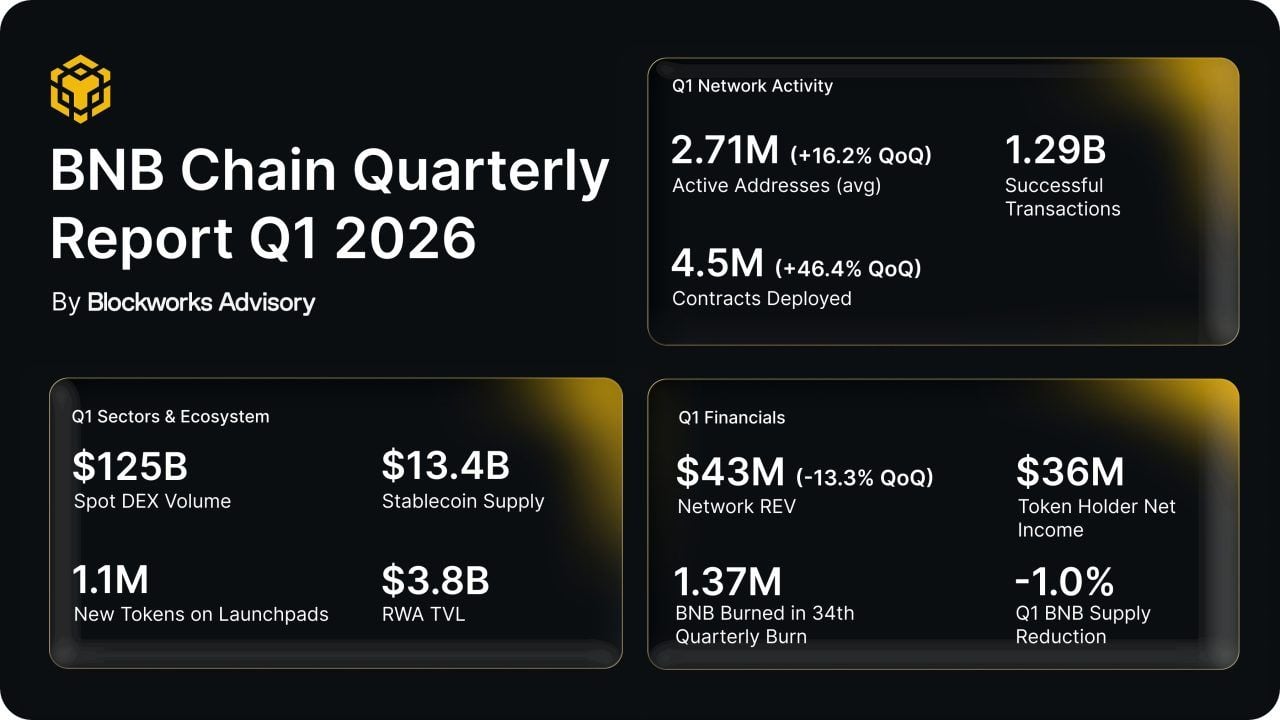
Core network activity also strengthened. Daily active addresses on BSC reached a quarterly high of 2.71 million, up 16.2% from Q3. Smart contract deployments hit 4.54 million, rising 46.4% from Q3, while $BNB Chain processed about 1.29 billion successful transactions during the quarter.
Stablecoins remained one of the network’s strongest pillars. Supply ended the quarter at $13.4 billion, while $BNB Chain led all networks in February with about 15.1 million unique stablecoin senders.
Yield-bearing stablecoins also gained traction. United Stables’ $U grew 167% over the quarter to about $1.09 billion, nearly 200 times its size at launch in mid-December. The token is backed 1:1 by established stablecoins and was listed on Binance within a month of going live.
$BNB Chain’s infrastructure improved as well. The Fermi hard fork, activated on Jan. 14, reduced average block times to 0.45 seconds from 0.75 seconds. Average transaction fees fell to about $0.027 from $0.055 in Q4, while median fees averaged $0.0038.
Rong said engineering work across BSC, opBNB, and $BNB Greenfield is focused on higher throughput, sub-second finality, and predictable low-cost rails for AI-driven finance. She remarked:
The next wave of finance won’t be human-triggered trades or manual DeFi positions. It will be fully agent-driven, autonomous systems executing 24/7. Our focus stays simple: keep delivering elite tech performance so the next generation of applications can scale.
Trading stayed important, even after normalization. Spot DEX volume reached $125.4 billion in Q1, with Pancakeswap accounting for 61.4% of activity. Memecoins remained the largest trading category, but stablecoin swaps gained share as the market cooled.
Source: Blockworks
Financial results reflected that reset. Network REV fell to $43.4 million from $111.5 million in Q4, largely because fee activity eased after the prior quarter’s trading surge. $BNB Chain still completed its 34th quarterly burn on Jan. 15, removing about 1.37 million $BNB, worth roughly $1.28 billion at execution. Total supply fell about 1% during the quarter.
The quarter also brought new institutional signals. Tether Gold launched on $BNB Chain in March, and Grayscale filed an S-1 registration statement for a potential $BNB ETF.
For $BNB Chain, Q1 was less about one breakout theme and more about diversification. RWAs, stablecoins, AI agents, and lower-cost execution are now shaping the network’s next growth phase.

 news.bitcoin.com