
 news.bitcoin.com
A recent report by Oobit disclosed that in almost all Latam markets, most stablecoin transactions were completed using $USDT, which acts as the de facto dollar proxy in the region. In addition, the company highlighted that the region’s use of stablecoins was akin to cash.
Key Takeaways:
- Oobit reported $USDT holds up near 100% of the stablecoin market volume across Latam, cementing Tether’s dominance.
- Spurring 202% growth in Brazil, Oobit links self-custody wallets to Visa’s 150M merchant network.
- Colombia became Oobit’s 9th live market, scaling daily cash-like crypto usage for local economies.
Oobit Highlights Tether’s Domain Of Latam’s Stablecoin Markets
$USDT, in addition to being the largest stablecoin by market cap in the whole crypto market, seems to have a special hold on Latam markets.
Oobit, a payments and remittance company, has released a report demonstrating the dominance of $USDT, Tether’s flagship dollar-pegged stablecoin, across almost every market in Latam where it operates.
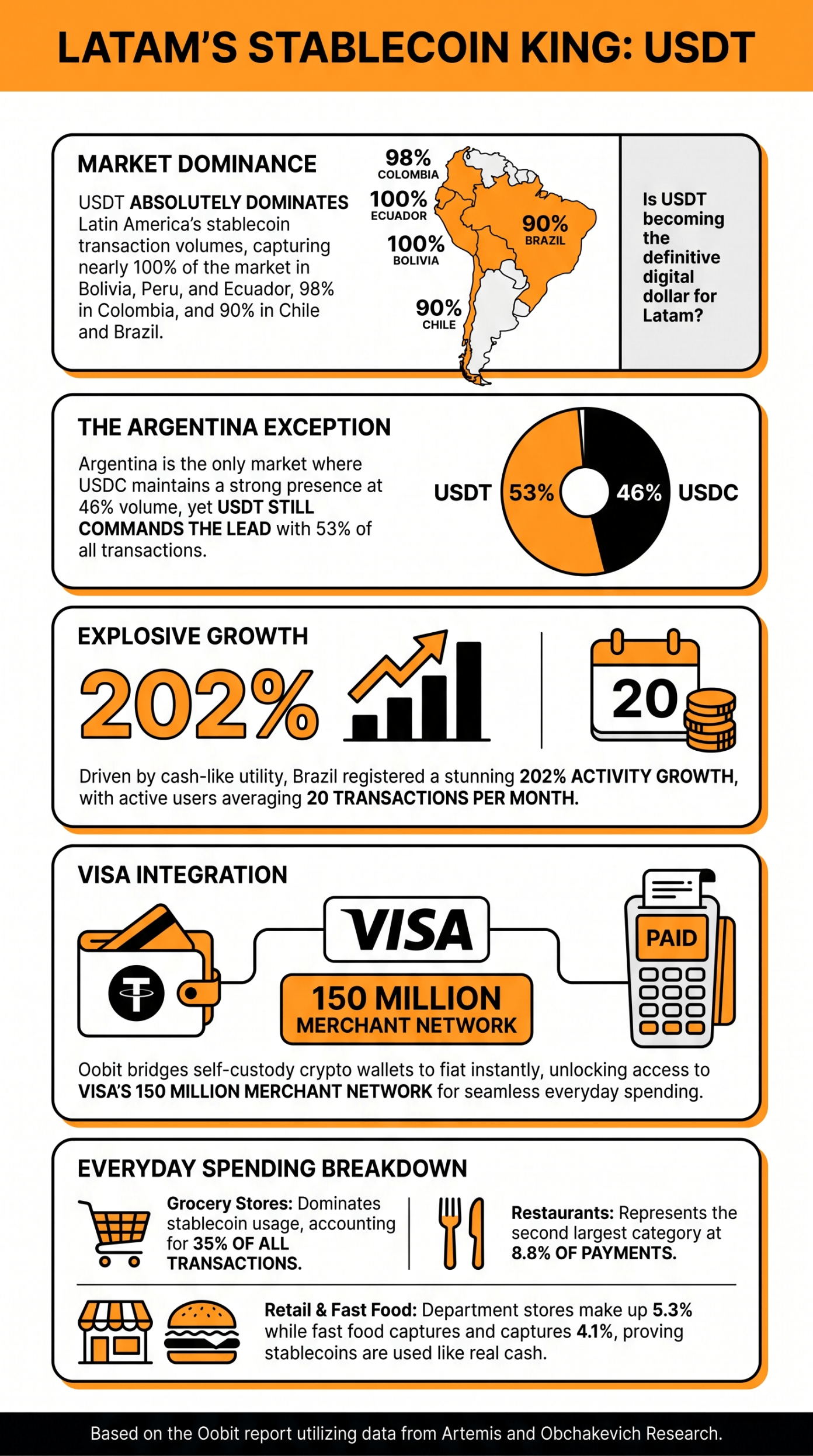
According to data sourced from Artemis and Obchakevich Research, “ $USDT absolutely dominates the region’s stablecoin transaction volumes: in Bolivia, Peru, and Ecuador it is effectively 100%, in Colombia around 98%, and in Chile and Brazil roughly 90%.”
The only country where USDC, $USDT’s largest competitor, has a relevant share of the stablecoin market is Argentina, where 46% of the volumes transacted leveraged it. Nonetheless, even there, $USDT still commands 53% of all volume.
Oobit highlighted the growth that Latam stablecoin markets have experienced, with Brazil registering 202% activity growth since the platform launched, with each active user averaging 20 transactions per month. The company recently launched operations in Colombia, becoming its ninth live market.
Oobit’s business model supports a cash-like use of stablecoins, with the company providing a system that allows users to spend stablecoins directly from their self-custody wallets like Phantom, MetaMask, and Trust Wallet whenever a merchant takes Visa cards.
“We convert stablecoins to fiat instantly on regulated Visa rails: the merchant receives local currency in seconds, and the user never leaves the crypto ecosystem,” the company stressed, allowing users to spend their stablecoins leveraging Visa’s 150 million merchant network.
This freedom allows Oobit to delve into the real necessities of users’ transactions with stablecoins. Payment transactions are completed in grocery stores (35%), restaurants (8.8%), department stores (5.3%), and fast food (4.1%). This shows that stablecoins have become the crypto equivalent of cash and not a display of status, Oobit concluded.