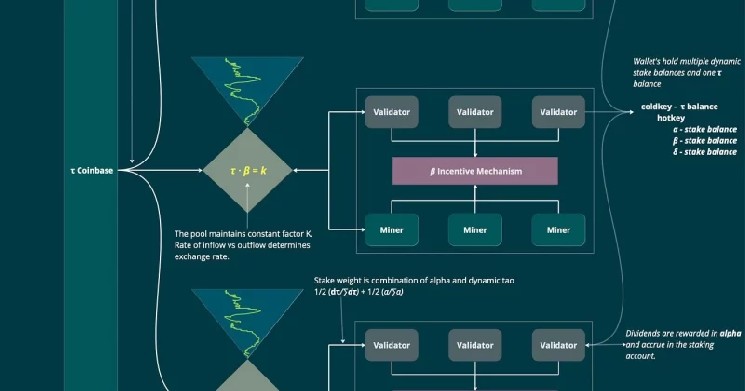
Instead of looking at the price of a subnet’s token to decide how much $TAO it should receive, the system now measures whether money is flowing into or out of that subnet. It uses an exponential moving average with roughly a 30-day half-life to smooth the signal, preventing short-term manipulation from gaming the results.
A subnet experiencing sustained net outflows receives exactly zero emissions. Post-halving, approximately 0.5 $TAO gets injected per block across the network. That flow gets distributed according to Yuma Consensus rules: 18% to subnet owners, 41% to miners, and 41% to validators and stakers. The halving event in December 2025 cut the per-block emission rate.
A Darwinian landscape with 128 subnets
Bittensor currently supports 128 active subnets, with cumulative subnet token valuations sitting near $1.5B. $TAO’s total supply is capped at 21 million, mirroring Bitcoin’s scarcity model.
Subnets on the wrong side of capital flows face a death spiral. Negative net flows mean zero emissions, which means fewer rewards for miners and validators, which means less reason for anyone to participate, which accelerates the outflows further. The 30-day EMA smoothing provides some buffer against panic-driven exits, but it doesn’t prevent the underlying trend from playing out over weeks.
Market effects and what investors should watch
Subnet alpha tokens now function as real-time sentiment indicators. Net staking flows into a subnet’s AMM pool are a leading signal for that subnet’s emission share, which means traders watching these flows can anticipate changes in reward distribution before they fully materialize.
The zero-emission threshold creates cliff risk. A subnet hovering near breakeven on net flows could tip into zero-emission territory with a single large unstaking event.
Industry analysis, including from Messari, has flagged increased volatility and miner-extractable value challenges in subnet trading as notable side effects. When capital concentrates rapidly, the AMM pools for smaller subnets become thinner, making large trades more impactful on price and creating opportunities for MEV extraction.
For investors evaluating Bittensor’s ecosystem, the key metric has shifted from subnet token price to net staking flow momentum. A subnet can have a high token price based on past performance while simultaneously bleeding capital, which under the old system wouldn’t have immediately affected emissions but now triggers the zero-emission penalty.

 cryptobriefing.com