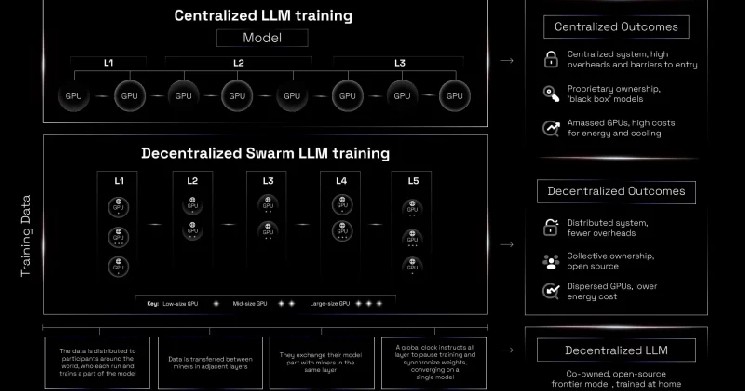
Instead of isolated competitors, miners now function as nodes in a collaborative pipeline. The architecture integrates both pipeline parallelism and data parallelism, two techniques borrowed from how major AI labs already distribute training workloads internally. Rewards under $IOTA are distributed proportionally among all pipeline miners based on their actual contribution, removing the primary disincentive for smaller GPU owners to participate.
Training AI models from your living room
The practical extension of this architecture showed up in February 2026 with the launch of “Train at Home,” a consumer application that lets Mac users contribute their GPU power to the training pipeline. The application works through an orchestrator that handles coordination across contributors. It distributes model layers evenly and manages the reward allocation so individual users don’t need to understand the underlying pipeline mechanics.
What this means for investors
Most “decentralized compute” projects in crypto have focused on inference, running already-trained models, rather than training new ones from scratch. Training is orders of magnitude harder because it requires tight synchronization, massive data throughput, and consistent uptime across all participating nodes.
$IOTA’s pipeline parallelism approach sidesteps the memory constraints that have historically made distributed training impractical for billion-parameter models by splitting model layers across machines rather than requiring each participant to hold a complete copy. The prior track record of SN9 pretraining models up to 14 billion parameters provides at least a baseline proof that the subnet can handle meaningful workloads.
For $TAO holders specifically, the shift from winner-takes-all to proportional rewards could meaningfully change mining economics on Subnet 9. Broader participation means more distributed demand for $TAO staking, but it also means individual reward rates will compress as more miners join the pipeline.
A malicious or malfunctioning node in a training pipeline can corrupt gradient updates for the entire run. How $IOTA handles Byzantine fault tolerance in practice will determine whether this architecture scales beyond proof-of-concept into production-grade training infrastructure.

 cryptobriefing.com