Bullish and Bearish Scenarios
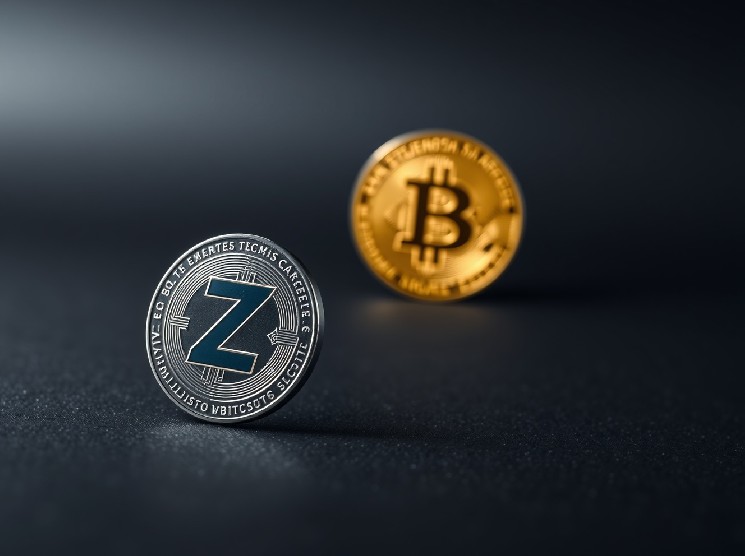
In his analysis, Wang outlined three potential trajectories for $ZEC relative to Bitcoin:
-
Conservative case: $ZEC reaches 3% to 5% of $BTC’s market cap, driven by steady adoption among privacy-conscious users and institutional investors seeking diversification.
-
Aggressive case: $ZEC climbs to 15% to 20% of $BTC’s market cap, assuming broader adoption of privacy technology and a favorable regulatory shift.
-
Black swan case: $ZEC surpasses Bitcoin’s market cap entirely, but only in the event of a catastrophic scenario for Bitcoin, such as a massive sell-off by major holders like Michael Saylor or a successful quantum computing attack on Bitcoin’s cryptographic foundations.
Wang emphasized that the black swan scenario is highly unlikely but worth considering as a tail risk hedge. He noted that Zcash’s privacy features could make it a refuge asset if Bitcoin’s transparency becomes a liability.
Market Performance and Current Standing
$ZEC has already shown signs of momentum, rising more than 25% over the past month. Its current market capitalization stands at approximately $10.9 billion, representing roughly 1.2% of Bitcoin’s market cap of around $900 billion at current prices. To reach Wang’s conservative target of 3% to 5%, $ZEC would need to more than double or triple its current valuation, while the aggressive target of 15% to 20% would require a roughly 12- to 16-fold increase.
For context, $ZEC’s all-time high market cap was approximately $13.5 billion, reached in late 2017. The current rally suggests renewed interest in privacy coins, which have faced regulatory headwinds in recent years, including delistings from some major exchanges.
Why This Matters for Investors
Wang’s analysis comes at a time when the cryptocurrency market is increasingly bifurcating between transparent assets like Bitcoin and privacy-focused alternatives. For investors, the projection highlights a growing debate: as blockchain analytics improve and regulatory scrutiny intensifies, the value of transactional privacy may rise significantly.
However, it is important to note that Wang’s targets are speculative and depend on a range of variables, including regulatory developments, technological advancements, and broader market adoption. Zcash’s development roadmap, including the planned transition to a proof-of-stake consensus mechanism, could also impact its valuation.
Conclusion
While Qiao Wang’s projections for Zcash are ambitious, they are grounded in a logical comparison to the silver-to-gold ratio and the growing demand for privacy in digital finance. Whether $ZEC can capture even a fraction of Bitcoin’s market cap will depend on its ability to navigate regulatory challenges and demonstrate real-world utility. For now, the market is watching closely, and $ZEC’s recent price action suggests that some investors are already betting on that outcome.
FAQs
Q1: What is the basis for Qiao Wang’s Zcash market cap projection?
Wang compares Zcash’s potential relationship to Bitcoin to that of silver to gold, arguing that $ZEC could serve as a complementary privacy-focused asset within the cryptocurrency ecosystem.
Q2: What are the key scenarios Wang outlined for $ZEC?
He outlined three scenarios: a conservative target of 3% to 5% of $BTC’s market cap, an aggressive target of 15% to 20%, and a black swan scenario where $ZEC surpasses $BTC in the event of a catastrophic event for Bitcoin.
Q3: How has $ZEC performed recently?
$ZEC has risen more than 25% over the past month, with a current market capitalization of approximately $10.9 billion, representing about 1.2% of Bitcoin’s market cap.

 bitcoinworld.co.in