
 ambcrypto.com

Venice Token [$VVV] remains among the artificial intelligence-focused tokens that have continued to attract strong investor capital in recent weeks, especially as Venice AI expands its product into real-world partnerships.
However, the gains have also triggered backlash over the project’s tokenomics structure. Critics across the market have questioned the dual-token approach, arguing that it could become a long-term liability for Venice Token [$VVV].
Converging capital flows support rally
There has been a notable convergence in buying activity across both the spot and perpetual markets for $VVV, suggesting aligned demand that continues to strengthen the asset’s market structure and bullish momentum.
The asset, which has gained roughly 13% over the past day and traded around $13 at press time, has recorded a sharp shift from selling pressure to net buying activity in recent days.
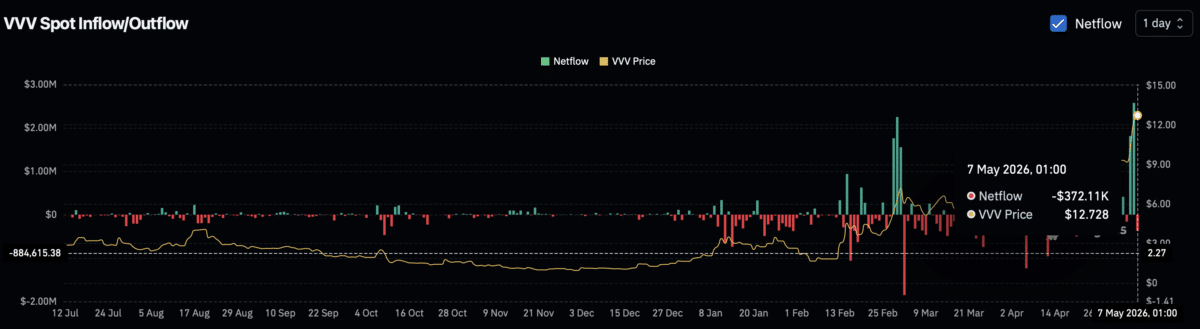
Between the 5th and 6th of May, investors sold approximately $4.38 million worth of $VVV. However, the trend has since reversed, with buyers accumulating roughly $372,000 worth of the asset, signaling renewed market confidence.
The perpetual market has reflected a similar trend, with capital inflows rising alongside a positive funding rate.
Data from CoinGlass showed that nearly $21 million in fresh capital entered $VVV’s leveraged market, while the Weighted Funding Rate climbed to approximately 0.0170% during the early trading hours of the day.
Criticism remains in focus
Criticism has persisted around Venice AI’s dual-token structure, particularly the role of $DIEM, a separate token used to pay for AI compute credits.
Some market participants argue that the design adds limited direct value capture for $VVV and could introduce long-term sell pressure if operational costs rise.
One critic noted:
Using $DIEM to access compute injects zero new cash into the company unlike pro subscriptions. So if they’re ever light on cash or want to scale infra, they’ll likely have to sell $VVV to cover it.
Erik Voorhees, co-founder of Venice Token, responded to the concerns, framing $DIEM as a deliberate design choice aimed at solving pricing instability within the original $VVV model.
He explained:
When $VVV launched we first enabled $VVV itself to grant the free access, but because of the variable price, supply, and inability to guarantee fixed quantities of allocation, it was too volatile to be useful for serious people needing inference over time. $DIEM was drawn out of $VVV to provide the stability ($1/day).
Both $VVV and $DIEM operate under a mint-and-burn mechanism designed to balance issuance with demand-driven consumption.
Strong community commitment persists
Despite the criticism surrounding its tokenomics structure, $VVV has continued to rally as community sentiment gradually improves.
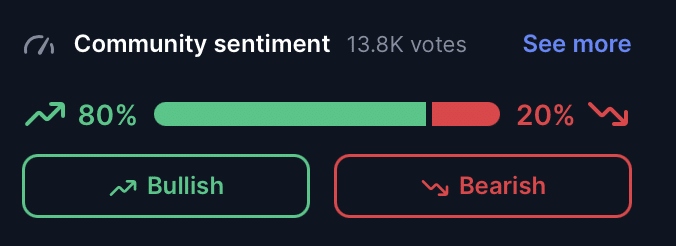
After trending lower since the 2nd of May, bullish sentiment within the community has rebounded sharply.
Press time market data shows that roughly 84% of participants now hold a bullish outlook on $VVV, based on approximately 13,800 votes, reflecting sustained investor confidence and commitment.
Part of that confidence appears tied to Venice Token’s continued expansion efforts and growing focus on product adoption.
Recently, Strike Robot announced a partnership with $VVV to power its humanoid robots with private and uncensored AI systems designed for vision processing and decision-making.
Final Summary
- Venice Token continued attracting strong capital inflows across both spot and perpetual markets.
- Criticism around Venice AI’s dual-token model remained a major discussion point, particularly concerns that $DIEM could weaken long-term value capture for $VVV holders.



