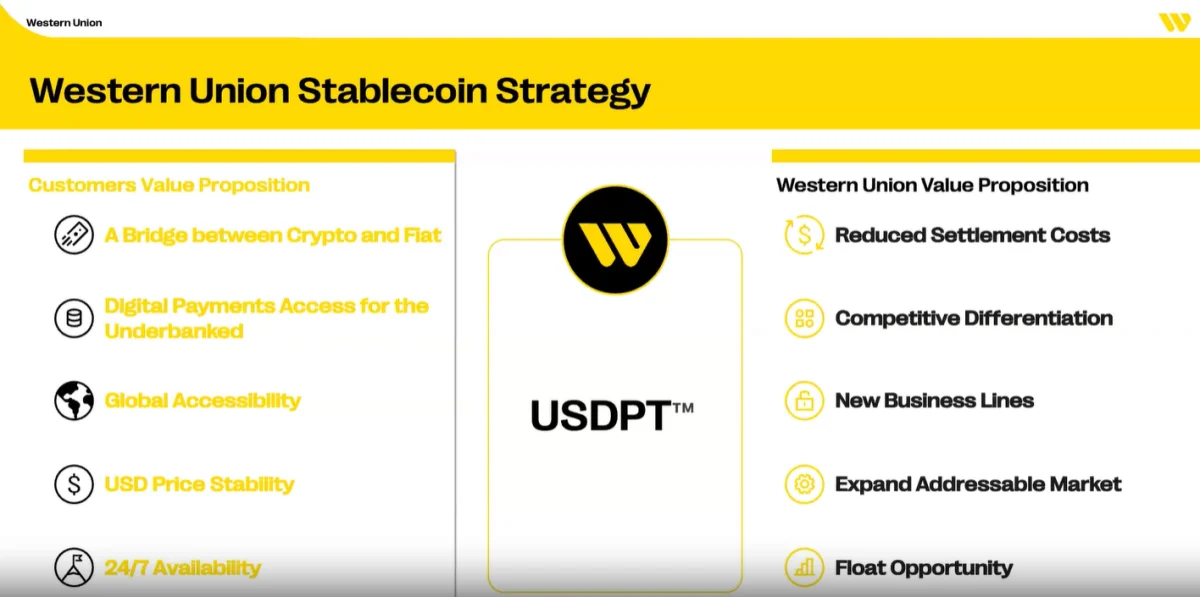
Western Union stablecoin strategy
Western Union first revealed the project in October and intends for the stablecoin to work alongside its developing digital asset network, allowing customers to move funds more efficiently across borders.
According to the company, exchange partners will help provide access, conversion, and distribution for USDPT, while banking and financial institution partners in priority regions will support direct settlement and treasury operations. Western Union believes these partnerships will make USDPT a key asset for scaling faster digital payments and settlements throughout its platform.
A number of major financial institutions are embracing stablecoins. These digital tokens, which are typically pegged to fiat currencies like the US dollar, have become one of the fastest-growing areas of crypto. US dollar stablecoins dominate the global stablecoin market, which is valued at around $320 billion. Tether (USDT) is the market leader with a capitalization of roughly $189.7 billion, followed by USD Coin (USDC) at $77.7 billion.
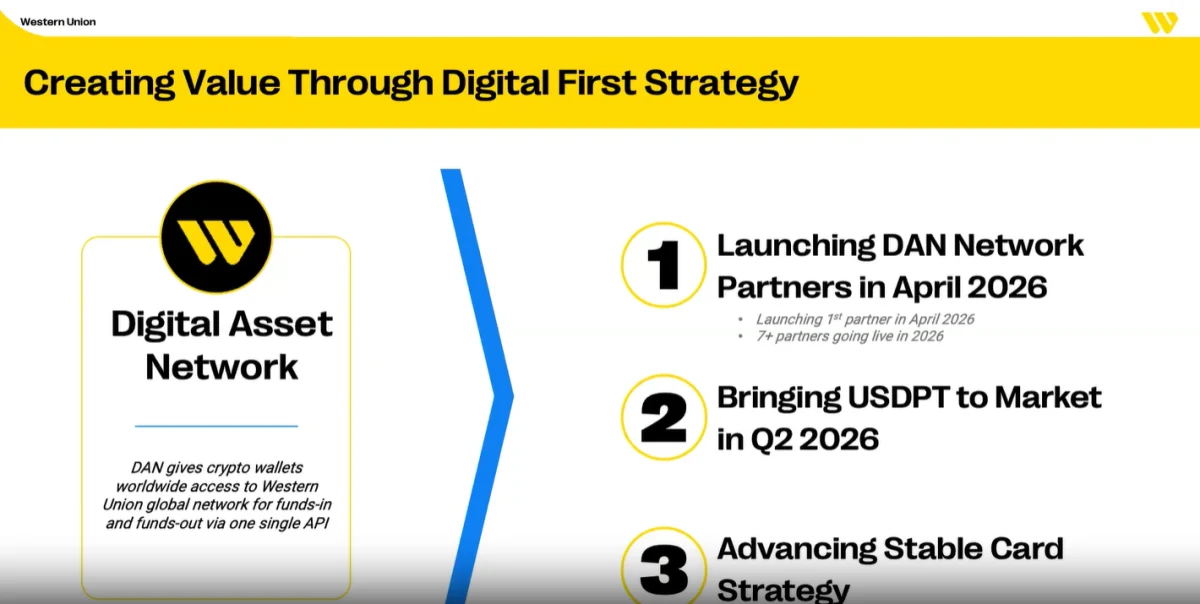
In addition to USDPT, Western Union is expanding its digital asset infrastructure through its digital asset network (DAN). The company said the network will welcome its first partner this week.
DAN is designed to let stablecoins and other cryptocurrencies move through Western Union’s payment rails while connecting users to real-world cash access. This could help solve one of the crypto industry’s long-standing challenges: converting digital assets into local cash safely and conveniently.
Western union’s DAN
Last month, Western Union said DAN will allow customers to convert digital dollars into local currency at more than 360,000 collection points worldwide. This would leverage the company’s vast global retail footprint and give crypto users access to one of the largest cash payout networks in the world.
Looking further ahead, Western Union also plans to launch a US dollar stable card later this year. The card is expected to let users hold and spend stablecoins more easily in everyday transactions.

 coinpaper.com